Warriors' Kevin Durant explains why he's more open with media than in OKC
The superstar acknowledged that the Thunder 'wanted to control the story'

•
4 min read

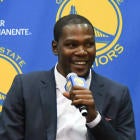
If Kevin Durant has seemed like a different guy since he joined the Golden State Warriors, it's partially because of the media culture. The Warriors are as open and laid-back with reporters as any team in the league, while the Oklahoma City Thunder are at the opposite end of the spectrum. In a Q&A with ESPN's Chris Haynes, Durant explained at length his approach to the media now versus then, making sure to say that he understood where the Thunder were coming from.
You should read the whole thing, but here's the most interesting exchange:
KD: That's the protocol they had in OKC. You had to respect it. They wanted to control the story. They wanted to control the narrative around our team, and I understood that, because there's a lot of bulls--- that can seep into a young team and affect a young team. When you've got an older group of guys like this, you've been around the block, this stuff really doesn't creep in. It may creep in with a young team.
Like for example, I'm not saying this ever happened, but if you sat down and talk to Jeremy Lamb about, "All right, you're not playing. How you feel about not playing?" And he says, "I want more minutes," and the rest of the team hears that as a young group of guys, what are they going to say? It's going to be, now it's us versus Jeremy.
So you've got to look at it from that perspective. When you've got a young team, we had a bunch of 20-year-olds, 19-year-olds, you got to walk them through this life, because it's different. You guys have a job to do, and it's not to cater to the players. It's to figure out a story. You guys aren't working together. He's trying to figure out his way in the league, and he shouldn't have to be distracted about a media story.
CH: So when does it get to the point where the PR staff should allow the player to speak?
KD: That's not my call. You can't fault me for that.
CH: I'm not faulting you, but you even told me there were times you wanted to speak more.
KD: Yeah, there's times I felt like I wanted to get something off my chest, but then I understood why they was like, "You know, it's not even worth it," because distractions are real. You can easily get distracted from this, but when you're around a bunch of veteran guys that's been covered just like this, it really doesn't matter. You can talk and just move on. But when you're on a younger team and we don't get that much coverage playing in a smaller market, that stuff can really seep in and really get a hold of the team and distract the team.
So, it's not about me not wanting to talk to y'all or feeling untouchable. I just followed protocol. I followed the rules, you know what I'm saying? Those are the organization's rules. I play basketball. I can't control the media, the way I play. I can't control all of it.
CH: OK. Fair. I've seen you conduct numerous one-on-one interviews in your brief time here with the Warriors. You didn't do many during your entire tenure in OKC. Has this been an adjustment for you?
KD: Yeah, because I don't mind talking about the game. I don't mind talking about what we go through as players, because I want people to get a deeper look inside instead of looking at stats all the time or looking at numbers or just watching the game. I want them to get a pulse on us as players, and a lot of players might not want that, but that's what I want. It may seem like I talk a lot.
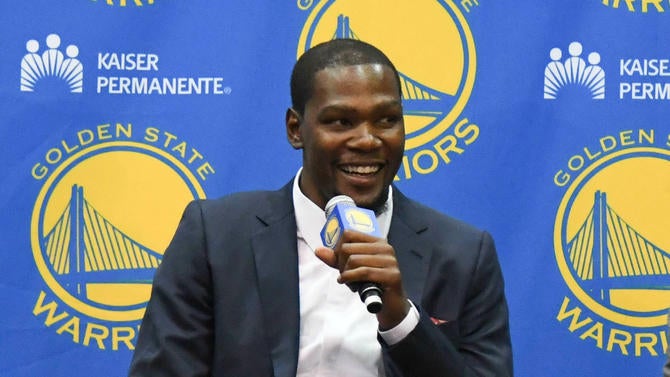
Observing Durant at a Warriors practice in New York last month, the difference was undeniable. After his normal scrum, he did an extensive interview with the Washington Post, and Golden State's public relations staff stayed completely out of the way. This is how things are with Golden State. The organization trusts the players to express themselves, and it's a much less tense environment for everybody.
Durant's comments, of course, come less than two years after he ripped the media at All-Star weekend in New York. He also chastised reporters for the way they covered Kobe Bryant's final season last year. Durant is not backing down from all of that -- he told ESPN that "you really don't know the game like I know it" -- but he is making an effort to explain why he was upset back then. He was upset with coverage of former Thunder coach Scott Brooks, who he thought was being unfairly criticized.
Also notable: Durant said that he wanted to hear from players when he was younger and following the NBA with dreams of getting there one day. For this reason, he wants to be able to tell fans the truth and give them a real idea of who he is as a person. That is an admirable goal, especially considering the amount of backlash he received from fans and media when he changed teams last summer.