How do teams respond to dirty hits?
Whenever a player gets taken out by a dirty hit or a cheap shot we want to see his team respond. But it rarely happens.

The response.
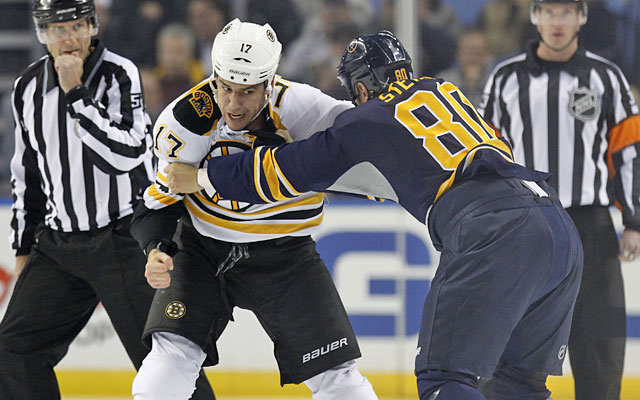
Whenever there is a dirty hit -- or even a borderline dirty hit, or simply a big hit -- during an NHL game one of the first things we talk about after the fact, aside from the length of the potential suspension, is what type of response there was from the team on the receiving end of said hit.
Did they do anything? Did anybody make the other team pay for their actions? If so, was it immediate, later in the game, or in a completely different game at a later date?
If there was some sort response during that game, the discussion usually plays out like this in the postgame media sessions:
Reporter: How did you like the response by your team to the hit by [Insert the dirty player of your choice here]?
Coach/Player: I liked our response. I thought we responded the way you would like to see our team respond in that situation.
And scene.
But if nobody does anything, which is actually far more common than most might realize, then the lack of a response becomes the story. The entire story. Why didn't anybody answer the call? Is this team too soft? Do they not have each other's back? What does this say about the state of the locker room when nobody will stand up for anybody else?
We've already talked about how having enforcers around doesn't really prevent the sort of cheap-shot nonsense that still shows up from time to time in the NHL. But what I was interested in now is what do teams do after something like that happens, and is it ever worth the psychological analysis of the state of the team that follows when nothing happens?
To start, I went back and looked at the 21 incidents (as of now) that have resulted in a suspension or a fine and looked at what happened in the aftermath. I was looking for immediate responses, which would be somebody stepping in and challenging to fight, somebody simply getting in the face of the person who delivered the hit, or if there was a response later in the game.
Admittedly, this is obviously just a small sampling of the incidents that happen in an NHL game over the course of the season, and there are no doubt many more situations where a team would like to see the "response." But the fine and suspension hits are generally the worst of the worst and the type of incident that would really get the blood boiling and have us looking for the response and getting angry if there was none.
Only in five of these situations did the team on the receiving end of the hit respond in some way during the same game, and if the response wasn't immediate, it never came later in the game. Out of the potential rematches, there were three fights involving players who delivered the suspension/fine-worthy hit. It seems that you are probably far more likely to see somebody step in and do something after a clean, legal hit (which is dumb) than you are after a legitimately dirty hit, and even that isn't as common as we might think.
For those looking for vigilante justice, this is probably a cause for concern. Why are teams going soft? Why doesn't anybody care about their teammates?
But there are a lot of reasons why you're seeing fewer and fewer teams doing anything after this type of play.
First, the role of the enforcer in the NHL, the guys that would be most likely to drop the gloves or jump somebody or engage in a fight, is all but extinct. Players like Paul Bissonnette, Krys Barch and Colton Orr are no longer in the league, and Calgary just waived one of its tough guys, Brian McGrattan, and sent him to the American Hockey League a week ago. Earlier this season, Flyers coach Craig Berube said "those days are over, boys" when talking about enforcers and whether or not his team was in need of one.
It is no secret at this point that type of player no longer has a use in the modern NHL.
There is also the liklihood that the player who delivered the hit isn't willing to fight when challenged, something that is also extremely common.
A month ago we saw Pittsburgh Penguins defenseman Robert Bortuzzo have several run-ins with New Jersey's Jaromir Jagr before Bortuzzo crushed him with a hit that resulted in a two-game suspension. The Devils' resident agitator, Jordin Tootoo, ranted for several minutes about how he had attempted to get Bortuzzo to fight on more than one occasion throughout the game because of the way he was playing Jagr and that Bortuzzo refused to go.
They ended up fighting two times the next time the two teams played.
So what is a player supposed to about that? If a guy doesn't want to go, he's not going to go.
And that leads us to another point: Nobody wants to do anything to put their team short-handed or at a disadvantage. If somebody decides they are going to take matters into their own hands and jump somebody to respond to a cheap shot, that is probably going to result in their own ejection from the game and perhaps even a suspension. And with games and playoff races as tight as they are around the league, nobody wants to be "that guy" who hurts their team.
We saw it last season when then-Penguins defenseman Brooks Orpik rocked Blackhawks captain Jonthan Toews (with a clean, legal hit, for what it is worth) that knocked him out of the game. The Blackhawks faced criticism in the immediate aftermath for not attacking Orpik (or somebody else on the Penguins). They defended their (lack of a) response by arguing that it was still a close game at that point, the points in the standings were important to them, and they wanted to get even by playing better and winning the game.
This seems to be a common trend among successful teams.
However, also last season, Orpik was involved in an incident against the Bruins when he (cleanly) leveled Boston's Loui Eriksson but refused to fight B's enforcer Shawn Thornton. Eventually, a frustrated Thornton dragged Orpik out of a scrum, threw him to the ice and landed a few punches on the prone Orpik. The Penguins defenseman suffered a concussion, and Thornton was suspended 15 games for his actions.
Earlier this season the St. Louis Blues went through a stretch where they had three players take head shots, including defenseman Carl Gunnarsson in a game against the New York Islanders when he was knocked out by Anders Lee. Following each incident the Blues had almost no response of any kind.
Lee was fined for his hit on Gunnarsson.
When the Blues had a rematch with the Islanders a couple of weeks later, there was a sides tory leading up to the game of whether or not the Blues would do anything to get even, which produced this quote from coach Ken Hitchcock, via Jeremy Rutherford of the St. Louis Post Dispatach.
"If you just become a reactionary team, then that is what you're going to do every game," Hitchcock said. "There are opportunities to react every game. If you're continually doing that stuff, then you're going to end up dealing with a high level of frustration.
"I've experienced that. I've coached teams where we needed to get even the next shift, or the next period, and all we did was get messed up. In a lot of cases we did get even, but we never won the hockey game, we never were able to create any rhythm in our season because we were just reacting to anything anybody did. Then after a while, the word came out that if you touch them up, they're going to react right away."
That is an interesting perspective from one of the best coaches in the NHL, because the perception of teams that do not feel the need to respond to every injustice against them is that they are too soft or that they can easily be pushed around. Just think back a couple of years to when Boston's Milan Lucic plowed through then-Sabres goalie Ryan Miller.
The Sabres' lack of a response to Lucic, a player that probably would have destroyed any of their players in a fight, became a major point of concern, especially within the organization. So the following offseason the team went out and completely overreacted and beefed up by signing John Scott and trading Derek Roy for Steve Ott, a series of moves that did nothing but make the team worse in the end.
But at least they weren't going to get pushed around anymore.
If you know a team or player is going to fly off the handle every time you play a little chippy against them (kind of like Pittsburgh's Steve Downie on Friday night late in the third period of a one-goal game), wouldn't that be all the incentive one would need to try and do something to get them to react?
There are definitely times where a team has to stand up and do something or play somebody a little more physically, but it's not always worth getting upset about if nothing happens. And if you are constantly finding yourself in situations where you are doing it, maybe there is another, bigger problem with your team or the players on it.
Sometimes the players who you think are preventing violence against your star players are actually instigating more of it, just as they might be doing if they feel the need to constantly respond when it keeps happening.