Why Martin Zubimendi and Viktor Gyokeres have adapted differently in their first seasons at Arsenal
Mikel Arteta bet on Gyokeres to come good while pointing at Zubimendi's excellent debut season with the Gunners

By
James Benge
•
7 min read
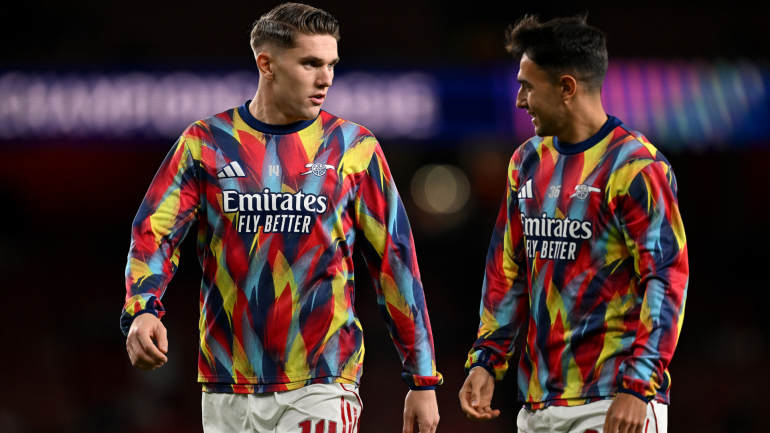
In a summer where Arsenal aggressively pursued the depth to bolster against their perennial injury crisis, there seemed to be two players who could realistically aspire to be starters in Mikel Arteta's strongest side. For Martin Zubimendi that prospect has now become a certainty, such that it is hard to imagine how this team could be the best version of itself without the Spaniard at the base of its midfield. You probably could not say the same of Viktor Gyokeres, never quite as much of a lock for the strongest XI, but faltering at just the moment when competition in his position is building.
Speaking in his pre-match press conference ahead of the visit of Wolverhampton Wanderers, Arteta was no less punchy in his assessment of both his players. Gyokeres, he said, is a player who can "explode" if put in the right positions by Arsenal, one whose performances were trending upwards before the hamstring injury last month. There was no such need to herald the future where Zubimendi is concerned. Arteta is already "very impressed," even if he admits he has some work to do to convince the player himself of his qualities.
The headline difference between these two marquee additions is clear. After stop start negotiations with Sporting CP, Gyokeres arrived with Arsenal midway through their preseason tour to Asia, the sort of commercial obligation that only happens after Arteta has had his players do the hard yards on their return from summer holidays. Zubimendi (and the rest of the football) knew he was Arsenal bound midway through last season. He had plenty of time to ready himself for 90 upon 90 in the Premier League.
"The fact that he could prepare for a longer period because he sort of knew that he was coming, I think that helped," Arteta told CBS Sports. "It wasn't something immediate that happened, so we talked a lot about why he was going to be needed, the challenges that he was going to face, but as well that his abilities and capacities were going to fit so well within the team and he's proven that on the pitch."
Zubimendi has only built on those solid foundations. In pure output terms Wednesday's 3-0 win at Club Brugge was the Spaniard's best, assisting both of Noni Madueke's goals with passes that demanded varying levels of cutting edge from the winger. Add another four shooting opportunities laid on for others and you had the joint most chances created by Zubimendi in his entire club career. For Real Sociedad Zubimendi averaged around 0.05 expected assists (xA) per 90 minutes, in an Arsenal shirt he has had already had games where he has cleared 0.5 xA, including the win in Bruges. No wonder his average has skyrocketed to 0.14.
However the intriguing aspect to Zubimendi's game is that he is not always flexing his creative muscles. Against Club Brugge his passing in the final third was aggressive in the extreme, particularly in the period before Madueke's opener. It was as if he concluded that, with Martin Odegaard more prone to slow the pace down and Mikel Merino a predominantly off-ball midfielder, he would have to be the one to push the tempo. Compare that with how he has played when Eberechi Eze is on the pitch to provide impetus. When introduced a third of the way through the win over West Ham, Zubimendi seemed to immediately grasp that his role should be one of keeping possession cycling through the attacking third.
It is one thing to be able to come into a new league and play your way within a matter of months, particularly in a role as challenging as the midfield pivot for a possession dominant team. Even players as talented as Rodri have needed to be phased in. And while Zubimendi is not performing at that Ballon d'Or worthy level (yet?), it is remarkable how quickly he has proven able to play the way Arsenal need him to. No wonder Arteta lights up as he lists Zubimendi's qualities.
"I know the difficulty of coming into this league and doing what he's doing immediately," he said. "First of all, you have to earn the role within the team, and that's not easy to do. Then it's a different way of playing, a different league but the variety of actions and involvements that he has in the game is exceptional.
"His defending metrics are incredible and I had no doubt that he could produce that, but this is the Premier League and you have to prove it. And then attacking-wise as well, the high [positions] that he takes, the way he's opened up teams in many ways, his goal threat, the capacity to assist, he's improved on set-pieces as well and he has a lot to improve in that area as well. It's a player that is never going to be satisfied.
"You can tell him and praise him individually, never enough, he's never satisfied with his performance, but that's what makes him as well-suited."
It is perhaps worth noting that Zubimendi has had about as valuable a running mate as he could wish for in adapting to life in Arsenal's midfield. Frequently deployed in something more akin to a double pivot with Declan Rice, he has shared 84% of his minutes with the do it all England international. His most important relationship is one that has had plenty of time to bed in.
You couldn't say quite the same for Gyokeres if you believe that a striker's most important relationship is with the player who provides the bulk of his service. Certainly what is true of the Gunners' most high profile new signing is that he has looked his best when getting a quick ball from Martin Odegaard, who has shown a real intent to fizz quick ball in the direction of his No.14. Both have been troubled by injuries, such that they have shared the field for only 396 minutes. Wednesday's Champions League match was only the second time since the opening weekend that Odegaard and Gyokeres had been on the pitch for over an hour.
The presence of another player might not in and of itself solve the fact that Gyokeres occasionally looks flat footed when the ball is flying around the box. It is doubtless however harder for the Swede to settle in when, on top of injuries slowing his momentum, Arsenal don't have the player who can get their striker in the positions he want to be. No wonder Arteta is talking about his players adapting to Gyokeres as much as he needs to adapt to them.
"The two things have to merge," he said. "I think we have to put the player in the best possible condition to explode and fulfil his potential. And there are certain things that within the role, in the manner that we play, has to be fulfilled. That's a combination of both. It's not only that.
"I think more important is the connections and the players around him at the end. Those interactions, that understanding, how it develops. Before the injury, I think he was in a great place. It took him a while at the beginning because, as you said, it's a different league, different demands. He had no pre-season.
"Now he's starting to get, again, some momentum. And the goals will come, and we're going to be very pleased with him.
"Probably the thing that's going to unlock him is goals, and he's so used to that that I think he needs that for himself, for his confidence, and I think we're going to judge his performances based on that as well. That's logical, but for the rest, I think he's in a really good place. I think physically he's in a good place, and now he needs to start to convert the chances that he's getting."
To an extent Arteta has a point. Though there can be a sense of feast and famine to Gyokeres' performances in front of goal, two and a half shots per 90 and around half an expected goal is hardly a crisis for a player who had never previously played in Europe's top five leagues. Perhaps the problem is as much one of perspective. When the other superstar addition to the XI is playing as well as Zubimendi is, one can only look insufficient by comparison.
Arsenal vs. Wolves viewing information
- Date: Saturday, Dec. 13 | Time: 3 p.m. ET
- Location: Emirates Stadium -- London
- TV: USA | Live stream: Peacock
- Odds: Arsenal -800; Draw +750; Wolves +2800