College coaches seeking social justice reform create activist group 'Coaches Coalition for Progress'
The group hopes to eventually be as important for social causes as Coaches vs. Cancer has been with cancer research

•
6 min read
A movement is afoot in college sports, and it's coming from three schools that, mostly, have very little in common.
Six basketball and football coaches at San Francisco, Oklahoma and Washington State have teamed up to create an activist organization with modest short-term ambitions but huge hopes for the long-term.
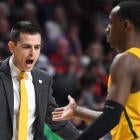
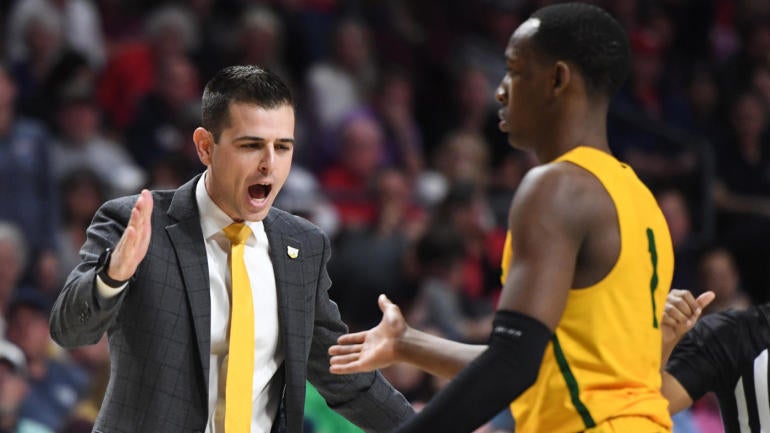
George Floyd's murder spurred San Francisco men's basketball coach Todd Golden to immediately put something tangible and meaningful into action. At the end of May, Golden met with his assistant, Vinnie McGhee, and they brought in four close friends in the coaching industry together to create the Coaches Coalition for Progress in a couple days' time.
The CCFP has a two-pronged mission: to financially give back to underserved youth through community-oriented educational and athletic opportunities; and to enlighten college programs on how they can affect change in their schools and communities through social-justice activism. The goal is to use this vital, massive, high-priority phase of civic unrest to rally via resources, compassion, education and empathy, and in turn foster stronger cultures and respect in communities that need it most.
Itching for more college hoops analysis? Listen below and subscribe to the Eye on College Basketball podcast where we take you beyond the hardwood with insider information and instant reactions.
"I could see that mainly African Americans and minorities were really hurting," Golden said. "There was a sense of defeat, of people struggling, and I wanted to see what I could do to unite people. … For me, I wasn't comfortable just putting out a statement on my Twitter and being like, 'All right, I did what I needed to do as a white coach.'"
The reality of systemic racism hit hard when Golden had a conversation with one of his players just 14 years his junior (Golden is 34, one of the youngest head coaches in D-I) who told him he'd never once had a positive interaction with a police officer.
In addition to McGhee, USF assistant Kevin Hovde and USF director of basketball operations Jonathan Safir are also founding members. The other two are Oklahoma assistant Carlin Hartman and Washington State defensive line coach A.J. Cooper. Hartman and Golden coached together previously at Columbia, while Cooper is Golden's best friend dating back to high school. Cooper's inclusion is important because the vision here is to not keep the CCFP hemmed in to only college basketball.
"The CCFP is striving to be sport-agnostic," Safir said.
The coalition will raise money through donations and annual membership -- being a college coach is not necessary in order to be a member -- and monies raised will be used to give back to tangible sources, both academic and athletic. The first project is to upgrade a Boys & Girls Club in West Oakland, one that McGhee has a personal connection with from his youth.
"The other mission that's come to the forefront of this is to do our part and use our platform to build relationships between players within our programs, and also asking the different coaches that join to take the same steps with their teams," Golden said. "Building relationships and providing platforms for our guys to interact with community leaders, mainly law enforcement."
Golden said a lot of the discussion from the founding members -- three of whom are black -- has involved messaging about the fear of the unknown and systemic racism that's infected police departments across the country.
"I've gone through being racially profiled and a lot of things as a 47-year-old black man in America," Hartman said, then later in our interview added, "With everything we've seen over the last two-plus weeks with the killing of George Floyd, the anger, the peaceful protests, the looting -- I don't condone the looting part of it -- but if you think about it, when Rodney King happened back in '92 that was one of the first instances where you saw a black man getting beaten on camera and it was obviously something that shook up the black community. I think it also probably bothered a lot of people in other ethnic groups, but it really shook us in the black community, especially when the acquittal of those officers came. Fast forward to now and the George Floyd incident and things have been boiling.
"It's not just Ahmaud Arbery, not just just Breonna Taylor, and the guy's got his knee on his knee [on Floyd] for eight minutes and 46 seconds, that's why you see a lot of people that are frustrated, angry, pissed and done. What's really good about it is, back in the Rodney King era, it was mostly black people protesting. Now you look at it and it's black, it's white, it's Latino, it's Asian, it's everyone coming together."
The initiative has received encouraging traction despite what Golden referred to as a soft opening -- its "startup stage" -- in the past two weeks. More than 100 members have signed up and nearly $20,000 has already been raised toward the CCFP cause. The founding members Zoom and brainstorm every Monday and Thursday. Soon, they hope to announce big-name ambassadors to further amplify the mission/message and bring awareness to the CCFP, specifically linking high-profile head coaches to the cause who are eager to build something long-lasting. Eventually, the idea is that professional coaches can be affiliated with the organization, too.
"That's 100% my hope, getting some of these bigger coaches on board, whether it's NBA or other professional leagues," Golden said. "[Gregg] Popovich is someone I would hope would want to be a part of it."
On the local end with USF and Oklahoma, coaches like Steve Kerr in the Bay Area and Billy Donovan in Oklahoma City might make for ideal ambassadors to this initiative.
Before things get to that point, Hartman said fundamental educational endeavors with their programs have to take root. These coaches have not yet even been around their players due to the coronavirus, but later this summer there will be conversations about being an American citizen and partaking in the democratic process. Hartman said the educational piece is huge: bridging the gap between law enforcement and communities. He wants to help educate not just his players, but young people in Norman and nearby Oklahoma City about voting locally, how to research the issues and to partake in elections of every kind. Golden added that, later this year, his players will be tasked to go out to the underserved communities around San Francisco.
"As time moves forward we want to try to model this after Coaches vs. Cancer," Hartman said, referencing the organization that's become synonymous with college basketball and reliably raises millions annually. "If you look at what Coaches vs. Cancer has done over the past two decades, they've been able to have tremendous success with cancer research and we believe they've been able to do it because of the American Cancer Society they partnered with. We're hoping we can look back in 10, 15 years and say, 'Look what we started.'"
There are also opportunities waiting to materialize. For example, schools with coaches involved could opt to schedule each other in nonconference games, with day-before-the-game events made to bring awareness and allow competing teams to unite in a charitable effort in the community.
"One of my big things," said Golden, "is I don't want to get ahead of ourselves. I kind of started it with a smaller vision, hoping that we could grow it at some point. The message I keep reiterating is, 'Crawl before we walk, walk before we run.'"
The next few months will be crucial in determining whether or not the CCFP can become part of the fabric of college sports -- and potentially beyond.