2018 Fantasy Baseball Draft Prep: Ceiling and floor for Aaron Judge and other sluggers
Chris Towers takes a dive into the numbers with some of the premier hitters in the game to figure out what their floor and ceiling is.

By
Chris Towers
•
7 min read
- Draft Prep Tiers: C | 1B | 2B | SS | 3B | OF | SP | RP
- Heath's Sleepers | Breakouts | Busts |
- Scott's Top 100 prospects | Sleepers | Breakouts | Busts
Projections are an invaluable tool when it comes to researching the upcoming season, and you really need to be looking at them when getting ready to draft. They'll never be perfect, but it's always good to establish a ballpark expectation and then adjust from there - if you like Gary Sanchez more than SportsLine, or ZiPS, or PECOTA, or whichever projection system you prefer, then move him up.
However, I find projection systems aren't necessarily the best way to think about player performance, because they tend to spit out one single number as the "official" projection. It's more useful, instead, to think about expectations for the upcoming season in terms of probabilities, with a range of possible production established rather than one big number. Most projection systems incorporate that into their public-facing numbers, but typically just produce a single average number as their "most-likely" outcome.
I started thinking about ranges and probabilities of outcomes when discussing Aaron Judge with my coworkers the other day, because he's such a fascinating player. His power is almost unparalleled in MLB history, but he also seems like a prime regression candidate for a number of reasons: to start with, he is vying to become just the sixth player in MLB history to homer 50-plus times in consecutive seasons. Add in what looks like an unsustainably high .357 BABIP and his massive strikeout issues, and Judge seems like a perfect player to try to figure out what his ceiling and floor might look like.
So, that's what I did. Or, at least, that's what I tried to do. I challenged myself to think of reasonable expectations for Judge's ceiling, and floor, as well as a middle-ground between the two for batting average. I took into account the key factors that go into batting average, with an eye on homers, strikeout rate, and batting average on balls in play. RBI and runs are largely team dependent, and stolen bases are largely independent of all other stats, but homers and batting average are inextricably linked. So I tried to project floor, ceiling, and middle-ground outcomes for a handful of players based on strikeouts, home runs, and batting average, to show a potential range of outcomes.
With Judge, that led me to the following ranges (based on 550 AB):
Ceiling: 27.0 K%, 50 HR, .330 BABIP
Middle-ground: 30.0 K%, 43 HR, .307 BABIP
Floor: 33.0 K%, 37 HR, .289 BABIP
The chart itself should be pretty straightforward: Green is the ceiling, yellow is the middle ground, and red is the floor for each skill.
Those led to the following results:
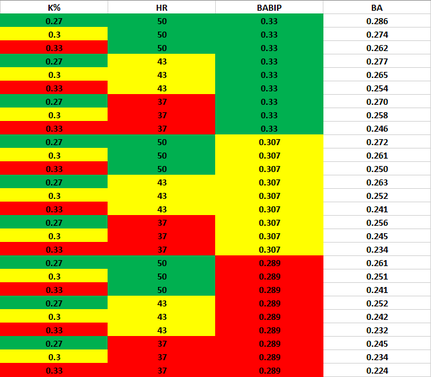
I know, Judge had a higher BABIP already in 2017, so how can his ceiling be lower? Well, BABIP fluctuates wildly from one year to the next, and very few players can sustain what Judge did last season. I also build in some room for his strikeout rate to improve, though I don't quite expect him to sustain his power from last season either; his 30-plus percent rate of home runs per fly balls might be even more unsustainable than his 2017 BABIP.
Put it all together, and I think his reasonable ceiling is probably a .286 batting average, with a floor around .224. The average of all outcomes is .254, which seems like a pretty good place to set your expectations. Judge probably won't help you in batting average; he strikes out too much. But, if a few things go right, he can get to a place where he doesn't hurt you too much, and his counting stats should more than make up for whatever else he lacks.
Let's look at my expectations for some other notable power hitters, with even higher highs and lower lows than Judge.
Joey Gallo (515 AB):
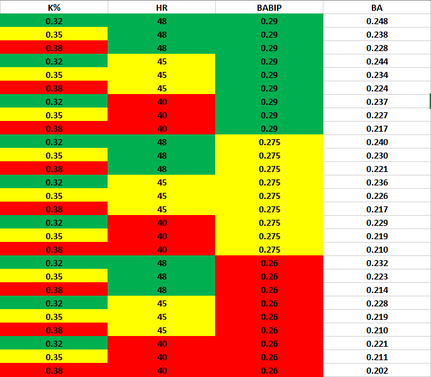
Gallo didn't have quite as many things go right for him as Judge did in 2017, but I might be a bit too rosy on his floor. There's a chance the bottom falls out entirely for Gallo, and he ends not playing every day. This assumes the same amount of playing time across the board for him, but if things go south, he could fall into the same not-quite-everyday role he was in early last season.
Miguel Sano (575 AB)

Why does Sano get so much credit for his batting average on balls in play compared to Judge and Gallo? Well, after 1,300 plate appearances in the majors, he has the highest career BABIP since the Expansion era in 1961. With that in mind, it might be unfair to say his ceiling is .360, given that his career mark is .362, however... he's bound to regress at some point, right? If you don't think so, it's not that hard to see a best-case scenario season where Sano approaches .300
Matt Olson (530 AB)

On a per-game basis, Olson was every bit Judge's equal as a power hitter last season, albeit only partially against major-league competition. In 138 games, he hit 47 homers, though I won't give him quite that much upside here for a few reasons: For one, he hit 24 homers and just two doubles in 59 major-league games, an unsustainable pace for both; secondly, he plays half of his games in a tough park to put the ball into the seats. He doesn't strike out as often as the guys above him, but he also hasn't necessarily shown a long enough track record, hence the relatively wide range of possible outcomes.
Cody Bellinger (565 AB)
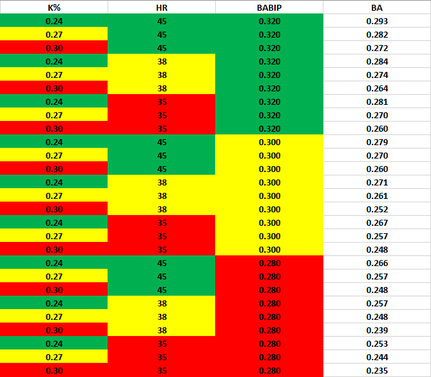
The ceiling is super high on Bellinger, who sported near-Judge-ian power numbers in 2017, with the batted-ball data to back it up, and better contact abilities. I could see a Kris Bryant type of track, where he starts to improve his strikeout rate and emerges as an MVP-caliber player – though he also struck out in almost one-third of his plate appearances in September and the postseason, a sign that the bottom could fall out in his sophomore season as well.
Rhys Hoskins (540 AB)
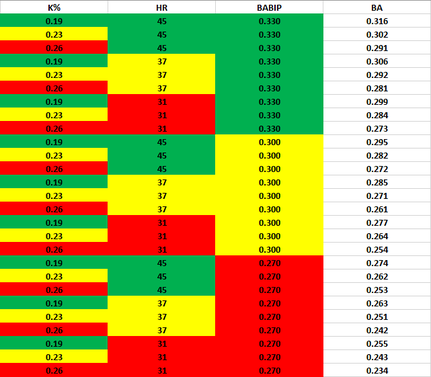
It's really easy to buy into Hoskins. Between 250 games in Double-A and Triple-A, he hit .283 with 67 homers and just an 18.8 percent strikeout rate. Between Triple-A and the majors in 2017, he hit 47 homers and struck out 121 times to 101 walks, elite production. If he can sustain anything close to that kind of plate discipline while still hitting for power, we could be looking at a Freddie Freeman ceiling, which is pretty much where his best-case scenario landed.
Rougned Odor (610 AB)
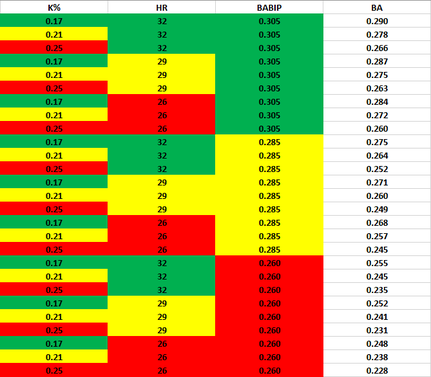
The bottom fell out for Odor in 2017, as his strikeout rate climbed to a career-high 24.9 percent, and his BABIP cratered to .224. You might think that makes sense as his floor, but it represents the sixth-lowest for any hitter over the last decade, so it's unreasonable to think that might happen again. Odor had a pretty strong track record in 2015 and 2016, and though he made some changes to his swing that hurt him, it's not hard to see him getting back to the .270 range without sacrificing power. He's a nice bounceback candidate.
J.D. Martinez (545 AB)
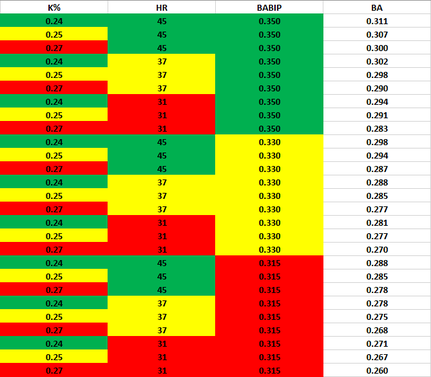
Last season finally earned J.D. Martinez some of the respect he deserves, however injuries have kept him from really racking up the kind of counting stats that would show just how dominant he is. If he stays healthy, Martinez should be in the discussion for the best power hitters in the game, while helping you in batting average, to boot. The floor is pretty high here, making him a likely four-category stud in a great lineup.
Giancarlo Stanton (580 AB)
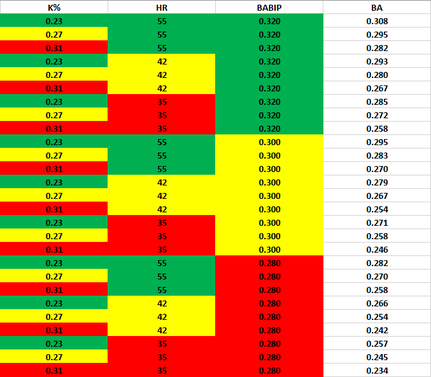
Stanton is another player who had a career-best season in 2017, finally staying healthy while cutting his strikeout rate and hitting for more power than ever. I think he has the highest power ceiling in the game, thanks to his advantage in contact skills over Judge, but he has settled in as a relatively low BABIP guy in recent seasons, perhaps as a result of tweaks he has made to his swing to maximize contact. That only slightly lowers his ceiling, which is still nearly as high as anyone's.
Kris Bryant (560 AB)

Bryant came into the league as a virtual Stanton clone, but has since become a more contact-oriented player, without the pop we hoped for. If he puts it all together, however, we could be talking about him as one of the two or three best players in Fantasy this time next year, especially with 15-steal upside.
Anthony Rizzo (570 AB)
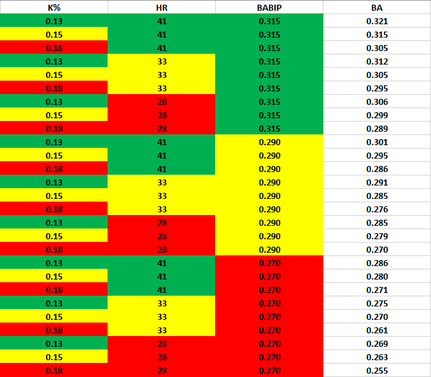
Rizzo seems like an easy player for this exercise, because he is so predictable on the surface: He's been between 31 and 32 homers, 94 and 99 runs, and 101 and 109 RBI over the last three seasons. However, Rizzo also cut his strikeout rate to just 13.0 percent in 2017, the best of his career, and had his career-best HR/FB rate in 2014, at 18.8 percent, while sporting a near career-best .310 BABIP. That's sort of simplified, but if you put all of those together with Rizzo's propensity to steal 10 bases and the lineup he plays in, and... well, it's easy to dream. He's not just the safe fallback option after all.