Tom Hoge caps inspiring journey to top of PGA Tour with victory at AT&T Pebble Beach Pro-Am
Hoge is not a sexy golfer, but his story of incremental improvement is aspirational

By
Kyle Porter
•
3 min read
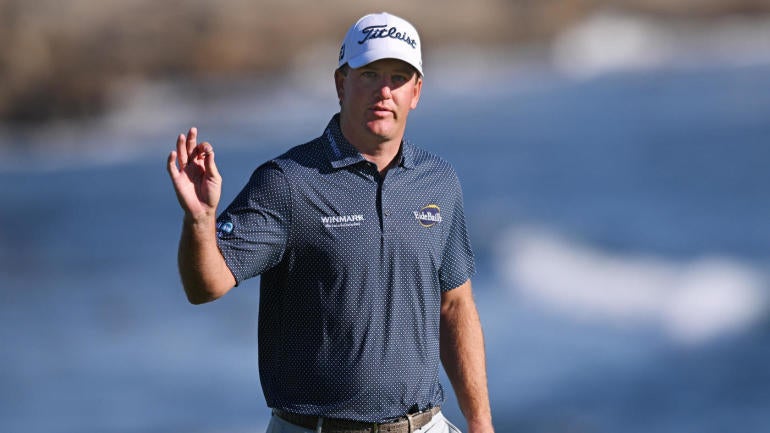
When Tom Hoge won the 2022 AT&T Pebble Beach Pro-Am on Sunday, everyone started looking up how long it had been since he last captured a victory. It took several seconds of scrolling to find that last victory, which came in 2011 at the Canadian Tour Players Cup, a tournament in which the field included about four golfers of whom you've never heard.
There were close calls over the years, but not a ton of them. It took over a decade until Hoge got his next one, but his trajectory of performance is interesting and also helpful as it relates to deciphering his career. His Canadian Tour Players Cup win in 2011 moved him all the way to No. 694 in the Official World Golf Rankings and earned him a spot in the Canadian Open the week after -- his first PGA Tour event. He opened 78-70 and missed the cut.
"That was a wake-up call real fast as far as how tough the golf courses are on the PGA Tour and how good everybody is," said Hoge on Sunday after winning Pebble. "I missed cut pretty badly that week, but that was big experience for me, seeing the type of golf that it would take to play out here.
"I think, more than anything, when you start playing with PGA Tour golfers it's eye-opening that the shots aren't necessarily that much better, it's just the misses are so much better and they really manage their games well. So that was eye-opening for me."
The climb from there was slow but steady. Here are Hoge's year-ending OWGR spots from 2011 onward.
2011: No. 803
2012: No. 792
2013: No. 628
2014: No. 518
2015: No. 262
2016: No. 399
2017: No. 394
2018: No. 266
2019: No. 240
2020: No. 106
2021: No. 110
2022 (current): No. 39
It's not sexy, but it's also not unusual because players like Justin Thomas and the man Hoge outlasted on Sunday at Pebble, Jordan Spieth, get so much of our oxygen that their trajectories appear to be the norm. Those trajectories, however, are not the norm. The norm is incremental improvement year over year like Hoge has shown and then, perhaps once or twice or three times over the course of a career, shutting down a tournament on a Sunday.
"[He's] somebody who I've really gotten to know here or there that I think the general public doesn't realize that he's a guy when he's in contention will be the guy that can close it out," said Spieth after falling two shots short of a playoff. "I mean, there's just ... there's few and far between the guys that are going to sit there and embrace it and play fearlessly."
Rick Gehman, Greg DuCharme and Kyle Porter react to Tom Hoge's victory at the AT&T Pebble Beach Pro-Am. Follow & listen to The First Cut on Apple Podcasts and Spotify.
A humorous but instructive story about how Spieth knew Hoge would be uninhibited with a lead on Sunday based on the way he operated at the craps table floated around on Sunday, courtesy of AP writer Doug Ferguson. It was funny but also enlightening.
It also doesn't tell the whole story because the whole story can't be told unless you dig into the details and see not only how minute Hoge's improvements have been but how much they added up over time. In 2011, he lost 1.79 strokes per round to the field (normalized to the PGA Tour average). That number started dropping, barely, and by 2018 he was right at PGA Tour average. It increased year over year after that (inversely related to how his OWGR rank was dropping), and this season he's gaining 1.02 strokes on PGA Tour fields, which ranks No. 35 on the PGA Tour this year -- better than Will Zalatoris, Webb Simpson, Tony Finau and Bryson DeChambeau.
Solid players aren't guaranteed victories, though, and that's where the craps story comes in. You can make a nice living and a good career out of averaging 1.02 strokes gained against fields for a long time. Plenty of golfers have done just that. But like Spieth said, closing is almost a different sport altogether. Hoge seems to have a bit of both in him, which is interesting and fun.
It doesn't mean the 32-year-old will ever be a top-10 player -- his game will never be well-rounded enough (or long enough) for that -- but it does mean he might not be done winning. Wunderkinds are more fun to talk about and follow than Hoges, but Hoges are perhaps more inspiring. Hoge's story is that you can, by some amalgamation of talent, will and time, rise to the top of your sport. That's not thrilling, but it does give others hope on a Monday morning with the world bearing down on them that they, too, can do the same.