2019 MLB First-Year Player Draft: The most interesting thing about each team's draft class
There were 1,217 selections made over three days and 40 rounds

By
Dayn Perry
•
7 min read
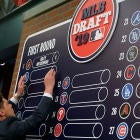
The 2019 MLB Draft is -- after three days, 40 rounds, and 1,217 selections -- finally over. While it will be years before we know which clubs fared the best and which 2019 draftees wind up shining at the highest level, we can at this early hour declare what's interesting about each team's draft class.
If you've already perused the top selections, then perhaps you're ready for the forthcoming cavalcade of team-by-team draft factoids. Those very things are coming at you...
 | |
| The D-Backs had an utter haul on the first day. No other team had more than four picks on Monday and the Diamondbacks got seven. They got a steal in the first round with high school outfielder Corbin Carroll and then went heavy on pitching the rest of the way. All told, they landed the following ranked prospects, per MLB.com on the first day: 15, 20, 49, 52, 59, 85 and 91. | |
 | |
| The Braves' fifth-round pick is a huge unknown. Stephen Paolini is a high school outfielder from Connecticut who is committed to Elon. He's said to be a left-handed power hitter with plus-speed, but past that there isn't much known nationally. The Braves believe they've uncovered a hidden gem here. It'll be interesting to track his minor-league career and see if this comes to fruition. | |
 | |
| How good of a hitter is top overall pick Adley Rutschman? The Oregon State catcher as a junior batted .411/.575/.751 this season with 17 home runs in 57 games. He led all of Division I in OBP and walks. Or, to put a finer point on it, Rutschman during the NCAA Tournament regionals was intentionally walked with the bases loaded. | |
 | |
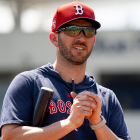
| With the 69th overall pick, the Red Sox took shortstop Matthew Lugo out of Puerto Rico. Lugo attended the Carlos Beltran Baseball Academy, and he also happens to be Beltran's nephew. | |
 | |
| The Cubs went heavy on collegiate pitchers, namely power arms, including Fresno State's Ryan Jensen and Louisville's Michael McAvene. Both can hit triple digits and could move quickly through the farm system, especially if used as relievers. | |
 | |
| By selecting Cal first baseman Andrew Vaughn with the third overall pick, the White Sox became the first team to take a listed first baseman in the top three picks since the Royals drafted Eric Hosmer with the No. 3 pick in 2008. | |
 | |
| Despite picking seventh, the Reds got the first pitcher in the draft, wiry 6-foot-6 lefty Nick Lodolo, who has drawn Chris Sale comparisons. He's an advanced college arm and should move quickly through the system. Perhaps we see him in the majors late next year. | |
 | |
| The Indians' top pick, right-hander Daniel Espina (No. 24 overall) is just 18 years of age, but his fastball registered 99 mph at the Under Armour All-America Game last summer. | |
 | |
| The Rockies' second-round pick was Aaron Schunk out of Georgia and although the Rockies have said they'll be using him primarily as a third baseman, he's a two-way player. He hit .339/.373/.604 while also pitching to a 2.49 ERA and 1.04 WHIP in 21 2/3 innings. | |
 | |
| The Tigers' top pick of 2019 was Florida high school outfielder Riley Greene. The rest of the way, though, they drafted only one more high school product -- shortstop Cade Doughty in the 39th round. Of their 40 selections, 38 were drafted out of college or junior college. | |
 | |
| The Astros' first pick was the No. 32 overall selection, with which they chose Cal catcher Korey Lee. That's the latest first-round pick in franchise history. | |
 | |
| Bobby Witt Jr., a prep shortstop from Texas whom the Royals tabbed with the No. 2 overall pick, is the son of Bobby Witt, who won 142 games and pitched parts of 16 seasons in the majors. The elder Witt was the No. 3 overall pick (Rangers) in 1995. | |
 | |
| With the 121st pick, the Angels nabbed Erik Rivera out of the Puerto Rico Baseball Academy. Rivera is a two-way prospect. He's an outfielder with big power from the left side, and he's also a lefty on the mound with a low-90s fastball and solid curve. | |
 | |
| In the first round, the Dodgers selected first baseman Michael Busch out of the University of North Carolina. He's a high on-base guy with nice power, but the interesting part here is that they picked him as a second baseman. | |
 | |
| The Marlins took one of the smallest players in the draft. At No. 46, they took high school shortstop Nasim Nunez, who is 5-foot-9, 160 pounds. The diminutive star is an excellent defender and baserunner, but is said at present to lack power. Maybe he'll develop it like Jose Altuve did. | |
 | |
| Their eighth-round pick didn't play all season, as he was recovering from a torn Achilles. David Hamilton, a shortstop from the University of Texas, hit .291/.404/.445 with 31 steals in 2018, but no one can be sure how he'll fare upon return, especially as a speed guy coming off this injury. Still, it's an upside play. | |
 | |
| The Twins took a high school product with their top pick -- shortstop Keoni Kavaco of Eastlake HS in Chula Vista, Calif. Their next 10 draftees, however, were college products. Kavaco is the first first-rounder out of Eastlake since the Marlins took Adrian Gonzalez No. 1 overall in 2000. | |
 | |
| In the third round, the Mets took Matthew Allan, a high school pitcher from Florida. He's committed to the University of Florida and most people don't think there's a chance he'll sign. If, somehow the Mets can convince him to sign, it would be a coup. He was talented enough to be picked in the first half of the first round. He only fell due to signability concerns. He projects to a frontline rotation starter. | |
 | |
| Roughly 21 years after selecting Al Leiter in the second round, the Yanks drafted his son, Jack, in the 20th round. Jack Leiter is expected to be a tough sign because of his strong commitment to pitch for Vanderbilt. | |

Athletics
| |
| Care for some Bay Area synergy? The Athletics' fourth-round choice, Kyle McCann out of Georgia Tech, is finalist for the Buster Posey Award, which is given each year to the top college catcher. McCann this season boasted a .468 OBP with 23 home run in 62 games. | |
 | |
| The Phillies might have gotten a steal at pick 14 with UNLV shortstop Bryson Scott. An argument could be made that he was the top shortstop in this draft, so him sliding to 14 was big for the Phillies. Also, through eight rounds, the Phillies only took shortstops (three) and pitchers (four). Ohio first baseman Rudy Rott broke the string when the Phillies took him in the ninth round. | |
 | |
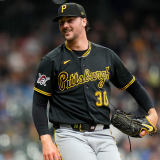
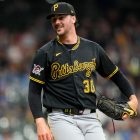
| You like raw power? We're here for you. In the 14th round, the Pirates took Aaron Shackelford from The Master's University. It's an NAIA school, but among all collegiate players, Shackelford led the nation with 36 home runs. He's a left-handed hitting shortstop. | |
 | |
| The Padres already have one of the best farm systems in baseball, at least they did before the season started when they could still include Fernando Tatis and Chris Paddack. They didn't pick in the top five, but still got a top-five talent in high school shortstop C.J. Abrams. The cheap comparison is Dee Gordon with power. A stocked system gets even more loaded. | |
 | |
| The Giants loved bats early. Through seven rounds, the Giants did not take a single pitcher. They went college outfielder, college first baseman, high school outfielder, college shortstop, high school first baseman, high school shortstop and college outfielder before they selected right-handed pitcher Caleb Kilian out of Texas Tech. | |
 | |
| In the first 10 rounds (11 picks for Seattle), the Mariners took nine pitchers and nine collegiate players. One of those was University of Arkansas right-hander Isaiah Campbell. As you know, the trading of draft picks is rare in MLB. Only competitive-balance round picks can be swapped, and the Mariners took Campbell with the competitive-balance pick they received from the Indians as part of the Edwin Encarnacion-Carlos Santana trade. | |
 | |
| Their seventh-round pick, Jack Ralston, is a 6-foot-6 right-handed pitcher. Prior to this season, he only had 14 appearances and it wasn't due to injury. He just wasn't deemed good enough (the 6.44 ERA backs it up). Now he's a seventh-round pick for an excellent organization after going 11-1 with a 2.55 ERA. | |
 | |
| The Rays' highest pick was UNC-Wilmington shortstop Greg Jones (No. 22 overall). Jones becomes the highest-ever draftee out of UNC-Wilmington. This season he batted .341/.491/.543, and he has tantalizing speed -- nine triples and 42 stolen bases in 63 games. Those 42 steals were good for fifth place in all of Division I. | |
 | |
| Outfielder Kellen Strahm (No. 145 overall) is a San Jose State product, but his parents are University of Oregon royalty. Strahm's father was an All-American wrestler for the Ducks, and his mother is in the University of Oregon's Athletic Hall of Fame as a softball player. | |
 | |
| In the 32nd round, the Blue Jays selected Braden Halladay, son of the late Roy Halladay. Roy Halladay, now a Hall of Famer, was taken by the Blue Jays with the 17th overall pick of the 1995 draft, and he spent the first 12 seasons of big major-league career in Toronto primarily wearing No. 32. | |
 | |
| The Nats really liked college players. Really liked them. They didn't take a high school product until the 23rd round when it was right-handed pitcher Michael Cuevas out of William J. Brennan in Texas. Prior to that pick, the Nats took 14 players from college and seven from junior college. | |