

California lawmakers propose legislation targeting MLB's antitrust exemption if teams don't pay relocation fee
The 'Moneyball Act' has been introduced ahead of a potential Oakland A's move to Las Vegas

By
Dayn Perry
•
2 min read
In response to the Athletics' ongoing efforts to relocate from Oakland to Las Vegas, two members of the U.S. House of Representatives from California -- Barbara Lee and Mark DeSaulnier -- have introduced a framework to repeal Major League Baseball's longstanding exemption from federal antitrust laws.
The "Moneyball Act" legislation introduced on Tuesday would require the owners of any relocated team to compensate the state and local authorities they move away from. In this case, A's owner John Fisher would be compelled to pay recompense to the city of Oakland and the state of California. Absent such compensation, the legislation calls for MLB to once again be subject to antitrust laws.
"This legislation will ensure that no city and community is left behind when billionaires decide that lining their own pockets is more important than the community that supports them," Congresswoman Lee said in statement released by her office. "The Oakland Athletics have been an institution of the East Bay for over half a century. If the A's ownership group decides to leave, Oakland should not be left empty handed."
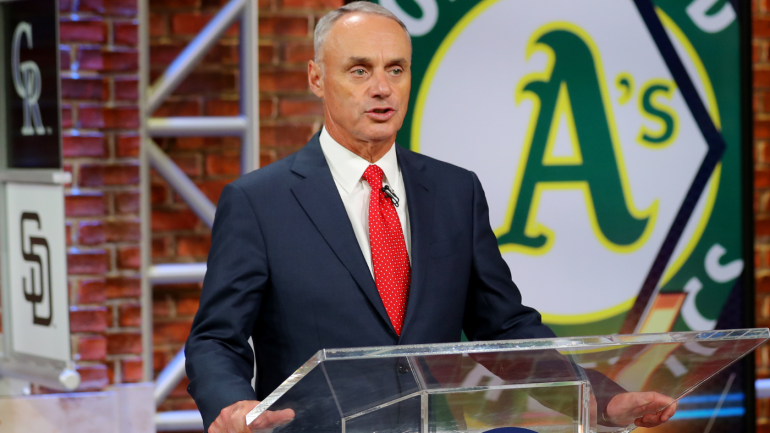
The legislation is also in response to MLB commissioner Rob Manfred's decision to waive the relocation fee for the A's in this instance. As things stand now, the A's future in Las Vegas is in doubt and likely will hinge on whether state and local lawmakers there agree to provide the club's requested amount of public funding.
MLB received its antitrust exemption, which allows it to serve as a legalized monopoly, in 1922 after it faced opposition from the Federal League. MLB's antitrust exemption has been allowed to stand since by virtue of the league being immune to the Sherman Act -- a piece of legislature that is supposed to prevent companies from fixing markets and thereby harming customers.
MLB's antitrust exemption was granted on the grounds that the league doesn't constitute interstate commerce -- a confusing claim given the very interstate nature of baseball and one that legal historians have almost unanimously criticized. However, the Supreme Court has stood by its ruling on other occasions, including as it related to Curt Flood's quest for free agency in 1972.
Part of MLB's antitrust exemption was later removed in the 1990s, when then-president Bill Clinton signed the Curt Flood Act of 1998 into law. The Flood Act removed only part of the exemption that deal with labor relations, and not those that deal with the minor leaguers, expansion, or other business matters. The exemption is the subject of periodic threats from lawmakers, but has thus far remained largely intact for more than 100 years.
As Marc Normandin recently pointed out, Manfred in 2022 said this about the exemption to Bill Shaikin of the Los Angeles Times:
"It's really interesting. The principal utility of the exemption is it allows us to be more aggressive than other leagues in terms of preventing franchise relocation. It is a fan-friendly doctrine in the law."
Not surprisingly, this remark of Manfred's has not been lost on Rep. Lee. While it's unlikely any efforts to overturn the exemption will be realized, the effort does bring attention to the ever-growing fiasco and Manfred's enabling of it.