Shohei Ohtani contract deferrals: How Dodgers are using MLB CBA to their advantage by waiting to pay $680M
Ohtani will defer $680 million of his record $700 million deal

By
Dayn Perry
•
3 min read
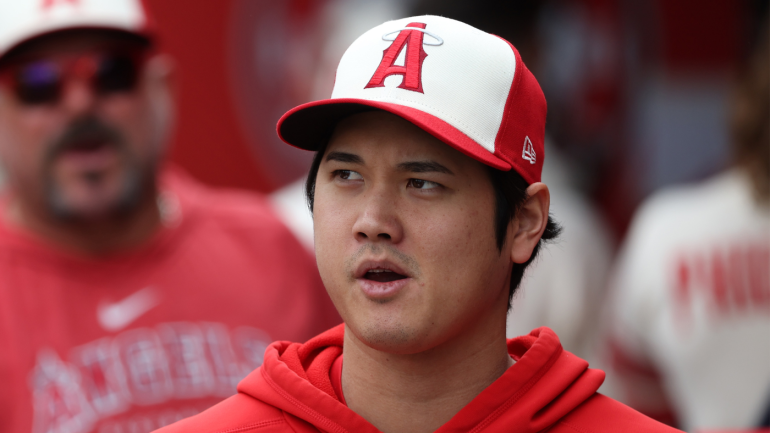
Reported details on Shohei Ohtani's record-busting $700 million contract with the Los Angeles Dodgers emerged Monday. While that $700 million figure was shocking enough, what's perhaps even more stunning is just how much of that tab will be deferred, or put off into the future.
Fabian Ardaya of The Athleric reports on the details of Ohtani's deferrals:
"In an effort to enable the Dodgers to continue spending around stars Ohtani, Mookie Betts and Freddie Freeman, Ohtani agreed to defer all but $2 million of his annual salary — $68 million of his $70 million per year — until after the completion of the contract. The deferred money is to be paid out without interest from 2034 to 2043."
Yes, Ohtani is deferring $680 million of those $700 million. Salary deferrals are nothing new, and they precede even the famous case of Bobby Bonilla and the Mets. They play into the future value of money principle, and that's something teams, which are of course basically companies, care much about. The star players who agree to those deferrals, meantime, care less about them because they're already getting more life-changing money than they can spend, and those deferrals provide a measure of long-term security. You're even more willing to agree to such an arrangement if, like Ohtani, you make millions upon millions in endorsements each year. The proportion of deferred money in Ohtani's deal, however, is unprecedented. To frame it another way, Ohtani each year will be deferring $23 million more than any other player has ever made in salary for a season.
All of this has led some to wonder aloud whether Major League Baseball or the players association would even permit such a thing. That's addressed in the collective bargaining agreement (CBA), which is the negotiated accord that governs the labor relationship between players and teams, and, yes, it's permitted. Article XVI of the current CBA reads:
There shall be no limitations on either the amount of deferred compensation or the percentage of total compensation attributable to deferred compensation for which a Uniform Player's Contract may provide.
So, yes, Ohtani and the Dodgers are indeed permitted to defer as much of that $700 million as they want. Have they tested the bounds of what's acceptable? That's uncertain. MLB probably has some incentive to try to limit deferrals because, even though it makes financial sense for the team, it helps the team skate around the luxury tax on payrolls (euphemistically known as the CBT, or Competitive Balance Tax). Long-term contracts are calculated in terms of average annual value for CBT purposes and not tailored to whatever a player's exact salary is in a given season. For instance, a player on two-year, $20 million contract who's paid $5 million in year one and $15 million in year two is nevertheless a $10 million CBT hit in both years because that's the average annual value of his contract. In Ohtani's case, his AAV is not $70 million – $700 million over the stated 10 years of the contract – but something around $46 million because of those massive deferrals. That allows the Dodgers to be much more nimble when it comes to avoiding CBT penalties. It's worth noting that all of this was reportedly the idea of Ohtani's side because he wanted the Dodgers to be able to add additional pieces – yes, more pieces than Ohtani himself and Mookie Betts and Freddie Freeman – in the service of winning the World Series.
On the union side, maybe they don't like deferrals because the players should probably be receiving interest rates on what are basically loans to their clubs. That said, deferrals make it more possible for players to do things like, oh, sign $700 million contracts and keep raising the salary bar. Whether there's any common ground between union and league on taming deferrals, nothing can happen until the next CBA is negotiated. The current CBA runs through the 2026 season. In the meantime, money finds a way, as it always has.
The extent to which this is a concerning thing for baseball and for fans of teams not named the Dodgers is a complicated matter, and it will be some time before all the consequences are fully realized. In the meantime, think of the Ohtani contract as something we've never seen before, except now it's in two different ways – the money and how the money will be paid out.