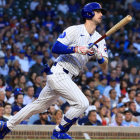
Yankees, Phillies, Cubs have ballparks that Stanton would enjoy to call home
Trade rumors are swirling about the Marlins' slugger now that he's cleared waivers

By
Dayn Perry
•
3 min read
Executive summary: Marlins slugger Giancarlo Stanton has reportedly passed through revocable waivers, which means he's now free to be traded to any team. As detailed at length in this space, a host of considerations must be addressed in order for Stanton and his massive, complicated contract to be dealt. The smart money says it probably won't happen. However, it could happen, and that's especially the case now that the Marlins have shuttled him through the waiver process.
A number of teams would have at least a cursory interest in a frontline hitter like Stanton, especially now that he's healthy and, per SportsLine (@SportsLine on Twitter), projected for a whopping 57 home runs this season. To indulge in more specific speculation, the Yankees, Phillies, and Cubs might be particularly good fits.
The Yankees have vast resources, and the appeal of pairing Stanton and Aaron Judge in the same outfield is obvious. The Cubs may not seem like an ideal fit, but they're trying to win now and their coffers are also quite deep. As for the Phillies, they're looking to emerge from a rebuilding process, and they have almost no long-term commitments on the books after this season. Adding the likes of Stanton would certainly reinvigorate the fan base. That's not an exhaustive list of potential landing spots, but those stick out. As it turns out, they'd also be good fits for Stanton's power.
Yeah, Stanton's power. You know all about it. Despite losing a chunk of his career to date to various injuries, he's topped 250 career home runs in this, his age-27 season, and over that career he's averaged 324 total bases per 162 games played. He's also done all that even though his home ballpark is a tough environment for right-handed power hitters.
We've seen before that Stanton has power to all fields. For instance, you can't forget this one from 2014 ...
Larduhmercy, we say. Even so Stanton for his career has shown modest pull tendencies relative to the league average. In that sense, he's a bit of a typical right-handed power hitter and as such prone to park effects in the typical way. Now let's jump over to Baseball Prospectus and average some three-year home run park factors for right-handed batters. We'll do so for the implied ballparks of note. These numbers will tell us how much a given ballpark tends to inflate or suppress right-handed power. We're using three-year averages because such measures are prone to single-year randomness. To the digits ...
Ballpark | % increase/decrease of RHB HRs, 2015-17 |
Marlins Park | -9.7 percent |
Yankee Stadium | +15.7 percent |
Wrigley Field | +9.3 percent |
Citizens' Bank Park | +12.7 percent |
As you can see, Marlins Park in Miami is suppressive of right-handed home runs, even though Stanton has thrived during his time there. The other three ballparks are much friendlier toward power from the right side of the plate. In the case of Yankee Stadium, we think of it being more accommodating toward lefty bats, what with that short porch in right. However, it's a good environment for any power hitter.
Stanton's power is such that it plays anywhere -- i.e. not too many of his home runs are cheap ones. That said, it's entirely possible that if he's dealt to one of these three plausible teams that he'll become even more of a force at the plate, at least in unadjusted terms. The idea of having a breathtaking power hitter like Stanton on your team is necessarily alluring. Think about Stanton perhaps reaching yet another level thanks in part to his new environment, and it becomes even more tantalizing.
Again, the sensible tack is to assume nothing comes of this, at least right away. Still, this should give Yanks, Cubs, and Phillies rooters some baseball daydream material.