Kevin Harvick calls for 'better leadership' from NASCAR on safety issues
Harvick says he believes safety issues are "second fiddle" to NASCAR

•
4 min read
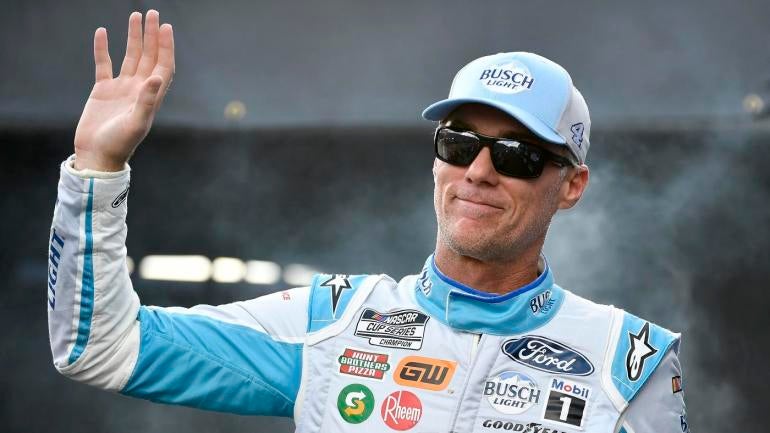
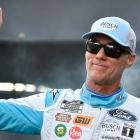
One week after he railed against NASCAR and the "crappy parts" on the Next Gen car following his car catching on fire in the Southern 500 at Darlington, Kevin Harvick once again made strong and pointed comments on the issue of safety in NASCAR while speaking to the media Saturday at Kansas Speedway.
During NASCAR Playoffs media day, Harvick spoke out on the issue of the Next Gen car being too rigid in crashes and causing drivers to absorb larger and more painful impacts, and what he felt was an inadequate response time to the problem by NASCAR. Then, days later, Harvick became the latest driver to have his car catch fire in the exhaust and rocker box area, prompting NASCAR to make rule changes earlier this week to try and mitigate the risk of fires.
Harvick stated that he felt NASCAR's response was too late, arguing that their reaction to earlier fires with the Next Gen car was too slow. Harvick expressed that he feels there needs to be "better leadership" on the matter of safety issues, whether it comes from collaboration from the race teams or from an independent group that is not beholden to NASCAR or the race team's concerns.
Kevin Harvick happy that changes were made to address fires but felt like it has come too late and feels NASCAR is too slow to implement changes. He wants an independent council from teams and NASCAR to try to accelerate safety changes. pic.twitter.com/U6WhtZhNyY
— Bob Pockrass (@bobpockrass) September 10, 2022
"The whole safety thing is really kind of second fiddle right now, and I just don't think that's fair to the drivers," Harvick said. "... I think when I look at the car itself, it's not rear impacts, it's not front impacts, it's not side impacts -- it's all impacts. And no matter what their filtered data says, it's not what the drivers are feeling. And we need a louder voice.
"As I sat and thought about it this week, it really needs to have more of an independent group that makes the decisions on how to implement things and how to go through a process that's outside of NASCAR and the teams. Because NASCAR is slow to react, and then teams are always worried about money, and that doesn't do anything for the drivers."
While the Next Gen car features more durable parts and pieces, supplied by a single source in the interest of long-term cost savings, the tradeoff has been that the car does not give or crumple as much upon impact, leading to more of the force of a crash being absorbed by the driver's body. Concerns among drivers throughout the season have been exacerbated by the circumstances of Kurt Busch, who is missing his eighth straight race this week after suffering a head injury in a crash at Pocono in July.
Harvick, the oldest driver in Cup, has as sobering a perspective as anyone in the garage area. Harvick made his Cup debut in 2001 as the replacement for Dale Earnhardt, who was killed in a crash on the final lap of the 2001 Daytona 500. Earnhardt was the fourth NASCAR driver to die in a crash in the span of nine months, as stiffer and more solid chassis resulted in cars giving less upon impact and more force being felt by drivers.
Three drivers during the 2000 season -- Adam Petty, Kenny Irwin and Tony Roper -- all died of basillar skull fractures, the same injury that would kill Earnhardt at Daytona.
Earnhardt's death led to a safety revolution in NASCAR, which included the mandating of head and neck restraints that have since prevented any such blunt force trauma injuries from occurring. Still, the fact that it took losing a figure of Earnhardt's magnitude before NASCAR took major action on driver safety has long been lamented.
"I've lived this, man. I've watched," Harvick said. "I watched when we had all the trouble with Adam and Kenny Irwin, and then it resulted in Dale Earnhardt. And then all of a sudden, it was mandatory to wear a HANS device. It was mandatory to wear the Hutchens device. We developed soft walls.
"It can't be slow. The safety cannot be slow, and this car is -- it's screwed up as far as the way that it crashes. Whether the data says it or not, every driver in this garage will tell you that it's not right, and it hurts. Feet hurt, hands hurt, head hurt. And there has to be a better solution."
It should be noted that NASCAR is making efforts behind the scenes to try and better address present safety issues. According to Dustin Long of NBC Sports, NASCAR stated Saturday that it met with its Drivers Advisory Council, which consists of multiple active and former Cup drivers, for two hours Thursday. NASCAR also employs three people who work exclusively on safety and consults a panel of independent safety experts from fields including biomechanical engineering and orthopedic surgery.
Despite NASCAR's sterling track record on safety over the last 20 years, the 2022 season has not been its smoothest. For instance, NASCAR had to issue a mea culpa after a Truck Series race at Las Vegas in March when no caution was called after Spencer Boyd's truck crashed on the backstretch, leaving it disabled along the inside wall as the field continued to race on the final lap (Boyd suffered a dislocated shoulder but did not miss a race). The response times of safety teams were also criticized in June, when Truck Series driver Carson Hocevar spent several moments in pain with a broken ankle before being helped.
Competition officials were also taken to task just weeks ago for not being proactive in throwing a caution for impending rain at Daytona, which led to virtually the entire lead pack crashing when a pop-up shower suddenly hit Turn 1 as they entered the corner. Harvick himself was involved in the crash, finishing 20th after suffering terminal damage.