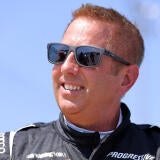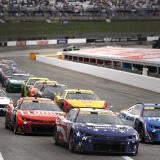
Michael McDowell reflects on how years of grinding created a Daytona 500 legacy all his own
McDowell sat down with CBS Sports to remember hard times in his career, and the part Daytona played on his path to glory

•
7 min read
In February of 2010, the concept of victory at Daytona was a relative thing for Michael McDowell.
His first attempt to qualify for the Daytona 500 was hardly heralded, and more against hope than filled with it. His car had no sponsor, and his team was among those that took up space in the back of the garage area. Of the 54 cars that showed up to try and qualify for the 500, McDowell's ranked 50th in time trials.
But on the last restart of his 150-mile qualifying race, McDowell made it happen. He tore through the middle of the field, passing the other cars he needed to finish ahead of in order to qualify and finish 14th, making the Daytona 500 field in improbable fashion through little more than force of will and what power and handling his motor and chassis had to offer.
"I feel like I won the Daytona 500," McDowell, then 26, beamed in his post-race interview. "I'm just real excited to be here and racing on Sunday."
"I feel like I won the Daytona 500."
— nascarman (@nascarman_rr) February 15, 2021
Never forget when Michael McDowell put the 50th fastest car in the Daytona 500 in 2010. Darn good superspeedway racer pic.twitter.com/JAOTRwAvMN
Revisiting those comments now, what McDowell accomplished that Thursday over a decade ago pales in comparison to what he has now achieved. He returns this year as the defending champion of the Daytona 500, having won the 2021 edition in one of the most-notable upsets the speedway has seen. But what made McDowell's Daytona triumph a compelling testament to the resilience and perseverance necessary to survive in the face of adversity was times just like 2010, where not qualifying for NASCAR's greatest race was something he simply couldn't afford.
"The prize money for the Daytona 500 was a huge swing, so if you missed the race, you probably weren't gonna run the rest of the season. It was a big deal for sure," McDowell told CBS Sports. "You feel that pressure ... And just that relief that you have when you make it across the line, you know that you're in and you get to start your first Daytona 500.
"But more than anything it was just the relief. Because the amount of pressure that was around missing it was huge."
In order to maintain his place as a Cup driver, McDowell took on the undignified work of being the driver of start-and-park cars -- cars which would run tricked-out qualifying setups fast enough to make the starting field, run a dozen or so laps, and then pull into the garage and retire from the race in order to collect the purse money while spending the bare minimum needed to field a team. It meant McDowell could drive a racecar at NASCAR's highest level, but it was far from desirable or glamorous.
"In the beginning I just wanted to be in the Cup Series and wanted to make the races, wanted to prove that I could be there," McDowell said. "And as the years went on and it wasn't really developing into any opportunities – It was just more opportunities to start-and-park, it felt like – I was just trying to figure out 'What am I doing? Why am I doing it?'
"There were a couple of reasons why I was doing it. One is that I never made it big and never made millions of dollars, so this is what I do to provide for my family. That's one element of it. And then the second element of it was holding onto the hope that one day I would get an opportunity to race again. Not just start-and-park, but to race again and to do it at a higher level than what I was doing it at. So it was a process, it was a journey."
During those years, the Daytona International Speedway and the Daytona 500 presented McDowell with an annual opportunity to actually run a full race and show what he could do against the other drivers in Cup. And as he otherwise toiled from week to week, Daytona began to smile upon him: Particularly in the 2013 Daytona 500, when McDowell surprised many by finishing a career-best ninth.
It was that race that led McDowell to a superspeedway epiphany, as he began to see order in a place where many others only saw chaos.
"I just realized that 'This is gonna be probably my only shot to run good and have a shot at winning a race.' And so from that point forward, I really became a student of those races in particular, Daytona and Talladega," McDowell said. "And I just watched the guys that consistently ran up front, consistently challenge for wins. Everyone talks about Daytona as like 'Oh, anybody can win it, it's a crapshoot, luck, you've just got to survive.'
"But I found that that's not really true. That it was the same five or six guys that ran up front, that won races consistently, and there was a lot of repeat winners. And so repeat winners, to me, doesn't say luck."
Eventually, McDowell was able to move past start-and-parks and work his way up the ladder of mid-pack Cup teams: First with Leavine Family Racing, and then with Front Row Motorsports. And as that happened, his work towards being competitive at Daytona began to bear fruit: He was second at the white flag of the track's 400-mile summer race, and ended up fourth at the finish. The next year, he led 20 laps at the midway portion of that race. In 2019, he mixed it up on the last lap of the Daytona 500 and finished fifth.
Each time, McDowell's success was treated simply as a nice story -- an underdog having his day at the front and earning a finish that would be his greatest run in the grand scheme of his career. But unbeknownst to most, a trend was developing, and McDowell's own ideas of winning a Cup race were becoming more and more realistic.
"Every time I would get a little bit closer, a little bit closer, it became more real. Not less of an opportunity, but more of an opportunity," McDowell said. "So I feel like that fourth-place, that fifth-place, there was some decisions in there that weren't great that I made. I felt like I could have probably gained a couple spots or even put myself in position to win. So you learn from those, and you feel even more confident going back that 'Okay, if I do this and that when I come to the white flag, this is what I need, this is what I can't do.' And so you just build on that.
"And I felt like we were doing that at Front Row. Our program was getting better and better at superspeedways, confidence was getting built, but more than anything else just the raw speed to be able to do the things you need to do. I think it was a process of four or five years of feeling like we're getting a little bit better, a little bit better, a little bit closer. And then it finally all came together."
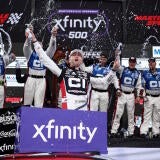
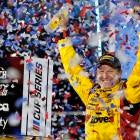
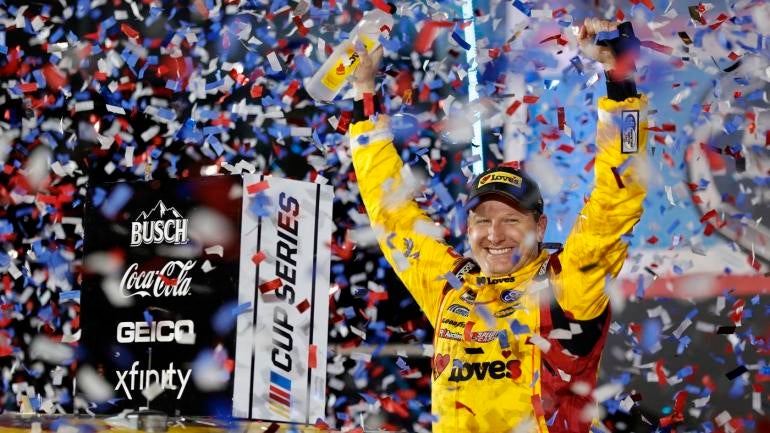
Going down the backstretch on the last lap of last year, McDowell was third and pushing Brad Keselowski as he made a charge at Joey Logano for the lead and the win. Then, Logano threw a late block, and the two spun opposite ways entering Turn 3. McDowell, a bystander and the first witness, split the difference between the two cars and took the top spot as a jailbreak occurred behind him. As the fire and smoke of a massive crash occurred behind him, the yellow flag flew with McDowell out front and driving back to the finish line as the winner of the Daytona 500.
Just like that, after 358 tries, McDowell had won a NASCAR Cup Series race. And he had done so in a way that forever changed his career, his legacy, and his life. No matter where else he goes, and no matter what else he does, McDowell will forever be known as a champion of the Daytona 500, a race which turned McDowell from a career journeyman into a name forever a part of the speedway's great history.
As it stands, the legacy of Michael McDowell as a Daytona 500 winner is one shared by other drivers who earned their very first win in the Great American Race. Unknowns who became instant stars like Tiny Lund, Pete Hamilton, and Derrike Cope. Youngsters who became stars like Mario Andretti and Trevor Bayne. Long-suffering veterans who were finally rewarded like Sterling Marlin and Michael Waltrip.
Entering the 2022 Daytona 500, McDowell is more than confident that he can go back-to-back, especially given that he no longer has to grapple with the pressure of only having one chance to win a race. History, along with McDowell's own abilities as a superspeedway driver, suggests that's perfectly possible. In 1994, Sterling Marlin earned his first career win in the Daytona 500 after years of trying, then came back the next year and won the 500 again for his second career win.
Whatever Daytona has to offer McDowell this year and years into the future, his 2021 Daytona 500 triumph forever ensures him a place as a hero of the speedway.