Are the Hawks better without Trae Young? We're about to find out
Young's return for Atlanta is nearing, but how much longer will he remain with the franchise?

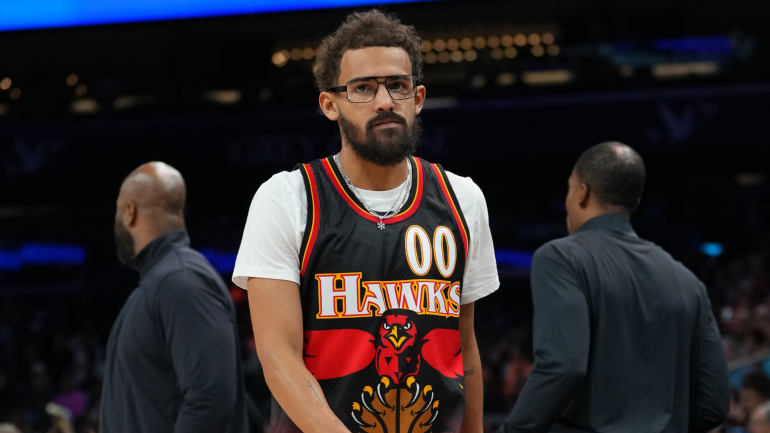
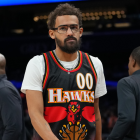
Are the Atlanta Hawks better without Trae Young? It's been the pervasive question surrounding this Hawks season to date. While we don't yet have an answer, what we can say fairly comfortably is that the version of the Hawks we've seen since Young went down with an MCL sprain is roughly as good, if not better, than any version of the team he played for. Just consider the numbers:
- The Hawks have a +2.1 net rating since Young went down. The best net rating Atlanta has posted over a full season in Young's career came in 2021, when they made the conference finals. It was +2.2.
- The Hawks started the season 1-3. Young went down early in their fifth game. They are now 14-9 in games Young hasn't finished. That's a winning percentage just below 61%. Atlanta has never won even 57% of its games across a full Young season, and the Hawks are 221-267 when he plays, meaning they've won around 45% of his career games.
- The Hawks have the NBA's No. 13-ranked defense since Young got hurt. Atlanta has never posted an above-average defensive rating over a full season with Young.
- The theoretical area in which the Hawks should be worse without Young is on offense, yet Atlanta ranks No. 12 since his injury. The obvious takeaway there is that Atlanta's athletic wings are dominating in transition, and there's some truth to that. The Hawks are the seventh-most efficient transition offense this season, according to Synergy Sports, and only the Heat and Bulls spend a greater proportion of their possessions in transition. But that doesn't mean the Hawks have made some great half-court sacrifice. Atlanta ranks 19th in half-court points per possession since Young hurt his knee, according to Cleaning the Glass, but they ranked 16th last year, and they haven't ranked higher than 14th since 2022, when they finished No. 1.
Again, this doesn't tell us that the Hawks are better without Trae Young. It tells us that the version of the Hawks we've seen for most of this season is probably at least as good as any version of the Hawks Young played on. Those are wildly different points, especially considering how deep this roster is compared to the ones Young has largely played for.
Jalen Johnson, today, is better than any player Young has ever played with. Nickeil Alexander-Walker has essentially morphed into the sort of backcourt partner Atlanta envisioned Dejounte Murray would be: a capable secondary ball-handler that brings high-level shooting and defense. Onyeka Okongwu may not quite be the prototypical Young big man, but he's more versatile and frankly valuable than Clint Capela has been for Atlanta in years. Dyson Daniels is great. The bench is full of shooters. There's a No. 1 overall pick here in Zaccharie Risacher going almost completely unnoticed. This team can be awesome. Young has never played on an awesome team.
That might be changing pretty soon. Young has been upgraded to questionable on Atlanta's injury report for Thursday's game against the Charlotte Hornets. Whether he indeed returns Thursday nght or at some point in the near future, we are about to see how Young responds to playing with the best talent of his career. There's a world in which his presence vaults the Hawks into genuine Eastern Conference contention. He has led the best half-court offense in the NBA, after all, even if it came years ago. That's one of this group's weaknesses. Maybe Young's return supercharges the offense, but the defense remains afloat thanks to all of the athleticism the Hawks have accumulated.
There's also another equally plausible world in which Young proves more disruptive than helpful. He's one of the most heliocentric players in basketball, and nothing about Atlanta's playing style without him suggests they're equipped to reintegrate such a high-usage player. Atlanta is averaging over 308 passes per game since Young's injury, the fifth-most in the NBA. They ranked 17th in passes per game last season, and believe it or not, that represents growth for Young. Between the 2019-20 and 2023-24 seasons, the Hawks ranked slightly better than 27th on average. In this season's tiny sample, only James Harden holds the ball longer than the 5.69 seconds per touch Young does, and only Shai Gilgeous-Alexander tops his 5.5 dribbles per touch. Those numbers are more or less in line with Young's standard. They're also incompatible with the way the team is playing now. Aside from bench guard Keaton Wallace, no Hawk is averaging even 3.5 seconds per touch or four dribbles per touch. They're living and dying on quick decisions right now.
Young has never played that way. He's taken baby steps in that direction, sure, but they're just that. As nice as it is to see Young set more ball-screens, he's never going to be an especially eager off-ball player. He scored 39 total points off of cuts last season, and he averaged less than one catch-and-shoot 3-point attempt per game. We're past baby steps, crawling and even walking. If Young is going to keep up with this new-look team, he's going to have to run with his younger teammates. While Atlanta will certainly welcome some uptick in half-court, pick-and-roll production, the impetus is now on Young to fit onto this team, not for the team to conform to him.
Young was eligible for a contract extension last offseason. We know little about those negotiations, but a deal never materialized. The league-wide landscape has changed significantly since Young signed his max rookie extension. Teams are pinching pennies on sub-superstar-caliber players as the aprons force them into harder and harder choices. As Ja Morant and LaMelo Ball are also demonstrating, there just isn't that much interest around the league in small, high-usage point guards who can't defend. Young has a player option for the 2026-27 season, so there's time for his future to be figured out, but when he returns, he's not just auditioning for the Hawks. He's showing the rest of the league what he looks like in a healthier overall ecosystem.
Players like Young are very often labeled as floor-raisers. They're so good at such a critical offensive staple (pick-and-roll shot-creation) that merely having them on the floor can usually at least get you into the play-in hunt. Sure enough, that's where Atlanta has been in recent years. But unless you're at Luka Dončić's level, such players have to diversify if they're going to raise ceilings, to amplify other great players and consistently push deep into the postseason. Right now, those are the players who get paid, who rosters are built around. Mikal Bridges nets five first-round picks in a trade because there's no question how he'd fit onto any roster in the NBA. Teams are hesitant to trade for players like Young because they come with several such questions, and his absence has proven that Atlanta's floor is high enough as it is. Their ambitions are grander now. The ceiling is what matters.
The unprotected 2026 first-round pick the Hawks have from the Pelicans gives Atlanta a pretty easy potential out from a talent perspective. They're going to have a very strong prospect joining their existing core next season. They don't have to worry about losing Young as an asset for nothing. They're more than covered on that front, and while things have gone south for other reasons, last year's Clippers are a bit of a model for the ways in which just letting an overpriced player walk can be beneficial. Give a team that has Johnson, Daniels, Alexander-Walker, Okongwu and Risacher locked into reasonable contracts an extra $50 million in financial flexibility and an incoming high lottery pick and they could get a whole lot more creative than just paying someone to run 40 pick-and-rolls per game. They could build whatever sort of team they want, and if this season has been any indication, the kind of team they want isn't one dominated exclusively by Young.
So once again, we're going to slightly sidestep the question of whether the Hawks are better without Trae Young, mostly because the far more pertinent question is if they're better off without Trae Young. That's what matters here. If Young returns and plays the brand of basketball we've come to expect from him, the answer is probably yes, they are in fact better off without him. He doesn't just have to prove that the Hawks can win slightly more games or post a slightly better net rating with him in the fold. If his return leads to only moderate improvement, well, that's not enough to justify the enormous extension he'll surely command. It won't be enough to prove that he's worth continuing to build around.
For him to do that, he's going to have to adapt. He's going to have to find ways of generating similar offensive impact that don't involve monopolizing the ball quite as much. He's going to have to make more of his 3s, ideally by taking easier ones, and he's going to have to find some way to at least minimize the damage his presence creates defensively. If he wants an extension worth $40-50 million per year, he's going to have to find a way to add $40-50 million worth of value to a team that's proven that even if it isn't necessarily better without him, it's more than good enough to weather his absence. Johnson, Daniels, Okongwu, Alexander-Walker have already proven they can be long-term cornerstones for the Hawks. Young is competing with a rookie who isn't yet on the team and veterans all across the league to prove that he deserves to be one as well.