Lakers-Warriors: LeBron James looked old and hurt in Round 1; he'll need a throwback series to beat the champs
James isn't the same player he once was, but he'll have to summon another vintage series to beat Golden State

By
Sam Quinn
•
7 min read
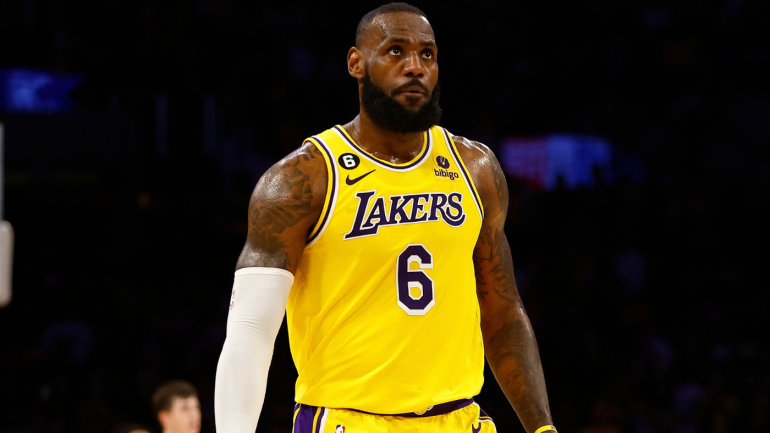
LeBron James will be remembered as the victor in his war of words with Dillon Brooks. It'd be hard for him not to be considering the way the series ended. The Los Angeles Lakers stomped the Memphis Grizzlies by 40 points in the Game 6 clincher on Friday night. Brooks had nearly as many fouls (20) as field goals (24) and he had half as many ejections (1) as wins (2). Brooks may be humiliated right now, but that doesn't mean he was wrong. At least, not entirely.
He probably shouldn't have poked the bear, and he certainly looks foolish after declaring his desire to play a Lakers team that just beat him, but Brooks challenged James to "come and give me 40." The 38-year-old James didn't need to, of course, but it's not as though he came especially close, either. James topped out at 28 points against the Grizzlies, a fine total for a mortal, but hardly up to his own absurd standard.
It was just the sixth time in his career that he has failed to reach 29 points in a playoff series. He's played in 51 of them. The others were a combination of his worst defeats (the 2007 and 2011 Finals) and his biggest blowouts (two 2016 sweeps and a five-game 2013 win over Chicago in which Miami's average margin of victory was over 18 points).
Dig a bit deeper and you could argue it was the worst playoff series James ever won. His average of 22.2 points per game was the third-lowest average of his playoff career, beating only the 2007 and 2011 Finals. He averaged only 5.1 assists per game against Memphis, his fewest in a playoff series since the 2014 Finals. He hadn't won a playoff series shooting below 50% from the field since 2016, but did so against the Grizzlies. The Lakers posted a plus-14 net rating with James on the bench against Memphis. That was the highest figure on the team.
The raw numbers should regress to the mean. James averaged 11.4 potential assists per game against the Grizzlies, but his teammates just missed the shots he created. James shot 19.5% from 3-point range in those six games. Take him up to his career average of 34.5% and his scoring average jumps to a hair above 25. LeBron is going to get his numbers no matter. It's the way in which they're coming that should concern the Lakers right now.
James scored as many points on putbacks against the Grizzlies as he did in isolation, according to Synergy Sports: 16 apiece. He ran pick-and-roll so rarely that he scored just 10 total points out of that action against Memphis, and what's worse, he did so on dreadful efficiency at just 0.588 points per possession. For perhaps the first time in his career, LeBron James struggled to create his own shots.
The difference between this version of James and the one who last faced the Golden State Warriors in the playoffs is enormous. The shot-creation numbers are essentially the difference between the greatest player of all time and a trigger-happy sixth man.
| 2018 Playoffs LeBron | 2023 Playoffs LeBron | |
|---|---|---|
Isolation field goal attempts per game | 8.3 | 2.3 |
Pick-and-roll field goal attempts game | 5.5 | 2.2 |
Possessions ending in a James pick-and-roll per game | 14.7 | 7 |
The one-man army who stormed into Oracle Arena five years ago and nearly beat the the Warriors by himself with 51 points, eight rebounds and eight assists? That guy might be gone for good. In his current state, James largely doesn't create his shots, he finds them.
Over a quarter of James' first-round points (34 out of 133) came in transition. As counterintuitive as it might sound for an older player to be running more than ever, this is the continuation of a multi-year trend for James. He averaged around 3.3 field goal attempts per game in transition between 2005 and 2021, never going above 3.7 or below 2.7 in that span. But last season, he took a career-high 4.6 shots per game in transition, and he pushed that figure all the way up to 4.9 this season.
External factors played a part in that shift. The league is faster now than it was at his peak, and with Russell Westbrook clogging the paint, the Lakers needed to take easy points on the break wherever they could find them. But James did as well. He averaged over 13 drives per game at the peak of his powers. Even before Westbrook's arrival, he was down to 9.5 per game in 2021. Transition was a reliable way to make up for points age was depriving him of in the half-court, so he pushed the pace whenever possible.
A more predictable product of aging has been his increased reliance on spot-up shots. He took a career-high 2.5 of them per game this season, more than double his average in his last Cleveland season. He was struggling to make them even before his 8-of-41 3-point shooting debacle against the Grizzlies. James shot 32.1% from 3-point range this season, his lowest mark as a Laker, and it's not to attribute those struggles at least partially to his persistent foot and ankle injuries.
James is missing short frequently this season, and one of his favorite shots has all but abandoned him: the ultra-deep bomb. James shot 35.2% on 3-pointers at least 27 feet away from the basket over the five seasons before this one, a number that undersells just how important those looks are. They're backbreakers, devastating opponents and engaging the crowd. James frequently uses them to punctuate successful stretches, but they're also an important spacing tool. By taking those shots and making them, James forces defenses to guard them. Give even the older James 27 feet of runway and he's still a lethal driver. He attempted more of them this season (113) than he did in his four years with the Heat combined (87), but made only 24.8% of those looks.
He's tried to make up for that shooting dip by mastering the art of cutting. He scored just under 1.8 points per shot attempt off of cuts this season, ranking him seventh overall in the NBA in cut efficiency. The younger James took those points as they came. He held the ball so often that when he didn't have it, he frequently dedicated possessions to rest. The older version hunts those looks by watching his defender's eyes. The moment he looks away and the ball-handler has an angle, he bolts to the basket. Once he's committed to a slot cut there's not much a defense can do to stop him.
These adjustments are a testament to just how much James has adapted his game to combat the aging process, but they're all meant to supplement what James does on the ball. None of this matters in a world in which James can't get by Xavier Tillman one-on-one. If his injured foot mutes his individual creation to the degree it did against Memphis, the Lakers are going to lose to Golden State.
That's the nature of high-level playoff basketball. Paces slow to a crawl. Defenses figure out your off-ball actions and game-plan around them. Small skill gaps become glaring weaknesses. Kevin Durant, a two-time Warriors champion, said so himself in 2019. "We can totally rely on only our system for maybe the first two rounds. Then the next two rounds we're going to have to mix in individual play," Durant told The Wall Street Journal. "We've got to throw teams off, because they're smarter in that round of playoffs. So now I had to dive into my bag, deep, to create stuff on my own, off the dribble, isos, pick-and-rolls, more so than let the offense create my points for me."
The Warriors have someone right now who can create in that way. Stephen Curry just willed Golden State into the second round with the first ever 50-point Game 7. Ironically, James' offense was once the best defense any team could play against him. LeBron frequently switch-hunted Curry in the Finals not only to score an easy mismatch, but to tire him out so he couldn't score as effectively on offense. It's not a coincidence that Curry never won a Finals MVP playing against James.
Despite Brooks' protests, we've seen James turn back the clock when he's needed to this season. He averaged just under 35 points per game during the six weeks or so Anthony Davis missed in December and January and created most of his own looks in the process. We even caught a glimpse of it at the end of Game 4, when James summoned his younger self for the final possession to score over Defensive Player of the Year Jaren Jackson Jr. and tie the game.
Doing that for a possession is one thing. Doing that for a series, while injured, is quite another. It isn't clear right now just how much James has left to give the Lakers, but if it's as little as he had against the Grizzlies, they aren't going to stand much of a chance against Golden State. He knows from experience just how unforgiving the Warriors can be. He may not have dropped 40 on Brooks, but he's probably going to need to come close a couple of times if the Lakers plan to win four out of seven against the defending champions.