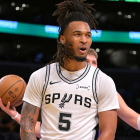

Nets preview: Two questions on Brooklyn's rebuild with D'Angelo Russell, Jeremy Lin
The Nets need to keep building their culture while identifying players who can be a part of their core

•
3 min read

NEW YORK -- The Brooklyn Nets are still in the early stages of rebuilding, stuck without their own first-round pick for another year and trying to slowly cobble together a roster that can be competitive in the coming years. They acquired the divisive but gifted guard D'Angelo Russell in an offseason trade with the Lakers, and they raised their payroll significantly by taking on the contracts of sharpshooter Allen Crabbe, big man Timofey Mozgov and 3-and-D guy DeMarre Carroll. Here are the two big-picture questions that will determine whether or not the Nets' 2017-18 season will be a success:
1. Can they build on the good parts of last season?
Stop laughing, there were good parts. Routinely, opposing coaches at Barclays Center praised them for how hard they played and how well-prepared they were. Sometimes, those same coaches would wind up ripping their own teams for not matching Brooklyn's intensity. The 2016-17 Nets might have been sloppy, lacking in star power and terrible defensively, but they were a fun bunch. No team in the NBA played at a faster pace. Few teams attempted 3-pointers with as much regularity. Coach Kenny Atkinson obviously didn't have the personnel to turn them into the 60-win Atlanta Hawks, but Brooklyn at least tried to play that way.
The challenge now is maintaining the good vibes in what is surely going to be another losing season. Brook Lopez, their best player and the adult in the locker room, was traded to Disneyland in the move that brought in Russell and Mozgov. Nobody knows how Jeremy Lin and Russell will work together. There is not a clear and obvious hierarchy in terms of minutes or playmaking responsibility. Atkinson needs his team to be unselfish and cohesive in order to simply avoid blowout losses, and keeping everybody happy will be a challenge.
At media day, reserve guard Spencer Dinwiddie announced he plans to auction off game-worn gear after every Nets game, using the proceeds to fund a four-year scholarship program. He said he was comfortable doing this because he felt he was more secure with his position in the league than ever before and expected to play in all 82 games. Given that he was effective on both ends last season and plays for a lottery team, this is a reasonable expectation … except for the fact that he will be competing with Isaiah Whitehead and Sean Kilpatrick for minutes in the backcourt behind Lin and Russell.
The small forward spot is interesting, too: Would Atkinson consider bringing Crabbe (and his $19.3 million salary) off the bench behind promising second-year wing Caris LeVert? Every coaching staff has to deal with players who want more playing time, but this could be particularly tricky because so many players are similarly skilled.
2. Who's going to pop?
"Pop" is my new favorite word in the NBA lexicon. It refers to a young player establishing himself as a reliable part of a team and a valuable commodity around the league. For Russell, the most obvious breakout candidate it would mean making good on the potential that led the Lakers to draft him with the No. 2 overall pick, scaling back his shot-jacking and becoming one of the league's more efficient pick-and-roll players. For Crabbe, it would mean becoming more than just an excellent shooter -- he needs to be at least an average defender and a willing playmaker if his contract is ever going to be seen as team-friendly.
If there is an exciting part of being a Nets fan, it's that there are a bunch of unknowns here. Maybe Rondae Hollis-Jefferson can find his niche as a playmaking 4; maybe rookie Jarrett Allen can be the next Clint Capela; maybe LeVert will be able to create offense out of the pick-and-roll; maybe Whitehead will fix his jumper and make his frenzied forays to the basket more dangerous. Atkinson's staff will be focused not only on finding lineups that work together, but helping these individual players improve to the point where one or two of them can credibly be called part of Brooklyn's core.
Ever since Sean Marks took over as general manager, the Nets have made smart gambles on players with upside. Kilpatrick, his very first signing, is still with the team about 20 months after signing a 10-day contract. Others, like former No. 1 overall pick Anthony Bennett, did not last long. Unlike teams with loftier short-term goals, Brooklyn has had the luxury of giving these guys legitimate playing time and seeing what they can do. Now that the roster has more players who have shown they are rotation-caliber, it's more a matter of finding out who deserves to be in the front office's long-term plans.