
Pelicans' Austin Rivers is focused on working to prove he should play
After a strong debut by New Orleans Pelicans' Austin Rivers in the 2013 Las Vegas Summer League, the young guard wants to prove he belongs.

By
Zach Harper
•
5 min read
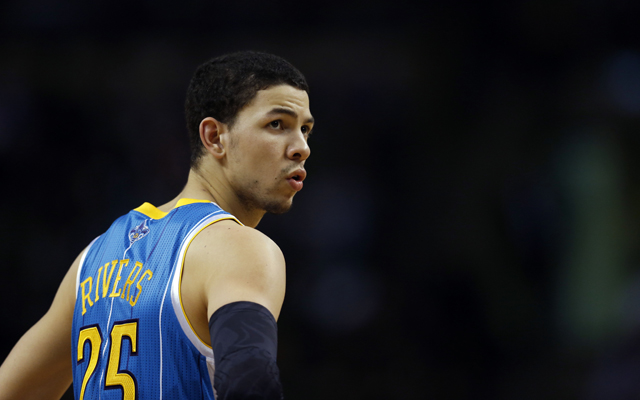
LAS VEGAS -- The early history revisionism of the perception of what Austin Rivers was supposed to be has been fascinating. As a high school player, the scoring machine from Winter Park High School in Florida was a can't-miss prospect. This seems to have been forgotten in the two years since he went from destroying ankles after homeroom to struggling to justify the hype at Duke to looking overmatched in his rookie season in the NBA.
The New Orleans Pelicans have loaded up on the position Rivers plays. Since drafting Rivers with the 10th pick in the 2012 NBA Draft, New Orleans has matched a max offer sheet to retain shooting guard Eric Gordon, traded two draft picks to bring point guard Jrue Holiday to the team this summer and signed ball-dominant wing Tyreke Evans. Considering his team sold him as a combo guard who could play both positions, it doesn't seem like Rivers is directly in the plans of the Pelicans just one year after they brought him aboard.
But that won't deter Rivers from working to prove he should be playing, even if he isn't given the chance. Rivers is playing for his team's summer league squad, looking to show that last season's struggles were an aberration and that he'll be fine earning playing time.
"It doesn’t intimidate me at all," Rivers said when asked about the Pelicans' offseason moves to load up the backcourt. "At the end of the day, I just have to go out there and work. If I’m there and there’s a lot of guards there, that means I have to work even harder."
Rivers knows he struggled last season. He knows the hype given to him as a prospect wasn't justified just because he made it to the NBA. He was supposed to make the league. What he wasn't supposed to do was have one of the worst rookie seasons in NBA history. No rookie in NBA history ever played as many minutes (1,418) as Rivers did and ended up with a PER (5.9) as low as what we saw from the one-and-done Duke Blue Devil. Whether you buy advanced stats or not, there is no positive way to spin a PER of 5.9.
He needed to change a lot of things. He needed to figure out the speed of the game and work on making his off-hand more of a weapon. The Pelicans gave him a list at the end of the season of what he needed to improve on.
“They gave me a list; it’s kind of like a discharge paper of what you need to work on when you come back," Rivers explained after putting up 24 points, seven rebounds and six assists in his team's summer league win. "That was basically it right there.
"One is to trust my work. Everyone knows how hard I work. When I go on the floor, sometimes I can be too unselfish. They want me to go out there, be aggressive within the team’s concept, and just be aggressive and have fun. Don’t think too much."
The speed of the game was also something he needed to figure out. As a rookie, he looked overwhelmed on the court. He couldn't make shots inside; he made just 48.9 percent of his shots at the rim (league average is 64.9 percent). He made just 22.0 percent of his long 2-point shots when the league average is 38.9 percent. He couldn't find the flow of the game until right before he broke his hand in early March and by then, his season was over.
When I asked him if the speed of the game was overwhelming for him as a rookie, he said, “It was in the beginning. I went through a rough stretch last year where I sat a lot of games and it gave me a chance to actually reflect and look at my games, at what I was doing wrong.
"I was going 100 miles per hour every time I had the ball, and that doesn’t work at this level. They can just read that and it’s too easy to guard. Towards the end of the season, right before I broke my hand, I started to play a lot better. That’s because I started changing speeds, relaxed, and let the game come to me. I ended on a good note. That’s why I’m very confident in myself now. I broke my hand, which gave me a chance to work on my left. I worked my butt off this summer.”
In his first summer-league game of 2013, he showed much better body control and balance around the rim. He showed a willingness to include teammates in an effective way. He played the type of game you would expect from someone who was a top prospect just two years ago. But how does Rivers show that not only is he ready to contribute but that he should be playing in such a crowded backcourt?
"All I can do is work," Rivers said. "I can’t tell them, ‘He needs to get off the team or I need to be traded here.’ All I can do is work hard and I’ll let the coaches and all of them handle all that stuff. I expect wherever I go, I know I’ll be playing because I know I’m going to work hard and outwork anybody.”
Most fans and pundits seem to have already written off Rivers' future as nothing but negativity and brevity in the NBA. It's gone so far against how the perception of his future used to be that it's now changing how people used to feel about him. He can't really concern himself with that now, though.
All Rivers can do is continue to work and try to prove that the early hype was legitimate -- even if you don't want to remember that the hype was indeed there.