
Road to the NBA Finals: The Raptors are better than ever, but is that good enough?
Led by Kyle Lowry and DeMar DeRozan, last year's runner-up in the East is trying to dethrone the King

•
6 min read

Last year’s Toronto Raptors earned a franchise-best 56 wins in the regular season, won a playoff series for the first time since 2001 and advanced to conference finals for the first time ever. It was a feel-good story but it almost wasn’t a story at all. Without a miraculous fourth-quarter comeback, the Raptors would have fallen behind 3-2 in the first round against the Indiana Pacers. They needed seven games to beat Indiana and seven more to squeeze by the banged-up Miami Heat after that.
After losing in six games to the eventual-champion Cleveland Cavaliers, they were lauded for their resilience. Few expected the Raptors to tie the series at 2-2 in Toronto, and no one called the season anything but a success. Still, big-picture questions remained: Where could the Raptors go from there? How could they close the enormous gap between themselves and the Cavaliers?
Entering the 2017 playoffs, it looks like the Raptors have indeed made up some ground. Let’s take a look at where they are and what lies ahead.
So, how exactly did Toronto build on its best year in franchise history?
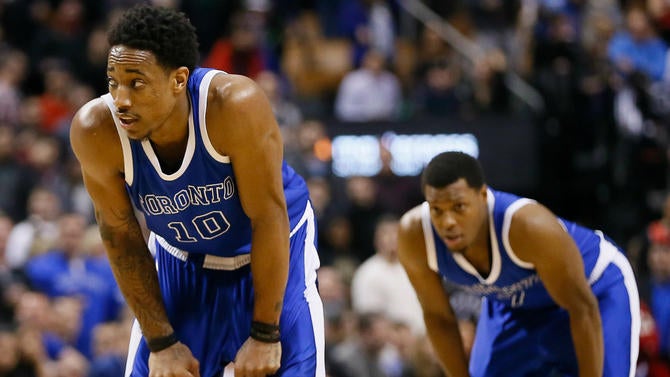
For the first time since Dwane Casey arrived, the Raptors won’t surpass the previous season’s win total. To say that they haven’t improved, though, would be flat-out wrong. After signing a near-max contract, DeMar DeRozan started the season on a historic scoring tear and is poised to end it playing the best all-around basketball of his career -- yes, his passing and defense have both improved. Fellow All-Star Kyle Lowry missed 21 games because of a wrist injury, but his numbers -- 22.6 points, 7.0 assists, 4.8 rebounds, 1.5, steals, 62.3 percent true shooting percentage -- have never been better. Together they account for the bulk of the team’s playmaking, and they fueled the league’s top offense -- yes, even better than the Warriors -- through mid-January.
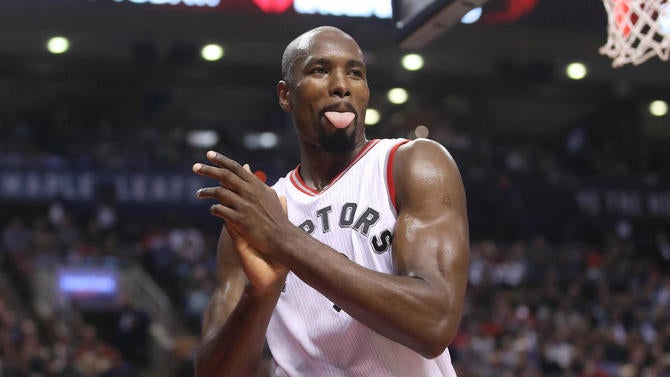
Even more meaningful than the backcourt’s continued ascension were the midseason acquisitions of Serge Ibaka and P.J. Tucker. The two of them provide defensive acumen and toughness, and they have transformed Toronto into one of the most versatile teams in the NBA. In a league that increasingly requires big men to be able to make 3s and switch onto guards, Ibaka has been a godsend. Tucker can play smallball 4, and he will likely be the primary crunch-time defender on LeBron James if and when the Raptors see him again. Their arrival has pushed players like Norman Powell, Jakob Poeltl and Lucas Nogueira to the fringe of the rotation or out of it entirely. Never in the Raptors’ 22-year history have they had a roster this deep.
Wait, weren’t they struggling on defense?
Yes. Heading into the All-Star break, this was a major concern. Toronto was a mediocre defensive team until the trades were made, and a lot of it had to do with roster composition. Patrick Patterson is the type of smart, selfless player every team would be happy to have playing power forward, but he was the Raptors’ only reliable player at the position. When he was hurt in January and February, Casey had to play rookie forward Pascal Siakam major minutes, go small or try two-center lineups with Nogueira or Poeltl playing next to Jonas Valanciunas. None of these options worked particularly well, and, barring injuries, you won’t see them again.
Toronto has had the league’s third-best defense since the All-Star break, and it is now one of the most balanced teams in the league. Overall the Raptors are sixth in offensive rating and ninth in defensive rating, one of only three teams (Warriors, Spurs) to be top-10 in both categories. Again, this is all about the midseason acquisitions:
- The Raptors are a different team with Ibaka playing center. They have outscored opponents by 11.6 points per 100 possessions when he’s on the court without Valanciunas.
- Tucker is a game-changer. Toronto has held opponents to 99.2 points per 100 possessions with him on the court. For reference, the Spurs’ league-best defense allows 100.9 points per 100 possessions.
How do they stack up against the other challengers to Cleveland’s throne?
Boston will finish with a better record and Washington might not, but that doesn’t mean there’s a ton of differentiation between these teams based on regular-season performance. If Toronto has an edge, it’s because it can play multiple ways. Against the Celtics, Valanciunas’ size and rebounding could be the difference. Against the Wizards, Ibaka’s shooting could render big men Marcin Gortat and Ian Mahinmi unplayable.
It’s not hard to imagine Marcus Smart and Avery Bradley giving Lowry and DeMar DeRozan fits. It’s not a huge stretch to picture John Wall and Bradley Beal outplaying them, either. I’d argue, though, that the Raptors have more playoff upside. Lowry only returned for the last week of the season, so the NBA hasn’t really seen what the best version of this team looks like. In theory, the combination of their elite offense in the first half of the season and their elite defense after the trades can’t be matched by the Washington or Boston.
Toronto will still have skeptics, though, based not only on Lowry having to find his rhythm quickly but because the team has underperformed on offense in the past few postseasons. Before the Pacers and Heat gave the Raptors trouble last season, they were swept in 2014-15 by a Wizards team that blitzed their ballhandlers and kept them off the free-throw line. Toronto should be well past that kind of meltdown by now, but it is going to have to prove it. That starts in the first round, where the Raptors could face a Bucks team that plays the most aggressive defensive style in the NBA. If that’s the matchup, then ball movement and decision-making will be crucial.
OK, but what about the Cavaliers?
The most important question might be which version of the Cavs shows up. If they are as dialed-in as they were in last year’s playoffs, then even a near-perfect performance by Toronto might not be enough. It has been rare, however, to see Cleveland play like that since the early part of this season. If the Cavs are sloppy defensively, then their advantage when it comes to star power is suddenly a lot less daunting. Lowry and DeRozan have both had big games against the Cavs in the regular season, and if their supporting cast is knocking down shots, the Raptors could be a serious threat.
On the other end, Cleveland presents a basic problem: James is one of the smartest playmakers in the league, and the front office has surrounded him with excellent shooters. That’s difficult for anybody to defend, but at least this version of the Raptors has a better chance than last time. Remember how effective Ibaka was against the Warriors in last year’s conference finals? He’ll need to be flying around the court like that again. Tucker, Patterson and DeMarre Carroll will likely both spend some time on James and some time on Love. Toronto could get torched again, but it has more options than most other teams do.
LeBron James hasn’t lost a series to an Eastern Conference team since 2010. The team that employs him will and should be favored all the way until the Finals. The Cavs appear more vulnerable than they were this time last year, though, and the Raptors have done all they can to put themselves in a position to challenge them.