The Hassan Whiteside problem and solution for the Charlotte Hornets
The Heat center dominated the interior but Charlotte can find an answer for him.

By
Zach Harper
•
8 min read

The Charlotte Hornets don't have a rim protector and their All-Star interior presence is becoming less and less of a focal point in their offense. Steve Clifford's team has made a dramatic improvement on offense this year by dramatically increasing the number of 3-pointers they're generating as a team. And he's had one of the top defenses during his three years in Charlotte despite never having a primary rim protector playing heavy minutes.
The concepts of spacing and playing defense on a string as a unit are things Clifford's teams just have down. He doesn't believe you need guys who get a ton of steals and block a lot of shots. He thinks those stats are completely overvalued when talking about defense. Take care of the ball as a team and stick together on the other end of the floor -- those are the core tenets of Clifford's squads.
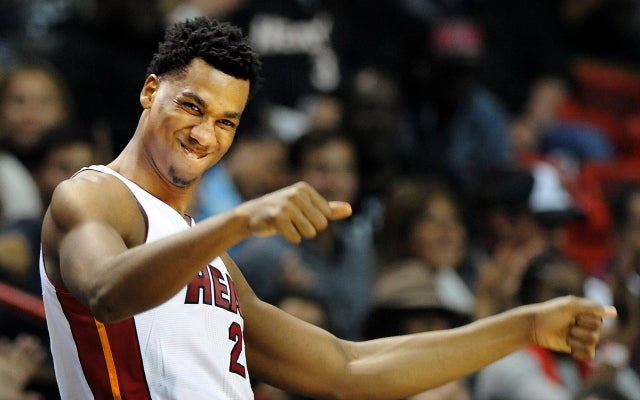
Charlotte has a big problem though in their first-round playoff series against the Miami Heat, and that problem's name is Hassan Whiteside. There has been plenty of debate over whether or not Whiteside truly impacts the game in a positive way for the Heat or if he's just putting up hollow stats while the team plays better basketball with him on the bench. However, Game 1 of Heat-Hornets blew up the concept of the Hornets not needing an interior presence and Whiteside not having a dramatic impact.
Whiteside's 21 points, 11 rebounds, and three blocked shots in 29 minutes resulted in a plus-19. The Hornets couldn't figure out how to defend him or the Heat when they put their big man into a pick-and-roll. On defense, there were times in which it looked like the Hornets simply were guessing on how to score against him inside. It's part of why Miami's 123-91 rout over Charlotte made what's expected to be a competitive series in the East look entirely one-sided.
WHITESIDE IS TOO BIG FOR THE HORNETS ON OFFENSE
The Hornets have a stable of big men to throw at Hassan Whiteside. Cody Zeller started the game next to stretch-4 Marvin Williams, but Clifford can also go to Al Jefferson, Frank Kaminsky, Spencer Hawes, or Tyler Hansbrough at any time. The problem though is none of these guys are big presences inside on defense. They play into what Clifford wants the Hornets' bigs to do quite well, but when they're faced with the challenge of handling Whiteside, things go awry.
The majority of Whiteside's damage was done in the pick-and-roll. Charlotte was 17th in points per possession allowed against pick-and-rolls (including passes) this season, which is fine. But against Whiteside, they seemed completely lost. In the six plays in this video below, there are times in which Whiteside is matched up with a help defender who is simply too small to slow him down, but often he's left open without any backline defense.
This is particularly confusing when looking at Charlotte's defense because it's not like they have to worry a ton about a Miami team that is bad at shooting from the outside. They should be able to dig into the middle of the lane, keep Whiteside from getting near the hoop, and either push him into a tougher hook shot from farther away or recover to a shooter on the perimeter.
Instead, far too often we saw broken coverages as help defenders refused to leave open Luol Deng, who was having an incredible game. Living with Deng hitting midrange shots instead of allowing easier looks at the basket seems like the way to go, but Charlotte could never get organized enough to make the proper correction in its scheme. They just left small people hoping Whiteside would get distracted by a shiny object and forget what he was supposed to be doing in those moments.
Whiteside scored 13 points on eight possessions in the pick-and-roll, which essentially makes him a human wrecking ball.
The running theme of the night for Whiteside vs. the Hornets was just that they were too small to deal with him. In the three plays below, Whiteside is either too strong or too big for the competition. Hornets players are bouncing off of him left and right on catches in the paint and offensive rebounding opportunities. Each time it's a demoralizing bucket that makes them feel diminutive.
Whiteside wasn't just a beast on offense though. His shot-blocking presence was felt as well, mostly because of mistakes made by the Hornets.
WHITESIDE WAS A SHOT BLOCKING PRESENCE THANKS TO SOME BAD SPACING
It's not necessarily bad to challenge a shot blocker. Some people believe the best way to deal with a great rim protector is to get into the chest of that big man and create space and an advantage for yourself from that contact. Others believe you need to do everything you can to force them away from the basket, which is what the Hornets typically do, in theory. They just didn't do it in Game 1.
The Hornets' biggest mistake in challenging Whiteside is they never made him change directions. He was able to camp out around the basket and treat the restricted area like he had a velvet rope and a clipboard, and you aren't on the list.
Check out these three blocks by Whiteside:
The Hornets were entirely ineffective on offense, and while you don't want to take away anything from the Heat and their game plan, it's pretty clear from the video above that the Hornets just didn't pay attention to details when executing their offense.
In the first play of the video, Williams and Nicolas Batum are standing next to each other like infielders talking during a pitching change. To compound that problem, it looks like Courtney Lee panics with the ball as Whiteside approaches him on the drive. Instead of forcing Whiteside to commit to stopping him, he never makes him move away from the hoop. He should be going up for the layup and trying to pass around Whiteside to a cutting Zeller. Instead, he gives Whiteside enough time to react.
The second and third plays are enough to drive you crazy if you're wanting the Hornets to put up a fight. Right before the second block, you'll notice Batum is in no man's land and Kemba Walker isn't much better off. Batum should either be diving behind Whiteside for a pass or moving back to create a spot-up 3-pointer option. It would help him do either if Walker would move to the right corner and create another passing lane for Williams. Instead, the spacing is off and Hassan gets a block.
We see something similar on the third block. You're not going to have Jefferson spot up from the perimeter, but if he dives into the paint, Joe Johnson is forced to collapse and Courtney Lee, who should be in the right corner, would have an open look. Instead, the offense and spacing are constipated.
HOW CHARLOTTE CAN IMMEDIATELY MAKE WHITESIDE AND MIAMI UNCOMFORTABLE
There is hope for Charlotte on offense though and it has everything to do with creating good 3-point looks at the expense of Whiteside. The Hornets are a 3-point heavy team. From last season to this season, Charlotte not only took more than 10 3-pointers per game than the previous year, but they also went from being the worst 3-point shooting team (31.8 percent) to eighth most accurate team (36.4 percent). That's a massive evolution in their offense simply due to Clifford recognizing where the league is headed and deciding to join them.
However, in Game 1 the Hornets didn't do this. They took the fewest shots from beyond the arc they've taken in any game this season. They attempted just 17 and their previous low was 19 (twice against San Antonio). They also made just six 3-pointers in the game, and have been held to six or fewer makes nine times this season. They're now 2-7 in those games. They need to take 3-pointers and they need to take a lot of them.
The way to increase those shots and the quality of those shots is putting Whiteside to work in an area of the floor he's not comfortable defending. There were several times in Game 1 that Charlotte made Whiteside defend a pick-and-roll on the perimeter and ended up with a great 3-point look. Whether they made them or missed them, these were the looks they needed to manufacture more often.
Whiteside can't defend the pick-and-roll well. The same goes for Amar'e Stoudemire. You see in the video above that Whiteside is dropped way back into the paint. Any decent screen by the Charlotte bigs on the play will result in a quality 3-point look coming off that pick. Whiteside is too slow to be able to react to taking away the shot and then recover to the paint where he's supposed to protect the rim.
Earlier in the season, the Utah Jazz put him into a lot of pick-and-roll situations, and they had great success against him in doing so. Their plan was to make him less effective by forcing him away from the hoop and it worked. The Hornets can do the same thing. If he does cheat out to prevent the 3-point look, Walker or Batum or Lee or Jeremy Lin can then blow by him and force the defense to collapse or stay out on shooters. This results in either a layup or a great look on the pass out to the perimeter.
It will cause the defense to crumble with Whiteside in the game. It also will probably then open up the corner 3-point looks. Of their 17 shots from deep in Game 1, only one of them came from the corner and it missed. The other 16 were above-the-break attempts. The Hornets were just 20th in corner 3's made this season, but they shot them at a 41.1 percent clip. Only the Kings, Clippers, and Warriors were better.
Charlotte needs to make the advantages of Whiteside become disadvantages. They may not be able to stop him on offense, but by forcing him into bad situations on defense, they may trick Erik Spoelstra into subbing him out of the game to keep the defense tight. If that happens, the Hornets will have solved the Whiteside problem while remaining to keep a style of play that helped them be successful all season long.