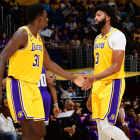

The Lakers' case for and against keeping Thomas Bryant in starting lineup when Anthony Davis returns
Bryant has thrived at center during the Lakers' recent winning streak

By
Sam Quinn
•
8 min read
It sounds almost impossible considering how well he played when healthy, but the Los Angeles Lakers actually have a better record in the games that Anthony Davis has missed than the ones he has played. With nearly half of the season in the books, the Lakers are 8-7 without Davis and 11-14 with him. This says nothing about Davis, of course. He's been one of the NBA's best players when healthy. Lately, though, his replacement hasn't been far off.
In 14 starts this season, Thomas Bryant is averaging over 16 points and just under 10 rebounds per game. He currently has the second-highest restricted area field goal percentage in the NBA among players taking at least four shots there per game at 79.8 percent, and yet he also manages to make just under 59 percent of his mid-range attempts and has hit 14 of his 30 looks from 3-point range. For the past two weeks, Bryant has been one of the very best offensive big men in the NBA.
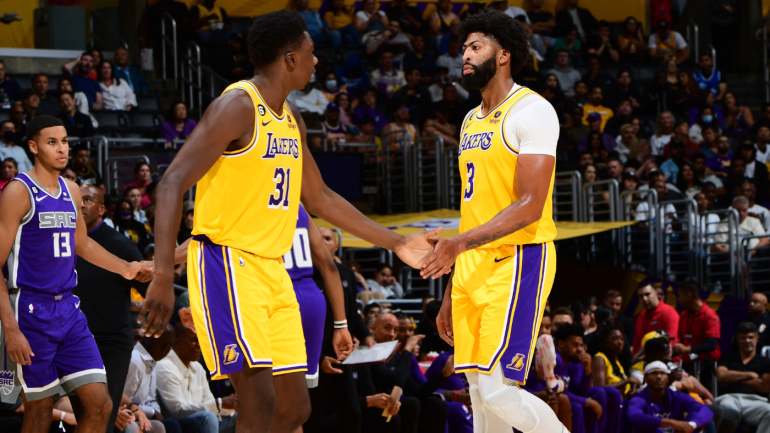
That creates a bit of a dilemma for the Lakers, albeit an enviable one: they already have one of the best offensive big men in the NBA in Davis. Few teams devote major minutes to lineups featuring multiple big men. When Davis returns, his minutes are safe. Yet Bryant has played so well that benching him hardly seems appropriate either. Even if multi-big lineups are suboptimal, can a team with eight minimum salaries on its roster really afford not to start the man who has pretty clearly been the second-best player during their longest winning streak?
There's not an easy answer here, so let's look at the pros and cons of keeping Bryant in the starting lineup and moving Davis down to power forward upon his return (which could happen before the Feb. 9 trade deadline) before ultimately settling on the proper course of action.
Why Bryant should keep his starting job
The obvious answer here is that Davis would probably prefer it. He's spent years stating his preference for the power forward position under the theoretical logic that it helps keep him fresher. Whether or not that is true is debatable. Here's what isn't: the Lakers were running Davis into the ground before he got hurt. He played 46 minutes in his last healthy game. If something might keep Davis upright into the spring, it's probably worth exploring. Bryant can supplement his minutes as a starter or a reserve, but the more minutes they spend together, the fewer Davis has to spend colliding with giants in the paint.
This approach has posed problems offensively in the past. It'd be less likely to now given the state of the Laker roster. Two-big lineups typically compromise spacing, but virtually every Laker lineup compromises spacing for Davis. The Lakers have used four different lineups featuring Davis for at least 90 possessions. Russell Westbrook is in three of them. Dennis Schroder is in the fourth, and he was shooting below 26 percent from deep before Davis went down. As a team, the Lakers shoot 33.3 percent from deep with Davis in the game. The spacing ship has probably sailed. Given his success in the mid-range and at least theoretical upside from deep, Bryant probably isn't limiting spacing much more than the guards that currently populate this roster.
He would have a number of other offensive benefits though. Despite their success scoring in the paint, the Lakers almost never grab offensive rebounds. They rank 25th in the league in offensive rebounding rate, and while some of that is the calculated choice to emphasize transition defense, pairing their two big men might at least drag them closer to league-average. The transition benefits would be more pronounced on the other end of the floor. A key feature of Frank Vogel's transition offense revolved around Davis leaking out on opponent shots and free throw attempts to create one-on-one post-ups.
Plays like this have been much rarer under Darvin Ham largely because the smaller lineups he's used simply can't rebound well enough to justify using Davis in this manner. Pair him with Bryant and suddenly they're back on the table. The Lakers are hovering around league average as an overall rebounding team. That probably improves meaningfully if Davis and Bryant play significant minutes together.
We should also point out that the starting lineup the Lakers put around Davis before his injury was largely failing. Their most-used starting lineup this season featuring Davis, Schroder, Patrick Beverley, Lonnie Walker and LeBron James was outscored by four points in 58 minutes. Sub in Troy Brown Jr. for Schroder and that figure balloons to 17 points in 42 minutes. If nothing else, starting Bryant would mean not starting lineups that weren't working.
And then there's the matter of lineup flexibility. Separate Davis and Bryant and you're practically guaranteeing that one of them must be on the floor at all times. And yet, purely based on the success of their lineups, neither has been the best Lakers center this season. That honor belongs to LeBron James. In over 500 possessions, James-at-center lineups have outscored Laker opponents by 7.8 points per 100 possessions this season, according to Cleaning the Glass. Do these lineups make sense against every opponent? No. But they play such a critical role in getting LeBron to the basket and finding a rhythm offensively that the Lakers should probably build their rotation with them in mind at least as a situational weapon.
Ultimately, while Bryant may not be an ideal fit with James and Davis, specifically, his presence does put the two of them in positions to succeed on balance. If that's the goal here, starting Bryant is a reasonable starting point.
Why Bryant should come off the bench
Just as we began the last section with the simplest answer, we begin here with the obvious: Davis has played over 1,700 possessions at center this season and only 29 at power forward, according to Cleaning the Glass. Now, in fairness, all 29 of those possessions came with Bryant and the Lakers played quite well in those possessions, but it's a tiny sample compared to two months of Davis dominating the league almost exclusively as a center. Why fix what isn't broken?
Davis might be able to maintain his performance as a power forward offensively. There's a good chance he wouldn't. Davis is taking only three mid-range shots and 1.2 3-pointers per game this season. That's down from 4.1 mid-range attempts and 3.5 3-point looks per game during the 2020 championship season, when Davis played mostly power forward. This is his natural inclination. Davis tends to want to take more jumpers than he should. He's not especially good at them. Even this season, he's at 29 percent from behind the arc and 41.3 percent from mid-range compared to 78.7 percent from the restricted area. Any lineup that encourages more Davis jumpers and less Davis layups is risky.
The defensive ramifications are more severe. The difference between what the Lakers were before Davis went down and afterward is startling: they've allowed 118.5 points per 100 possessions in the 12 games Davis has missed since getting hurt compared to 111.5 when he was healthy. That difference has largely come at the rim, where Laker opponents have shot just under 71 percent in the restricted area compared to the below 66 percent figure they held opponents to with a healthy Davis. Now, Davis can defend just about anyone. He's functioned as a primary rim-protector this season, but has done just fine as a weak-side helper in the past.
But Bryant isn't as versatile. He's not suited for perimeter duties and yet he struggles at the rim. A similarly pressing issue here is James, who almost has to play power forward defensively to preserve energy for offense. James largely guards shooters now, leading defensive communication from the back line without exerting the sort of energy he'd need to spend on higher-usage ball-handlers. He needs to save that energy for offense.
From a rotational standpoint, finding minutes for all of the Laker guards becomes difficult if they start big. Dennis Schroder, Austin Reaves and Lonnie Walker have all earned significant playing time. Russell Westbrook has as well, though he remains the most obvious matching salary if the Lakers pursue a deadline deal. Patrick Beverley has played well lately. Ham just can't quit Kendrick Nunn. The Lakers would prefer to have a wing or two in place of one of these guards. They don't. They've had to play extremely small this season. There's an argument to be made that starting Bryant would actually have a positive defensive impact simply by making the Lakers bigger. Regardless, this is an unbalanced roster. The best Lakers are largely the smallest Lakers. Even if the lineups don't always make sense, the goal here should be putting the best players on the floor as much as possible. Bryant himself might be one of those players, but extensive playing time complicates the path for others.
The Verdict
The regular season is about strengths. The playoffs are about weaknesses. We're in the regular season right now. Whether or not the Davis-Bryant frontcourt's strengths can outweigh its weaknesses is almost immaterial. The strengths are immense. That's what matters here and now. Bryant's presence would give the Lakers badly needed size in a number of areas without sacrificing much in the same way of spacing. For now, that's enough.
In the playoffs? It's suboptimal, especially on defense. But the playoffs aren't here yet. The Lakers can cross that bridge if and when they get to it. At that point, Davis will likely play almost entirely at center. He won't be able to do that if he doesn't get to the playoffs healthy. If Bryant provides him, the team and its fans a bit of peace of mind in the interim, then all the better.