Falcons burning question: How much of a leap will Dan Quinn's defense make?
Atlanta looks like it's loaded with young talent and could be a dangerous defensive team

By
Will Brinson
•
5 min read
The lasting image of the Atlanta Falcons defense from the 2016 season is not one of the defense at all. It's a shot of a victorious Tom Brady, holding the Lombardi Trophy after setting records for completions and passing yards en route to engineering the greatest comeback in Super Bowl history.
Atlanta's effort in the first half should not go unnoticed, however, because the Falcons performance offers a hope that the defense, in its third year under Dan Quinn, can become an elite-level unit stocked with young talent. More than one writer in that Houston press box had "Baby Seahawks" on their mind before Brady burned all the prewritten leads to the ground.
(The Falcons are back at training camp! Don't MISS anything as they prepare to try and return to the playoffs -- take five seconds to Sign up for our Free Falcons newsletter now!)
Prior to their Week 11 bye, the Falcons allowed 28.3 points per game to opponents. After the bye, they were a different unit entirely -- including the playoffs, the Falcons allowed just 22 points per game over the course of nine games.
| Points Allowed | First Downs/Game Allowed | Yards Per Play | Sacks | Turnovers | |
|---|---|---|---|---|---|
Before Week 11 Bye | 28.3 | 23.9 | 5.81 | 22 | 11 |
After Bye + Playoffs | 22.0 | 21.9 | 5.86 | 22 | 17 |
The playoffs portion is key too, because it would be easy to dismiss the Falcons as a team that got lucky with the late-season schedule. The Rams and 49ers were speed bumps last year, but remember the Falcons manhandled the Seahawks and Packers in the first two rounds of the playoffs and held Tom Brady to three points in the first half of a Super Bowl.
Late last year the Falcons were emerging as a legitimate defensive threat; only the yards/play number increased down the stretch. Otherwise this was an emerging defense with a lot of young talent.
The defensive line looked like a strength last year after being a major problem for the Falcons over the last half decade. Multiple misses in free agency and the draft meant a lack of a pass rush for Atlanta. The emergence of Vic Beasley, who led the NFL with 15.5 sacks, should signify a change in that status for a while. Beasley's shift to outside linebacker is more or less just a technicality -- in Dan Quinn's defense he's just an EDGE rusher looking to wreck havoc on quarterbacks.
Beasley's power is still developing but his speed is lethal and his athleticism is undeniable.
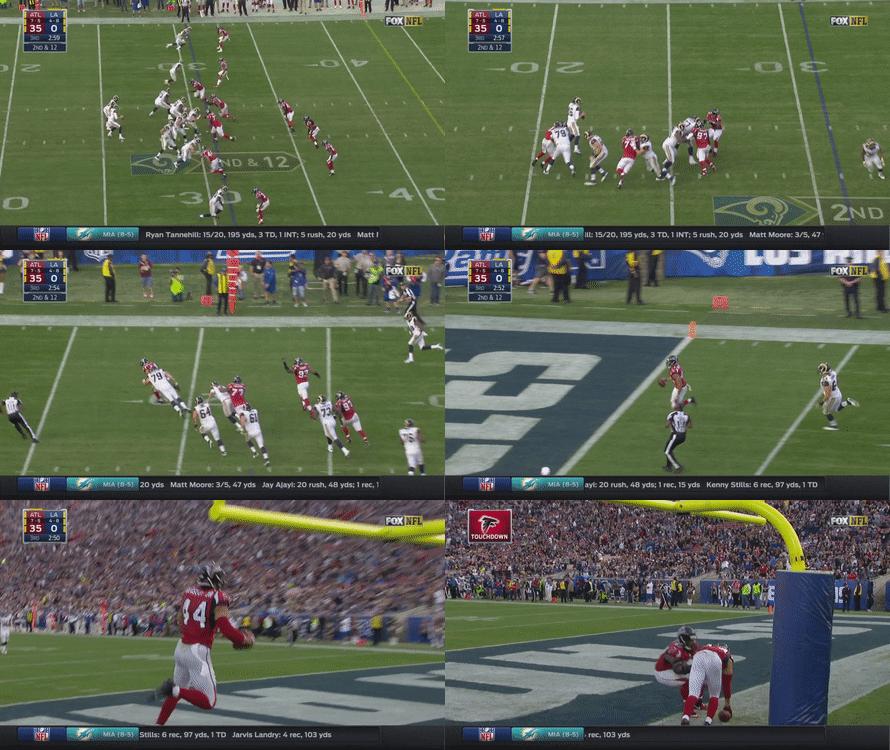
Grady Jarrett, like Beasley, was a productive player at Clemson. Unlike Beasley, he fell in the draft, with the Falcons scooping him up in the fifth round and plugging him in on the defense with his teammate. He has been, like Geno Atkins before him, a steal as an undersized defensive tackle who fell to the middle rounds of the draft. Jarrett dramatically improved in a role as a starter during his second season, and he came on like gangbusters in the Super Bowl when he sacked Brady three times.
Jarrett's first step is terrifyingly quick and he's got a ton of power for his size. He sort of looks like a poor man's Aaron Donald, which is not an insult in the slightest.
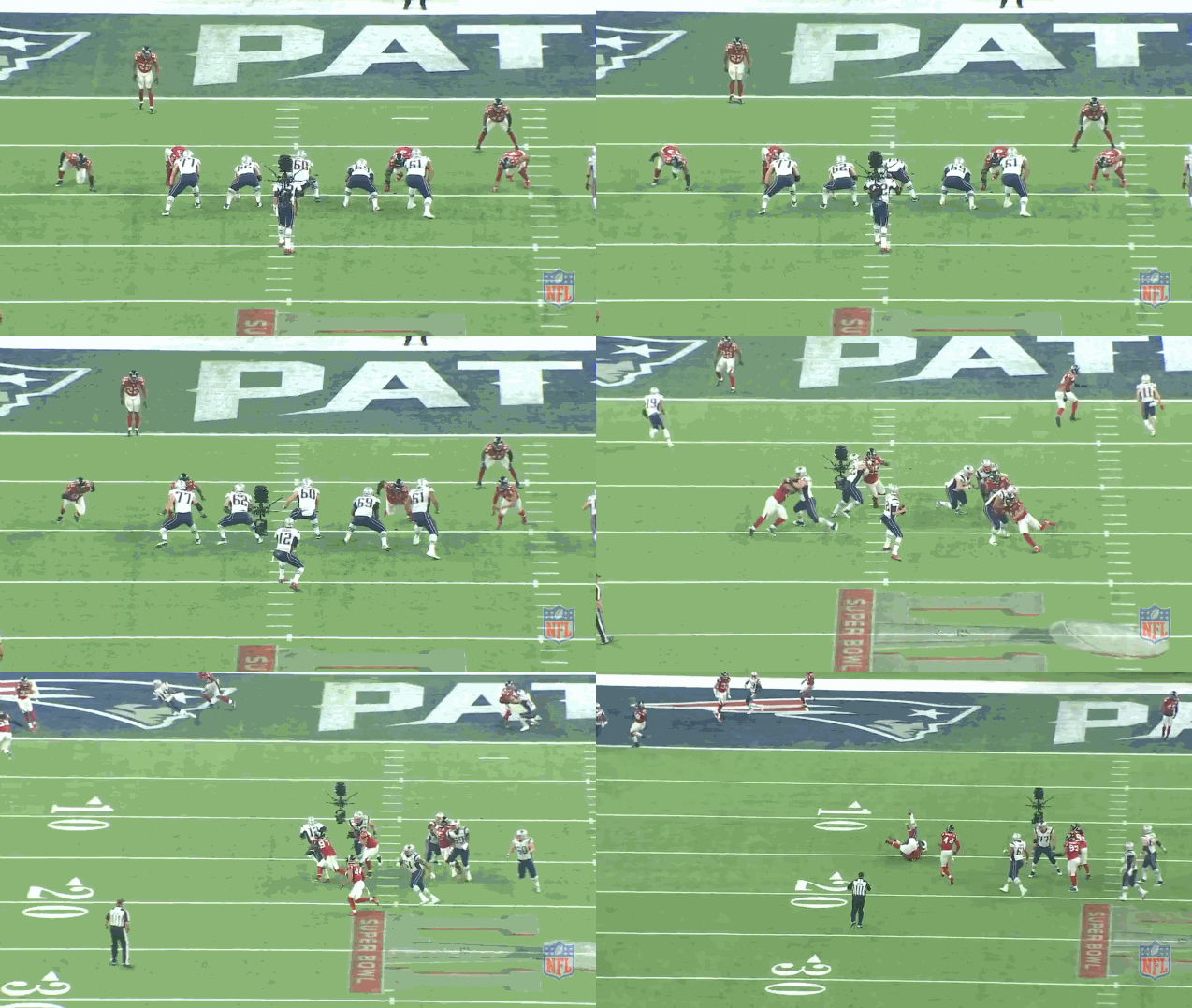
Jarrett is just a gamer, although it's worth noting that these sort of athletic players just fit well in Quinn's system. Like in Seattle, where Quinn served as defensive coordinator before taking the Falcons gig, there isn't a concern with positions so much as skill sets. The less standard the players are the more versatile and dangerous the defense can become.
Look no further than Deion Jones, who emerged last year as a do-it-all threat on Atlanta's defense. Jones finished the year with three interceptions (with 165 return yards and two touchdowns, most in the NFL), 11 pass deflections, one forced fumble and 106 tackles. He sparked the Falcons early scoring run in the Super Bowl thanks to a strip of LeGarrette Blount that would snuff out a Patriots drive and set up an Atlanta touchdown just two minutes later to give the Falcons a 7-0 lead.
He's a special, rangy player who can operate at any level of the field and gives Quinn flexibility on the defensive side of the ball.
In the secondary, the Falcons saw a slew of strong players emerge during their NFC Championship run last year. Robert Alford stepped up in the role as the No. 1 corner and made a key play late against the Patriots, picking off Brady and taking it to the house, a moment where the world absolutely believed the Pats were not winning the Super Bowl.
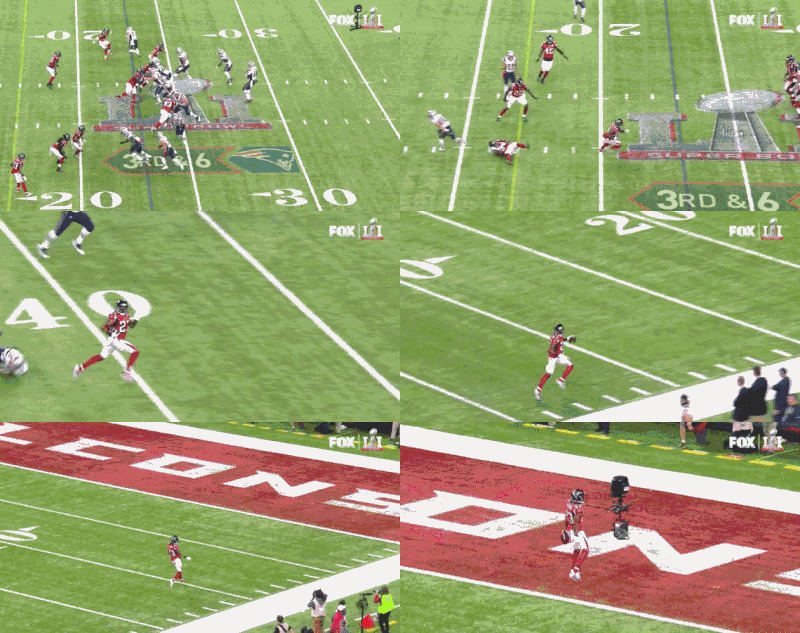
There's good news too: Alford doesn't have to be the No. 1 guy this year, thanks to the return of Desmond Trufant.
Scary to think of the fact that the NFC champion Falcons will soon get back one of their best coverage defenders pic.twitter.com/UtHNTyaABd
— Zoltán Buday (@PFF_Zoltan) July 6, 2017
This is pretty big, because Jalen Collins is going to miss 10 games with a suspension. Quinn hasn't said whether Collins will be back after the suspension, but it doesn't sound good for his future. Keanu Neal, the team's first-round pick in 2017, looks like a budding star on the back end as well.
The Falcons have a young, potentially elite talent base at all three levels of their defense. And they added Dontari Poe to the interior and Takkarist McKinley (another freaky, rangy athlete) as a pass rusher in the draft. You look at the starters on this defense and the majority made their way to Atlanta after being selected by Quinn in the draft during his first three years on the job.
Taking over a franchise and adding talent at this rate might be more impressive than Quinn's work as a coach. In the drafts alone, he has acquired Beasley, Collins, running back Tevin Coleman, wideout Justin Hardy, Jarrett (all from 2015), Neal, Jones, tight end Austin Hooper and linebacker De'Vondre Campbell (2016).
And there's plenty of precedent for a defense taking a huge step forward like that. Last year alone, three teams went from ranking in the bottom half of the league according to Football Outsiders to being top-10 units. The Giants bought their way to an improved defense, while the Ravens had a combination of breakouts from younger guys as well as veterans like Eric Weddle who improved the defense. The Chargers fared poorly in points per game allowed (29th) but did finish as 7th in terms of DVOA. Like Atlanta, they added a pass rusher in the first round and made some smaller maneuvers in free agency that panned out well.
The Falcons finished 26th in Defensive DVOA last season and ranked 27th in points allowed. Given the skill set of the young players on the roster, it would not be surprising if this team finished in the top 10 of both categories after the coming year.