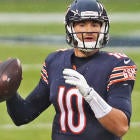
Mitchell Trubisky landing spots: Here are five teams that would be good fits for QB's skill set
Let's discuss what we know about Trubisky and how that should shape his market in free agency

•
4 min read
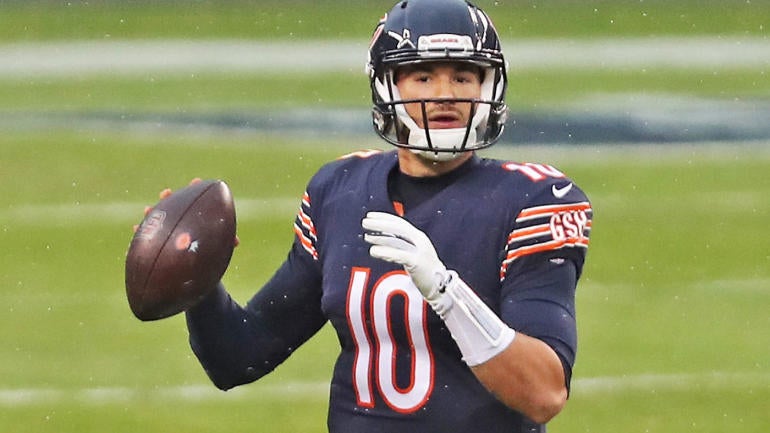
Despite a decreased salary cap, NFL free agency hasn't lacked excitement. However, we are now to the point where Mitchell Trubisky is the best quarterback on the market. It's rare that high-end quarterbacks hit free agency, anyway.
Sure, we could see a Deshaun Watson, Sam Darnold, or Jimmy Garoppolo trade in the coming days or weeks, but for now, let's pinpoint which teams would make the most sense for the former No. 2 overall pick after the Bears signed Andy Dalton. But first, let's size up Trubisky's talent.
What we know about Trubisky as a QB
- He's very careless with the ball under pressure
In 2020, according to Pro Football Focus, Trubisky had a turnover-worthy play rate of 7.0% while facing pressure. Only Drew Lock's rate was higher among qualifying passers. The year before his turnover-worthy play rate was only 4.5% under pressure, but his quarterback rating was 55.2 compared to a rather respectable 84.8% in those pressure situations in 2020.
- He's best when he can rely on his legs frequently
During Trubisky's best season in the NFL (2018), he carried the ball 32 times on designed runs, forced more missed tackles than Russell Wilson (nine vs. eight) and only Taysom Hill and Josh Allen averaged more yards after contact per rush. There were also 36 Trubisky scrambles that year, the third-most in the NFL. As a runner, he averaged 6.2 yards per carry in 2018. For some reason, the Bears dialed back Trubisky's willingness to run ever since. Interestingly though, on less than half the amount of carries in 2020, Trubisky averaged 5.9 yards per carry.
- He's not an accurate deep-ball thrower
The best accuracy percentage on throws made 20-plus yard down the field Trubisky's managed in his four-year career came as a rookie in 2017, and that figure was just 37.6%, which ranked 25th out of 38 qualifiers. After back-to-back seasons with an accuracy percentage of 37.5% down the field, his ball placement deep actually dipped to 18.2% in 2020.
Landing spots that make the most sense
New York Jets
We all know by now the Jets are almost assured to draft BYU quarterback Zach Wilson with the No. 2 overall pick at the end of April. He's an improvisational master with high-end arm talent and great accuracy to all levels of the field. Behind him currently is 2020 fourth-round pick James Morgan and Mike White.
It would behoove the Jets to have a veteran with starting experience in the quarterback room, and, heck, Trubisky has started multiple playoff games. New offensive coordinator Mike Lafluer's scheme is derived from Kyle Shanahan's offense that features plenty of quarterback rollouts off play-action. The system works the short-to-intermediate levels much more frequently than deep. Trubisky is a good athlete who's more comfortable in moving pockets -- to mitigate pass rush and accentuate his legs. Plus, the Jets still have loads of cap space.
Cincinnati Bengals
Similar to the situation with the Jets, the Bengals have a young, relatively inexperienced quarterback locked into their starting role. Joe Burrow can execute off-script despite average-at-best athletic tools, and head coach Zach Taylor learned under Sean McVay, another Shanahan disciple.
The Bengals got to see what current backup Ryan Finley looks like as a starter last season, and while there were a few flashes, it wasn't very pretty overall. The offensive line situation is the only red flag about this fit for Trubisky, but one can expect the Bengals to go heavy on blockers early in the draft to protect Burrow.
Tennessee Titans
Ryan Tannehill has had a career revitalization in Tennessee. His backup right now is Logan Woodside. New offensive coordinator Todd Downing as worked under many established play-callers and helped a variety of quarterbacks with vastly different skill sets. But he did spend the past two seasons in Nashville under Arthur Smith.
Smith's system was routinely near the top of the league in play-action rate, and Tannehill certainly can run with the football when needed. Getting another veteran on that roster would be smart for a team that simply lacks depth at the position. And if he had to play, Trubisky wouldn't be asked to carry the team on his back. Hand the football off to Derrick Henry, find A.J. Brown over the middle off play-action, run on some read-option keepers.
Dallas Cowboys
In 2020, the Cowboys saw first-hand what can happen to their team if Dak Prescott goes down. With Andy Dalton now a member of the Bears, Trubisky would be a logical Dalton 2.0 backup option behind Prescott if anything on the injury front were to occur again.
Kellen Moore is a creative offensive coordinator, and Dallas absolutely has the offensive weaponry to hold up a lesser quarterback, and offensive line is likely to be a priority for the Cowboys front office in the draft. Plus, Tyron Smith and La'El Collins should return to full strength in 2020, good developments for Prescott of course and more reason why Trubisky would make sense in Big D.
Atlanta Falcons
Arthur Smith is now running the show in Atlanta, and Matt Ryan just restructured his mega contract, which signals that 2021 isn't the final season with the Falcons for the franchise's all-time leading passer.
From his time resurrecting Tannehill's career, we know Smith can insulate a previous first-round bust at the quarterback spot who's inconsistent, struggles against pressure, and has above-average running skills. Ryan's been amazingly durable during his time in Atlanta -- he's missed three games in 13 years -- but after Matt Schaub's retirement, the Falcons are certainly in the backup quarterback market.