NFL Week 12 historical matchups: Terrell Owens makes 'The Catch, Part 2' adding to 1990s Packers-49ers rivalry
Owens' catch ended the 49ers' playoff misery against Brett Favre and the Packers

By
Bryan DeArdo
•
8 min read
The NFC had a compelling hierarchy in the 1990s. The 49ers reigned supreme at the start of the decade before being upended by the Cowboys, who were later dethroned by San Francisco midway through the decade. The 49ers, however, could not defeat the Packers in the postseason, as league MVP Brett Favre upset San Francisco in the second round of the '95 playoffs.
Favre's Packers, at that time, could not beat the Cowboys, who defeated Green Bay three straight times in the playoffs, including their win over the Packers in the '95 NFC title game. Green Bay finally broke through in 1996, defeating the 49ers again in the playoffs en route to the franchise's first Super Bowl win in 29 years. The next year, Green Bay again defeated San Francisco, this time in the NFC title game, before being upset by John Elway, Terrell Davis, and the rest of the Broncos in Super Bowl XXXII.
Most fans and sportswriters expected another Packers playoff win over the 49ers when the two teams faced each other in the 1998 wild-card round. While Green Bay wasn't as strong as they were the previous three years, they still had Favre (who threw 31 touchdown passes that season), All-Pro receiver Antonio Freeman (14 touchdown receptions in '98) and future Hall of Fame pass rusher Reggie White (16 sacks in '98) at the height of their powers. The 49ers boasted the talents of future Hall of Fame quarterback Steve Young (36 touchdown passes), future Hall of Fame receiver Jerry Rice (1,157 yards, nine touchdowns) Pro Bowl running back Garrison Hearst (1,570 yards), and future Hall of Fame pass rusher Chris Doleman (15 sacks). They also had a young receiver named Terrell Owens, who ended up having one of the most remarkable games of his colorful career.
As expected, the Packers took an early lead before the 49ers rallied back to take the lead with just under three minutes left in the third quarter. Six carries for 38 yards by Hearst, along with a 15-yard pass interference call on a third and 15 play, set up Wade Richey's go-ahead field goal.
Both teams then traded field goals before a drop by Owens -- who dropped several passes throughout the course of the game -- forced the 49ers to punt with 4:19 left. Trailing 23-20, Favre quickly drove the Packers 89 yards in just over two minutes, completing three passes for 62 yards on the drive before hitting Freeman for the go-ahead touchdown. At that moment, it seemed that the Packers were on their way to a fourth straight postseason win over the 49ers.
Which teams will cover the spread in Week 12? Pete Prisco and R.J. White join Will Brinson to pick every game, offer gambling advice and more. Listen below and subscribe here for daily NFL goodness fired into your eardrums.
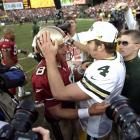
The 49ers, with their season -- and that era's Super Bowl window -- on the line, took over at their own 41-yard-line with 1:50 left. Two completions to receiver J.J. Stokes, and a terribly missed call on what should have been ruled a fumble by Rice (the NFL did not have instant replay at this time), the 49ers had the ball on the Packers' 25-yard line with eight seconds left. It was at this point that Owens, who had had a terrible game up until then, made the play that is still known on the West Coast as "The Catch, Part 2".
With T.O. receiving his @ProFootballHOF Ring of Excellence tonight, we remember the catch that cemented him as a 49ers legend.
— NFL Throwback (@nflthrowback) November 2, 2018
After losing to them three straight years, the @49ers finally overcame the Packers in the '98 Wild Card thanks to @terrellowens' incredible game-winner. pic.twitter.com/uamcFBxQM3
While the 49ers would not win that year's Super Bowl, that game -- and that play -- is still remembered as one of the great moments in franchise history.
Here are four other Week 12 matchups with historical relevance
Jaguars vs. Titans
Before the NFL added two more divisions in 2002, the division with the best rivalries may have been within the old AFC Central, a division that included the Steelers, Jaguars, Titans, Browns, Bengals, and Ravens. By the end of the 20th century, the best rivalry in the division -- and possibly within the entire NFL -- was between the Jaguars and Titans.
The Jaguars, who took control of the division in 1998, went 14-2 during the 1999 season and were the No. 1 seed in the AFC heading into the postseason. The Titans, despite going 13-3, were a wild card team after finishing second to Jacksonville in the division standings. After coming from behind to defeat Buffalo in the wild card round, the Titans, led by quarterback Steve McNair, running back Eddie George and rookie sensation Javon "The Freak" Kearse, upset Peyton Manning's Colts in the divisional round. That set the stage for a third matchup between the Titans and Jaguars, who had dismantled the Dolphins, 62-7, in the divisional round in what would be the final game of Dan Marino's Hall of Fame career.
Tennessee, the only team that defeated the Jaguars that season, trailed at halftime before scoring on offense, defense and on special teams in the third quarter. After McNair's touchdown run gave the Titans the lead, a safety of Jaguars quarterback Mark Brunell stretched the Titans' lead while giving Tennessee momentum that they would not relinquish. Derrick Mason's 80-yard kickoff return just seconds later gave the Titans a 26-14 lead heading into the fourth quarter.
.@deemason85 has good memories when it comes to playing the #Jags.
— Justin Beasley (@JBeasleyWSMV) September 19, 2019
Here’s his 80-yard kickoff return in the 1999 AFC Championship game to help send the #Titans to the Super Bowl. pic.twitter.com/JPSsZDwGj1
In that fourth quarter, after a second interception of Brunell, a 51-yard run by McNair set up his game-clinching, one-yard scoring run with just over nine minutes left. The Titans, despite committing four turnovers and being out-gained by the Jaguars, defeated Jacksonville for a third time that season after forcing six turnovers and holding the Jaguars' high-powered offense to just 14 points. While they would lose to the Rams in Super Bowl XXXIV, the Titans' Super Bowl run in 1999 helped put football on the map in Nashville while still standing as the greatest moment in franchise history.
Browns vs. Dolphins
Cleveland and Miami do share some pretty significant playoff history. The undefeated 1972 Dolphins' first playoff game was against the Browns, who held Miami to under 300 total yards in their playoff showdown while taking the lead several minutes into the fourth quarter. In a twist of irony, running back Jim Kiick -- who saw his role in Miami's offense reduced that season after the emergence of fellow running back Mercury Morris -- score the game-winning touchdown in the Dolphins' 20-14 victory. Miami, who forced five turnovers in in their win over Cleveland, would then defeat the Steelers and Redskins to become the only perfect team in NFL history.
Thirteen years later, the defending AFC champion Dolphins trailed the heavy underdog Browns (who made the playoffs despite going 8-8 during the regular season) 21-3 before Marino led Miami on three consecutive scoring drives to pull out a 24-3 win.
No. 79: 1985 AFC Divisional Playoff - Dolphins vs. Browns “Marino 18-pt Comeback” (Jan. 4, 1986) #NFL100 @MiamiDolphins @DanMarino
— NFL (@NFL) September 28, 2019
📺: NFL 100 Greatest Games on @NFLNetwork pic.twitter.com/GlHy7oh4j3
While the Dolphins' bid at a third Super Bowl trip in four years ended the following week against the Patriots, the Browns would advance to the next two AFC Championship Games, losing to John Elway and the Broncos in heartbreaking fashion on both occasions.
Raiders vs. Jets
Oakland's 1986 regular-season victory over the New York Jets continues to live in infamy as "The Heidi Game." With Joe Namath and the visiting Jets enjoying a slim fourth-quarter lead, NBC decided to cease showing the game in favor of a made-for-TV film titled "Heidi." As enraged NFL fans called the network to voice their displeasure, the Raiders -- without a TV audience watching -- scored three fourth-quarter touchdowns to pull off the come-from-behind victory.
A game that changed broadcasting standards forever.
— Oakland Raiders (@Raiders) September 28, 2019
'The Heidi Game' comes in at No. 41 on the #NFL100 list of greatest games. pic.twitter.com/ex2HSA4z0s
NBC would not make the same mistake the following month when the two teams met again in the AFL Championship Game. And unlike their previous matchup, it was the Jets who came from behind to beat the Raiders, with Namath completing a six-yard touchdown pass to future Hall of Fame receiver Don Maynard to give New York a 27-23 victory over the defending AFL champions. Namath and the Jets would then pull off the greatest upset in Super Bowl history, defeating Don Shula's Baltimore Colts to become the first AFL team to defeat an NFL franchise.
Rams vs. Ravens
It's fitting that these two franchises are playing each other in 2019, 20 years after both reached pro football's summit in two entirely different fashions. In 1999, the Rams, led by a little known backup quarterback named Kurt Warner, took the NFL by storm by unleashing one of the greatest offenses the league has ever seen. The Rams' offense, which was given the nickname "The Greatest Show on Turf," scored a staggering 526 points that season behind the talents of Warner (the league's MVP that season) and fellow future Hall of Famers Orlando Pace, Marshall Falk and receivers Isaac Bruce, Torry Holt, and Az-Zahir Hakim. The Rams' storybook season ended in storybook fashion, as St. Louis survived a late rally by the Titans to win Super Bowl XXXIV.
“The whole team just had a swag to them, and it was electrifying!” 💥@Nelly_Mo on the 1999 St. Louis Rams 👇 #NFL100
— NFL Network (@nflnetwork) November 16, 2019
📺: NFL 100 GREATEST TEAMS on NFL Network pic.twitter.com/NRnlr52AkA
The following season, the Ravens, a .500 team the previous season, would win 12 regular-season games behind the play of one of the most dominant defenses in NFL history, a unit that allowed an average of just 10.3 points per game. The Ravens, led by Hall of Fame linebacker Ray Lewis, would shock the defending AFC champion Titans in the divisional round before defeating Jon Gruden's Raiders in the AFC title game. In Super Bowl XXXV, Baltimore shut out the Giants' offense while bringing home the franchise's first Vince Lombardi Trophy.
The @Raiders. The @Ravens.
— NFL (@NFL) November 24, 2018
Two early 2000's powerhouses.
One ticket to @SuperBowl XXXV available. 🎟️ (via @nflthrowback)
📺#OAKvsBAL: Sunday 1PM ET on CBS #fbf pic.twitter.com/Ff6Zzev6Ii
Like two comets, the Rams and Ravens time atop the NFL mountain didn't last long. Baltimore was dethroned by the Steelers in the divisional round of the 2001 playoffs, while St. Louis was upset in that year's Super Bowl by the Patriots, whose reign as the NFL's best franchise appears destined to continue into a third decade.