After an illustrious college career at Columbia in which he took a mediocre football program and turned it into a team that could beat mighty Army, Sid Luckman planned to become a regular working man upon his graduation. Even after the Bears drafted him with the No. 2 overall pick in the 1939 draft, Luckman still planned to eschew the NFL and join his family's trucking business.
That's a fact. Those was actually Luckman's postgraduate plans.
But 75 years ago, it was a decision that made at least partial sense. College football, in those days, was a much bigger deal than pro football, and let's face it, he probably could have made more money by working with his brother than he could have taking hits from defensive linemen and linebackers on the football field.
Said Luckman to the NY Times: "I'd taken a lot of punishment and I knew how rough the pro game could be."
But Bears owner George Halas saw something different in Luckman. Though Luckman was a single-wing tailback in college, Halas believed Luckman could play quarterback in the newfangled T-formation offense. He procured a dinner invitation to the home of Luckman and his wife, Esther, and while there, Halas slid a contract toward Luckman that offered him a $5,500 salary.
Halas' reported final pitch to Luckman: "You and Jesus Christ are the only two people I would ever pay this to."
Seventy-five years ago, with the engine idling on a career in the trucking business, Luckman instead chose pro football. His life -- and the Bears organization -- never would be the same.
For instance, this happened just one year later.
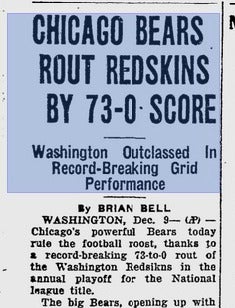
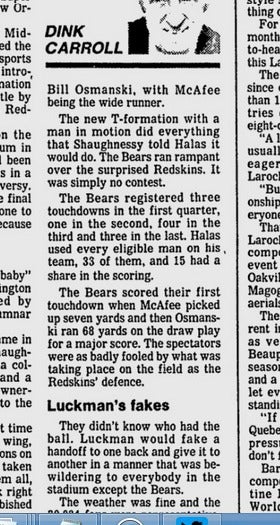
With that T-formation, here's how the destruction occurred, via the Montreal Gazette in 1986 and the wonderfully-named Dink Carroll. (FYI, the Shaughnessy named below is Clark Shaughnessy, a long-time college coach who is credited with helping develop the T-formation).
Luckman's career was mighty impressive, as he racked up five All-Pro team honors while leading the league in passing yards and touchdowns in 1943 and 1945-46.
But the Hall of Famer wasn't an overnight success. He struggled during his 1939 rookie season, and Halas temporarily revoked the T-formation because Luckman wasn't getting it right. He eventually did.
"Sid made himself a great quarterback. No one else did it for him," Halas once said. "He worked hard, stayed up nights studying and really learned the T. Sid wasn't built for quarterback. He was stocky, not fast and not a great passer in the old tradition. But he was smart and he was dedicated."
An interesting aside, here -- via Dan Daly's book, The National Forgotten League -- is what happened to Luckman's father, Meyer, the man who ran that trucking business.
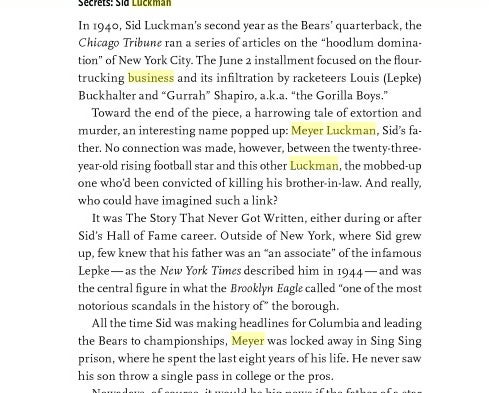
Either way, Luckman was a team player on the football field. More from the NY Times obituary of Luckman from 1998:
Luckman took to stardom gracefully. He was a gentle, modest and thoughtful man who was immensely popular. In one game during the Bears' heyday, the 250-pound guard Ray Bray confessed to Luckman in the huddle that he would cherish the chance to score a touchdown. The Bears were a yard short of the goal line at the time. Luckman called on Bray to carry the ball a la William (The Refrigerator) Perry. Bray was ground into the dirt still a yard short of the goal line.
Luckman was gracious to his teammate. "Get back where you belong, chum," he said mildly and then handed the ball to one of his powerful backs for the score.

Luckily for Luckman, he made the right decision 75 years ago when he avoided the family trucking business and instead opted to take NFL glory.
But he needed something to do after he retired following the 1950 season.
That's when he went into the packaging industry.