Spread 'Em Out: What did NFL preseason tell us about Ravens, Cardinals offenses?
While each team has a mobile QB, their usage of formations shows they'll approach things differently

Everybody knows that teams hold things back during the preseason. Nobody runs their "real" offense or defense, because nobody wants to give away any secrets that could be used to steal a win or two during the games that count.
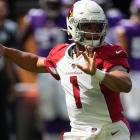
Nowhere has this lack of transparency been more noticeable than in Baltimore and Arizona, where we have been hearing throughout the offseason about the creativity and novelty the Ravens and Cardinals will be bringing to their respective offenses but have yet to see them bring said creativity and novelty to the field during actual games. Instead, the Ravens and Cardinals have trotted Lamar Jackson and Kyler Murray onto the field throughout the preseason and largely asked them to do what any other quarterback in the league might do in preseason games.
But while both teams stuck largely with the most vanilla concepts possible during the preseason snaps for which their starter was on the field, the way they aligned themselves and their play-calling within those alignments highlighted some of the differences in the way the Ravens and Cardinals plan to attack opposing defenses this season.
Personnel | Plays | Run | Run Yd | Pass | Pass Yd | Penalty | Pen Yd | Total Yd |
11 | 14 | 4 | 8 | 9 | 65 | 1 | -10 | 63 |
12 | 7 | 2 | 4 | 5 | 39 | 0 | 0 | 43 |
21 | 4 | 3 | 12 | 1 | 1 | 0 | 0 | 13 |
22 | 3 | 2 | 18 | 1 | 0 | 0 | 0 | 18 |
13 | 2 | 1 | 3 | 0 | 0 | 1 | -10 | -7 |
02 | 1 | 0 | 0 | 1 | 0 | 0 | 0 | 0 |
ALL | 31 | 12 | 45 | 17 | 105 | 2 | -10 | 130 |
The chart above shows the personnel groupings and play-call frequencies for the 31 snaps (not including pre-snap penalties) on which Lamar Jackson and the first-team offense were on the field for the Ravens during the preseason. While Baltimore was in 11 personnel (1 RB, 1 TE) nearly half the time (42.6 percent), you can see that offensive coordinator Greg Roman and company mixed things up quite a bit, formation-wise. Baltimore used six different alignments on its 31 plays, and called at least one run and at least one pass out of four of them.
The Ravens called zero designed quarterback runs for Jackson and zero jet sweep hand-offs. They lined up a wide receiver somewhere other than in the slot or out wide zero times. They had two of their running backs on the field together zero times. They took zero snaps with Robert Griffin III or Trace McSorley sharing the field with Jackson.
In one-back formations (11, 12, 13) the Ravens called a pass on 15 of 23 snaps (65.2 percent, including penalties). In two-back formations (21, 22) they called a run on six of seven snaps (85.7 percent). Those tendencies carried over to the way the Ravens had Jackson taking the snap. Baltimore passed the ball on 13 of 15 snaps out of shotgun and ran it on eight of 10 snaps Jackson took under center. Only in the pistol formation did they distribute the play-calls evenly.
QB Loc | Plays | Run | Pass | Penalty | Yards |
Gun | 15 | 2 | 12 | 1 | 64 |
Under | 10 | 7 | 2 | 1 | 33 |
Pistol | 6 | 3 | 3 | 0 | 33 |
ALL | 31 | 12 | 17 | 2 | 130 |
Of the Ravens' 12 total running plays, six of them were undisguised dive runs right up the middle. The pass plays they called were largely designed to get the ball out of Jackson's hands extremely quickly on easy-to-complete routes: 12 of his 16 passes were released within 2.5 seconds of the snap, per Pro Football Focus, and his average depth of throw was just 8.5 yards. This was a team intent on showing nothing, and other than a desire to mix things up with formations and snap-delivery system, they mostly did not show anything at all.
The Cardinals, meanwhile, were on the complete opposite end of the spectrum. While the Ravens changed things up on a near every-snap basis, the Cardinals stayed largely in the same exact personnel packages for almost the entire time they had Murray on the field. In fact, 53 of the 62 snaps Murray took (excluding pre-snap penalties) saw the Cardinals line up in 11 personnel. That's an 85.5 percent rate, nearly on par with where the Rams were last season.
Personnel | Plays | Run | Run Yd | Pass | Pass Yd | Penalty | Pen Yd | Total Yd |
11 | 53 | 10 | 23 | 37 | 153 | 6 | -40 | 136 |
12 | 5 | 4 | 12 | 1 | 3 | 0 | 0 | 15 |
13 | 3 | 1 | 3 | 0 | 0 | 2 | -20 | -17 |
10 | 1 | 0 | 0 | 1 | 0 | 0 | 0 | 0 |
ALL | 62 | 15 | 38 | 39 | 156 | 8 | -40 | 134 |
Like the Ravens, the Cardinals appeared to tip their hands regarding the intention of the play to come with their personnel groupings and the alignment of their quarterback. With three-plus receivers on the field (10, 11) the Cardinals called a pass play on 42 of 54 snaps (77.8 percent, including penalties). With two or fewer wideouts in the game, the Cardinals ran the ball on seven of eight snaps (87.5 percent).
Unlike the Ravens, the Cardinals kept the snap-delivery system extremely consistent. Murray lined up in the shotgun on 57 of 62 snaps and took the ball from under center just once. (There was one snap in the pistol formation.) But much like Baltimore, the snap deliver was often a tell regarding Arizona's intentions. To wit: The Cardinals ran the ball all four times they had Murray take a snap from under center, while they called for a pass on 43 of 58 snaps where he was in the shotgun or pistol formation.
QB Loc | Plays | Run | Pass | Penalty | Yards |
Gun | 57 | 11 | 38 | 8 | 121 |
Under | 4 | 4 | 0 | 0 | 13 |
Pistol | 1 | 0 | 1 | 0 | 0 |
ALL | 62 | 15 | 39 | 8 | 134 |
The post-snap play-calling, again, was extremely vanilla.
Let's look at the 19 run plays Arizona called (including penalties) by what type of run they were: six dives, three zone runs, two power runs, three stretch runs, three delayed draws, and one read-option keeper where Murray was tackled almost immediately.
And the passes: Murray got rid of the ball within 2.5 seconds almost half the time he dropped back, completing 16 of 19 passes for 141 yards, per PFF. The times where he did not release quickly were largely because of pressure or because he was throwing a deep corner route, which he missed on every occasion the Cardinals called for it. His average depth of throw was just 8.0 yards, as the Cardinals had him throw mostly quick outs, quick slants, quick hitches, and screens.
Though they have been trying to hold back on the wrinkles that will help define what they look like on the field, all of these tendencies play to what we already know about the play-callers involved in building these offenses. Ravens offensive coordinator Greg Roman, for example, built offenses in San Francisco and Buffalo that utilized the skill sets of running quarterbacks (Colin Kaepernick, Tyrod Taylor) by marrying diverse formation and snap-delivery systems with spread concepts. Cardinals head coach Kliff Kingsbury is an Air Raid aficionado who likes to spread the field with multiple wide receivers and get the ball out quickly on short routes before the pass rush has a chance to hit home. We saw all of that in the preseason, even though the actual play-calls were garden-variety type stuff.
Undoubtedly, both of these play-callers will get considerably more creative during the season. For example, it seems highly unlikely that Baltimore gets through its first offensive series without designing a run play for Jackson, let alone the whole season. And the Cardinals will presumably run something other than the smash, spacing, drive, and dagger route concepts at some point, while Murray seems nearly guaranteed to run the ball fairly often as well.
But in the meantime, the approach they each take to get into their preferred concepts and wrinkles is worth noting, and it sure looks like these teams will be going about things quite differently.