Mike Gundy wants Big 12 refs every week, but compares them to cartoon characters
Oklahoma State's coach is requesting Big 12 refs every week, or the equivalent of a Power Five crew

By
Jon Solomon
•
4 min read

After an officiating error cost his team a win, Oklahoma State coach Mike Gundy said Monday he opposes playing non-conference home games without Big 12 officials, yet he compared Big 12 replay officials to cartoon characters.
"There are a lot of good officials out there, but they're all working to get to that level, right?" Gundy said. "Aren't most umpires in Double-A trying to get to the majors? So I'm guessing that they're trying to put those guys that are more experienced, have been in those situations; have seen it more, at that level. That's just a personal opinion. And that's not sour grapes."
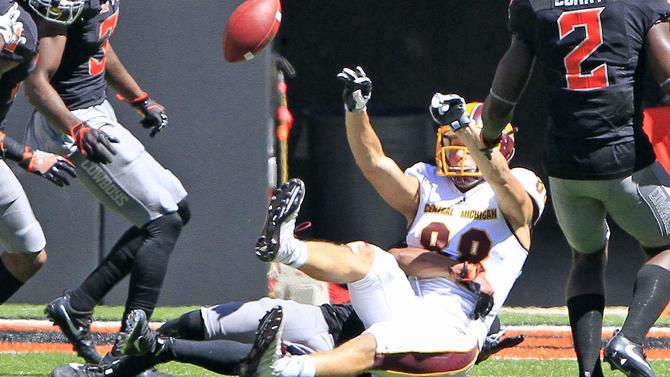
Oklahoma State lost Saturday to Central Michigan on a Hail Mary and lateral with no time left after an untimed down. By rule, the play should not have happened. The MAC on-field officiating crew and the Big 12 replay officials have all been suspended two games.
Gundy appeared to take a conciliatory tone Sunday when he said he wouldn't address the officiating error again. The frustration was too painful, though, and he discussed it during his weekly news conference Monday.
"I think that we have Big 12 officials in Dallas watching the games with a buzzer to the people here. Is that right?" Gundy said. "So that is being done. They're watching every game. So jokingly, you ever watch cartoons when they have a guy at a fort and he's watching and he's like this (Gundy pretends to sleep). I'm serious. So I wondered, 'Is that happening?' I know they're going to be mad at me. They may fine me for that."
A portion of Gundy's argument centered on having only Big 12 officials work Oklahoma State home games moving forward.
"The best (officials) will be at (the Power Five) level," Gundy said. "When we're playing in these games, we need to use our officials. Or we don't sign a contract."
MAC commissioner Jon Steinbrecher said he empathizes with Oklahoma State. In 2011, Toledo lost a game at Syracuse when the Orange appeared to miss an extra point, but the Big East officials and replay ruled the kick went through the uprights.
"There's no appeal process. It hurts," Steinbrecher said. "I understand both sides of this coin."
But Steinbrecher noted that both MAC and Big 12 officials could have changed the outcome by knowing the rule.
"First, I'd say (Gundy's) comments are entirely predictable and understandable given the situation that occurred," Steinbrecher said. "The person I was sitting next to as this erupted, I immediately said to him, 'We're likely to hear this comment somewhere in the next couple days.'
"Secondly, there was a Big 12 crew on the game and they were in replay so this is not a Power Five vs. Group of Five issue. The officials that worked this game were assigned through the consortium we're part of. Those officials have all worked and been assigned to so-called Power Five games. I think in this case, those officials would meet the definition that Coach Gundy was looking for. Finally, in watching Power Five games, have there been officiating errors? Probably every game. You just hope they don't occur in a major fashion."
The MAC is part of an officiating consortium that shares officials, training, oversight and evaluation with the Big Ten and Missouri Valley. For example, Tim O'Dey -- the referee in the Central Michigan-Oklahoma State game -- worked Nebraska-Southern Miss in 2015. In Week 1 this season, O'Dey and his crew called Maryland-Howard.
The question has come up if collaborative replay could have helped this mistake. The experiment allows arguably the most knowledgeable rules people to be watching multiple games in a command center to weigh in on calls.
"I guess it depends who's back in the command center," Steinbrecher said. "You're likely to have in the command center someone similar who's in the replay booth. That's why in this situation you hope replay can pick it up. Again, this was a group effort and unfortunately it did not get corrected."
In recent years, regional officiating consortiums have moved college football closer to having one national entity over officiating. But whether that ever happens "comes down to whether certain entities are willing to release some control in terms of who they schedule and assign," Steinbrecher said.
Steinbrecher said he is "sick" that an officiating mistake related to a "fairly obscure exception to a rule" has taken focus off the players. Central Michigan still executed an "incredible" play at the finish, he said.
In 2011, Steinbrecher explored whether there was an appeals process for Toledo to change the Syracuse result. There is not -- and he doesn't sound interested in creating such legislation for once a game is over.
"I don't know where you draw the line on that," Steinbrecher said. "Is it only things in the last 30 seconds? In the last quarter? We can all point to issues that occurred in various points of the game. I'm not sure that's a path we want to go down."
Gundy could have helped himself by knowing the rule and protesting at the time. There should have been no untimed down after intentional grounding because the penalty results in a loss of down.
But it's also a very obscure rule. Privately, some people in the officiating community believe the rule could be changed after the season. The rule essentially encourages a team to commit a penalty on the final play to run out the clock.