No bluffing -- NCAA has lost all of its credibility with Penn State, USC, etc.
The NCAA questioned its jurisdiction to punish Penn State, but did it anyway? Just when you thought its reputation couldn't get worse ...

By
Dennis Dodd
•
5 min read
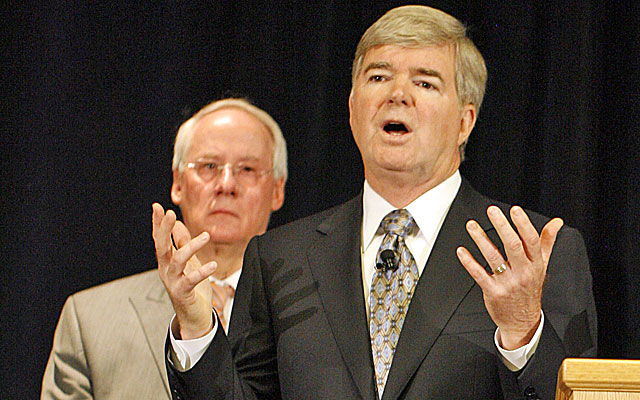
Three years ago this week, Mark Emmert and his wife walked into the back of the Alabama press box for the latest Game of the Century.
Emmert was particularly interested because the man he proudly hired at LSU, Nick Saban, was coaching Bama to what would become another BCS championship.
But there quickly developed a larger, more ominous story than even that day's 9-6 LSU victory. Emmert, the NCAA president, briefly acknowledged it in the press box that day as the news unfolded. Some media were just opening up their laptops to read the Pennsylvania grand jury's presentment in the Jerry Sandusky case. It was horrific.
According to a source, by a Tuesday senior management meeting at the NCAA, Emmert and some top association officials were already formulating a plan. They would punish Penn State.
We already know there was significant disagreement about setting precedent by penalizing Penn State outside the enforcement realm. The release of damning emails this week reinforced the leanings of Emmert's loyal opposition. The NCAA apparently attempted to "bluff" Penn State into accepting those unprecedented penalties.
Not considering Sandusky's heinous acts themselves, this might be the lowest of the low points in this narrative.
The NCAA had never punished a school in a criminal matter. It had never re-interpreted the NCAA Manual for penalties outside of the enforcement process.
The day the NCAA's investigation was announced, veteran attorney Scott Tompsett told ESPN.com, "In my opinion, this is without precedent, outside the legislative intent of the bylaws, and it sets a dangerous precedent for the NCAA because it can be a slippery slope. The NCAA has exercised authority over the recruitment of prospective student-athletes, the eligibility of student-athletes and practice and competition. This inquiry is far outside those areas."
But Emmert, then-executive committee chair Ed Ray and key supporters moved on. Flush with a reform ethic that had begun in August 2011 with key college presidents, Emmert perhaps thought this was a chance to consolidate NCAA power.
As we know today, it all failed miserably. It's hard to tell what was more outrageous: The Penn State penalties or the fact that the NCAA rescinded many of them two years later.
A "football first" climate that the NCAA characterized as insidious under Joe Paterno was cleaned up in 24 months? The truth is the NCAA never should have meddled in the first place.
The poisoned climate that has continued since Penn State is probably going to get worse. If anything, the email story was underplayed nationally this week. The NCAA attempted to bluff a member school because it knew it had no jurisdiction?
It's to the point now that the membership itself is to blame. Any real change -- i.e., Emmert's ouster -- is going to have to come from them. Congress has been able to shame the NCAA but hasn't taken any meaningful action.
Yes, it's going to get worse, especially if lawyers representing Todd McNair have their way. The former Southern California assistant has sued the NCAA for defamation. A judge ruled that the association might have made malicious statements regarding McNair. That's why the NCAA is appealing a judge's ruling to unseal the case file in the USC case.
So far, the NCAA's arguments against unsealing that file have been met with skepticism. Unsealing the case file would be as unprecedented as penalizing Penn State. And that would be a delicious irony.
Try to imagine what truths would be learned from one of the most controversial investigations in NCAA history.
In dismissing an NCAA motion to dismiss McNair's suit, a judge ruled NCAA emails "tend to show ill will or hatred" toward the former coach.
Hatred?
Bluffing?
What's next, blackmail?
Reggie Bush lost his Heisman. USC lost its BCS title. That we can live with. But McNair lost his professional life. He has not worked in coaching since the NCAA said 4½ years ago he "knew or should have known" Bush was getting extra benefits.
Releasing that case file might embarrass the NCAA further. Its lawyers have argued such action would keep potential witnesses from coming forward in future cases. To that a judge said, "Why should confidentiality be maintained four years later?"
If you weren't outraged this week, you should have been. Bravo to those whose emails suggest they stood up the rising tide of rules misappropriation at Penn State -- former enforcement director Julie Roe Lach, former vice president Wally Renfro as well as current vice presidents David Berst and Kevin Lennon.
They were overruled by hubris, misjudgment and misguided power. Three years since that press box scene, confidence in the NCAA has never been lower. An external review at North Carolina discovered what enforcement couldn't -- willful and longstanding academic fraud.
A cynic might suggest the NCAA knew or should have known about that scandal.
Even the reform that Ray and Emmert were attempting to capitalize on three years ago failed. It led to the current real reform movement instituted by the Power 5 commissioners.
A lot of us have changed our minds on the Penn State situation. That's allowed. More information has come to light since that July 2012 day I sat in an NCAA press conference in Indianapolis. King Football, Emmert called it at Penn State.
Since then I've looked into the eyes of the innocent Penn State players whose careers were altered, dreams dashed. They had nothing to do with this.
We've all felt sympathy for the victims themselves.
I've seen Penn State do nothing but the right thing since, hiring upstanding coaches in Bill O'Brien and James Franklin.
The NCAA sure did teach King Football a lesson. O'Brien won more games than Wisconsin and Michigan in his two seasons. Franklin just landed a top-25 recruiting class. His 2015 class is projected to be in the top 15.
What happened to change our minds? Miami happened. North Carolina happened (or rather, didn't happen).
The net result of Emmert's bold action has been upheaval. There has been at least one Congressional hearing in which he was admonished. He is expected to be deposed in at least one of the existing lawsuits against the NCAA.
It's now beyond the association's reputation being tarnished. Some damage can never be repaired.
Not when it's going to get worse.