Fantasy Baseball: Is there still hope for these five starting pitchers, Dylan Bundy included?
Done with Dylan Bundy? Doubting Zack Godley? Disenchanted with Luke Weaver? Our Scott White assesses the likelihood of these once trusted starting pitchers bouncing back.

By
Scott White
•
7 min read
More Fantasy Baseball: Don't buy these breakouts | Prospects Report | Waiver Wire
Chris Archer in his past two outings has 12 strikeouts vs. one walk, allowing three earned runs over 13 innings. And you wouldn't consider dropping him.
Luis Castillo in his past two outings has 14 strikeouts vs. two walks, allowing four earned runs over 11 2/3 innings. And you wouldn't consider dropping him.
Jon Gray in his past three outings has 25 strikeouts vs. three walks, allowing one earned run over 20 innings. And you wouldn't -- not for minute -- consider dropping him.
But you may have considered it for each of them before these most recent stretches, when they had ERAs of 6.61, 7.85 and 7.09. And you would have felt really stupid if you had followed through on it.
- Subscribe to the Fantasy Baseball Today podcast for free on Apple Podcasts, Stitcher, TuneIn, Google Play or anywhere else you listen.
That is why you should give all benefit of the doubt to every player -- and especially every pitcher -- of that stature after only a few weeks' time. No stat line is linear. Everyone has his ups and downs over the course of six months, and they tend to be more extreme for pitchers just by virtue of them having to wait five days for a chance to correct.
Granted, we didn't know exactly what it would take to get Gray, Castillo and Archer back on track. For Gray, it turned out to be better location on his fastball and renewed confidence in his slider. For Castillo, a rediscovered arm slot to make his changeup again one of the best swing-and-miss pitches in the majors. For Archer ... well, who the heck knows? But in each instance, there were enough signs that the health and skills were still intact for you to suspect some small adjustment was in the offing.
So if you're having doubts about these five, allow me to alleviate them for the moment. Any additional patience you can afford them will most likely be worth your while. Though it's possible not all of them will bounce back to expectations, it's virtually impossible that none of them will.


How dramatically Dylan Bundy's fortunes have turned in the span of only three starts, downgrading him from one of this season's biggest breakout pitchers (ranking up there with Patrick Corbin and Blake Snell) to a wholly untrustworthy infectious blight on humanity. Don't tell me you weren't tempted to drop him the moment you saw he allowed four homers without recording an out Tuesday -- to the Royals, no less -- just to rid yourself of the stink.
What makes it especially troublesome is he did sort of the same thing last year, going from having a 1.65 ERA in his first five starts to a 5.61 mark in his next 15. The discrepancy then was tied to how often he used his best pitch, the slider. When he got back to throwing it at least a quarter of the time last August, he turned on a dime again, compiling a 3.58 ERA, 1.03 WHIP and 10.7 strikeouts per nine innings over his final eight starts.
Not surprisingly, his slider usage was down in two of his past three starts, including the most recent. Then again, you could argue he didn't get a chance to throw it in his most recent, lasting just 28 pitches, and of course in one of the three, he threw it as often as ever. So the answer may not be as simple as "same as last year."
"You are looking for crispness of the pitches. You are seeing kind of that lazy spin," catcher Caleb Joseph said after Tuesday's outing. "He's obviously capable and there may or may not be other things kind of going on or whatever."
Other things? Or whatever? Could Joseph be referring to the groin injury for which Bundy is known to have received treatment already? And doesn't it stand to reason that a groin injury might impact Bundy's follow-through, compromising the "crispness" of his pitches? All I know is a pitcher doesn't go from being one of the league's premier bat-missers to a human launching pad without some external force at work.
Having gone down this road before with Bundy makes it easier to trust in the underlying talent. Sit him and wait until he's right again, because he will be.


Yu Darvish has been one of the more reliably dominant pitchers in Fantasy Baseball since he debuted in 2012. His track record is a big reason you drafted him, and his track record includes stints like this one when he seems to fall out of sync mechanically.
Yes, mechanically. His release point is lower, as revealed here in these side-by-side images from BrooksBaseball.net (left shows 2017, right 2018).
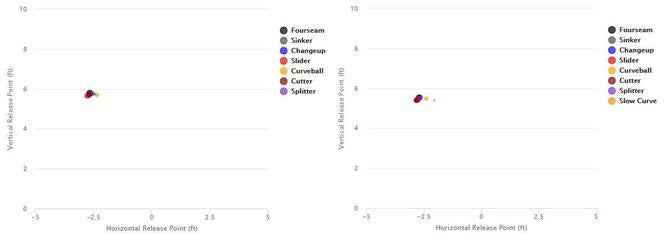
A lower release point often means a flatter fastball, and sure enough, the fastball is the pitch getting pummeled. Opponents are hitting 100 points higher against it than a year ago. It's also the pitch most responsible for the drop in swinging-strike rate, its whiffs cut in half from a year ago.
It's sort of what Castillo went through a couple weeks ago, and it's 100 percent correctable. In fact, Darvish may be on the DL right now (the flu, they say) to give him a chance to correct it. The good news is he's throwing as hard as ever, so it's not like he's working with diminished stuff. Things could fall back into place pretty quickly.


Zack Godley was an unexpected out-of-nowhere breakthrough last year, and so the natural reaction when he struggles is to assume he has gone back from whence he came -- i.e., to nowhere.
But what made Godley so effective last year was combining an elite ground-ball rate with an elite swinging-strike rate. He still has the elite ground-ball rate, just as he always has, but it's the swinging-strike rate, the game-changer for him a year ago, that's down.
From whence he came, right? Well, not exactly. See, he got more swinging strikes by leaning more than ever on his best swing-and-miss pitch, the curveball, throwing it a whopping 35 percent of the time. So far this year, he has thrown it 40 percent of the time.
In other word, the things Godley changed to make himself great last year are still in play last year. He hasn't reverted to some previous habit. His 2017 tendencies aren't the outliers. No, the outliers are plainly evident this year with the number of swinging strikes he's getting on the curveball and, of course, his walk rate.
And because they're outliers, it's reasonable to assume they'll correct themselves in time. For goodness' sake, three starts ago Godley had a 3.09 ERA, 1.16 WHIP and 9.3 strikeouts per nine innings, and none of his Fantasy owners had a care in the world. Let's give him a chance to correct the blip.


First off, I'd like to remind you that, because of a DL stint, Rich Hill has made only four starts this year, and the first one was great. He threw six shutout innings, strikeout out five.
Then came a not-so-great start -- one that's to this point unexplained but also an isolated incident because the next time out, his first genuinely awful start, his command was confirmedly compromised by the cracked fingernail that ultimately forced him to the DL.
He obviously deserves a pass for that one, which means if we're changing our opinion of him today, we're doing it on the basis of two starts -- that shaky second outing and his most recent one Tuesday when he was fresh off the DL and obviously rusty. It's not like he went on a rehab assignment. He hadn't pitched competitively in three weeks.
He blamed the outing on poor fastball location. It leaked over the middle of the plate, right into right-handed batters' sweet spot, and the result was three home runs. It's exactly the sort of thing you'd expect from a rusty pitcher. Meanwhile, his velocity and pitch selection are what they were a year ago.
You might worry about Hill's 38 years of age and availability given his injury history, but those were just as true when you drafted him. Nothing about his actual performance is raising a red flag for me.

Luke Weaver was a popular breakout pick coming into the season and seemed to be living up to the hype in his first three starts. But his four starts since then ... ugly.
The reason for the collapse isn't immediately discernable in the numbers. He isn't allowing especially hard contact. Only two home runs in seven starts, so it's not like he's getting crushed there either. And while his swinging-strike rate is average at best, the same was true in limited action the past two years, when he had 10.9 strikeouts per nine innings.
No, the biggest change for Weaver this year is something that hasn't afflicted him at any level in the past. He isn't throwing enough strikes.
His stuff isn't exactly overpowering. He doesn't have the 99-mph fastball that's ubiquitous in today's MLB. His game is more about getting ahead in the count and then deceiving hitters with an unusual throwing angle and precise release point. But he has had 10 percent fewer 0-2 counts this year than last year, which ruins the whole formula.
Seems like a simple enough problem, right? If nothing else, it's a singular problem and not a litany of issues to address -- the sort of thing we might not even notice if it happened during a four-start stretch in August. And I still love the upside.