Fantasy Baseball: What stats matter most early on?
How do you separate the important from the trivial so early? Chris Towers looks at which factors actually matter in the early parts of the season.

The hardest thing about the first few weeks of the baseball season is convincing yourself not to overreact to what you’re seeing. It’s a long season, and a bad month in April isn’t necessarily a reason to be concerned.
As a rule of thumb, you probably shouldn’t react at all to any non-injury news in the first two weeks. And, for the most part, your opinion of a player shouldn’t change much in the first month or so of the season. A bad month can be enough to cost someone on the end of your roster their spot, but it shouldn’t change your opinion on the core guys.
As we head into the first month of the season, here are a few things you should keep an eye on, because they can be early indicators of changes players have made early on. Nothing here is foolproof, but when you’re looking for an edge, every head start helps.
Velocity
Physical changes are hard to fake, and velocity is a great example of this. Velocity tends to peak around July or August for most major-league pitchers, so keep in mind that just because a pitchers’ velocity is down in April doesn’t mean there is anything to be panicked about. However, an extra tick or two in either direction can be a sign of a change that might stick, especially when compared to last April’s numbers.
For instance, the entire baseball community is keeping a close eye on Zack Greinke’s velocity, after a number of reports came out in the spring that he was way down. He pitched well enough in Sunday’s season opener, and perhaps more importantly, was in line with his April marks in recent years:
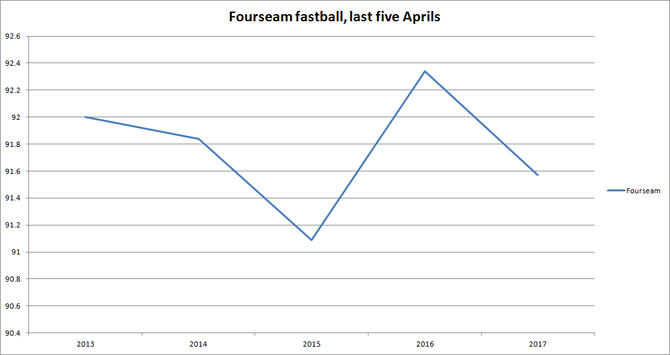
That’s no guarantee that Greinke is going to pitch like his vintage self this season, but it does ease potential red flag Fantasy players might be worried about. I’ll also be keeping a close eye on Greinke’s teammate Shelby Miller’s velocity, after he was up two MPH from his career high in the spring. Charlie Morton is also in this category, after seeing a big velocity bump in the spring.
New pitches
This isn’t a stat, necessarily, but there are stats related to it that matter. I want to see how Taijuan Walker’s re-worked breaking ball looks, and I’ll be keeping an eye on his velocity and movement with the pitch, yes, but also his results. I want to see him picking up swings and misses with the pitch, and throwing it as the out pitch he has lacked in recent seasons.
I’ll also be keeping an eye on Dylan Bundy’s cutter, Robert Gsellman’s slider and Jimmy Nelson’s split-change because all three have shown flashes in the past. A new pitch could help unlock more potential.
Balls in play
We are, potentially, in the midst of a new batted-ball revolution. Players like J.D. Martinez, Daniel Murphy and Josh Donaldson have rather unexpectedly developed into star-caliber players after tweaks to their swings that allowed them to unlock their latent power by lifting the ball more frequently, and more batters have talked about making that approach a part of their game this offseason as a result.
According to research done by BaseballProspectus.com, line drive and flyball rates tend to stabilize pretty quickly -- around 80 balls in play for hitters and 70 for pitchers. Murphy put about 80 balls in play last season overall, and while he is on the extreme end of batters in terms of strikeout rate, you should still be able to get a feel for the beginning of any changes hitters are making by around the first month of the season.
Some things I’ll be keeping an eye on early this season are:
- Billy Hamilton -- He increased his ground-ball rate late last season, and that could be a key to him breaking out.
- Ryan Zimmerman -- Zimmerman still hit the ball hard last season, but too often hit it into the ground, negating his raw power. He has expressed a desire to hit the ball in the air more often this season.
Eric Thames -- He was one of the best power hitters in Korea over the last three years, and if he can consistently lift the ball -- and avoid striking out too much -- his power could play up at Miller Park.
Strikeout rates
According to that same research from BaseballProspectus, strikeout rate tends to stabilize relatively quickly as well. For pitchers, it comes around 70 total batters faced; for hitters, around 60 plate appearances. That’s well within the first month, so any changes in strikeout rate could become apparent early on. I’m not necessarily keeping a close eye on anyone in particular here, though after watching Carlos Martinez strike out 10 in his first start, I would like to see if he can finally start missing enough bats to get his K rate to the elite level, where his stuff suggests it should be.
It will also be interesting to see how Aaron Nola fares early on in this regard. He had one of the best strikeout rates in baseball last season, and struck out 23 in 19 1/3 innings in the spring, but has consistently had middling swing-and-miss rates backing him up. His spring K/9 is also inflated by the number of baserunners he allowed, and his lack of swing-and-miss stuff could be tied to how hittable he has looked at times. If he can post an above-average strikeout rate early, it could go a long way toward assuaging any concerns in this regard.