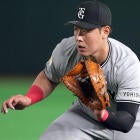

Craig Biggio's Hall of Fame career marked by defensive flexibility
Not many throughout baseball history have been able to hold three different key defensive positions in their careers, but Hall of Famer Craig Biggio is a notable exception.

By
Dayn Perry
•
2 min read

Craig Biggio, who will be inducted into the Baseball Hall of Fame on Sunday, has the kind of "counting stats" dossiers -- i.e., more than 3,000 hits; 668 doubles; 414 steals; 1,844 runs scored, for instance -- that would argue for a plaque regardless of what else he did. Biggio, though, did quite a bit that doesn't show up in the usual litany of offensive bestowals. Biggio is a rarity in that he spent significant time at three different premium positions. He was furthermore a rarity in that he spent time, specifically, at the unlikely troika of catcher, second base and center field.
Biggio was drafted as a catcher out of Seton Hall and spent the first four seasons of his big-league career wielding the tools of ignorance (even making the NL All-Star team as a reserve catcher in 1991). In 1992, though, the Astros moved him to second base -- not because of any defensive shortcomings behind the plate, but rather in an effort to keep him healthy and in the lineup as often as possible. Four Gold Gloves at the keystone followed. In 2003, Biggio deferred to the newly signed Jeff Kent and moved to center field. He was in his age-37 season. At such an age, Biggio didn't flash great range, but he committed only one error in center all season, and the Astros won 87 games and finished second in the NL in Defensive Efficiency.
Not only are Biggio's three primary positions lodged at the far-right end of the Defensive Spectrum, but they're also high-skill positions that would seem to have little to do with one another when it comes to the required skill sets. Yet Biggio spent a lot of time at each one of them. So the question is teased: How rare is it for a player to do what Biggio did on defense throughout his career? Speaking of which, here's what Biggio did ...
| Craig Biggio's career playing time at catcher, second base, and center field | ||||||
| Position | Games played | Games started | Complete games | Total defensive innings | ||
| C | 428 | 392 | 348 | 3,493 | ||
| 2B | 1,989 | 1,959 | 1,691 | 17,154 2/3 | ||
| CF | 255 | 254 | 220 | 2,203 2/3 | ||
Biggio played the 14th-most games at second base in baseball history, but he did more than just dip his toe into those other two positions.
As it turns out, since 1901 just 80 players have spent any time at all at second base, catcher, and center field. Raise the bar to minimum 500 career games, and the list since 1901 is whittled down to 48. Go to mininum 1,000 career games, and you get 28. Of course, a number of those barely spent any time at one or two of the three positions of note. Filter for a mininum 30 games at each C, 2B, and CF -- a pretty permissive standard, it should be noted -- and you get one player: Biggio. Only other Hall of Famer saw time at all three of these positions, and that was Roger Bresnahan. However, Bresnahan's playing career dates back to the 19th century, and he played just 28 games at second base.
What Biggio did in terms of this particular shade of defensive flexibility simply hasn't been achieved by anyone else, at least to the scale that Biggio did it. That's not the primary reason he's going into the Hall, but it's an indelible part of what made him a great baseball player.
(As always, an awkward fist-bump to the Baseball-Reference Play Index, which makes possible research such as this.)