
How a makeshift Mets starting rotation of relievers and reclamation projects has carried the first-place team
Mets starters have allowed the fewest runs in MLB so far this year

•
4 min read
NEW YORK — Frankie Montas stood at his locker inside the Mets clubhouse with a huge grin across his face. It was the afternoon of May 23, ahead of what would ultimately be a series victory for New York against a loaded Dodgers club.
Montas, who has been sidelined with a high-grade lat strain since the end of March, was set to begin a rehab assignment at High-A Brooklyn a day later and was elated to see the mound again for his new club.
But that wasn't the only reason he was content. The rotation, in the absence of him plus others, has been one of the best in baseball to this point.
"We're a family," Montas told CBS Sports. "Somebody's gonna have to step up, you know. And we were fortunate enough to have those guys."
Through 59 games, the Mets' rotation has been lights out, compiling a 2.91 ERA, which ranks second in the majors behind only the Texas Rangers, with a 23.5% strikeout rate and a .226 opponents' batting average.
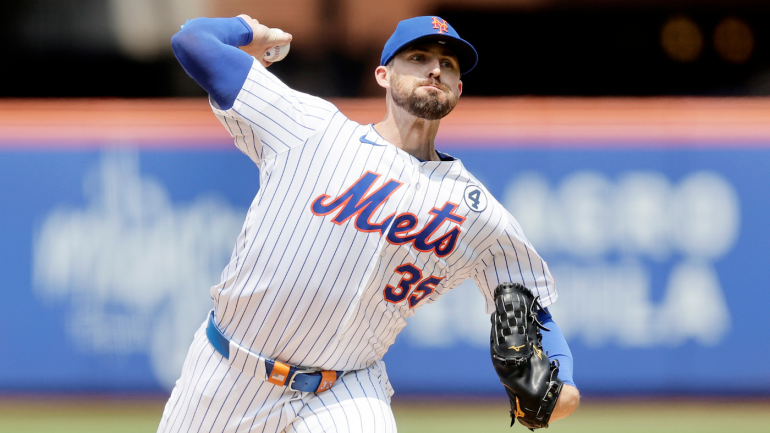
They have done it not only without Montas, but also without Sean Manaea and Paul Blackburn, the latter of whom will make his 2025 debut Monday night against the Dodgers. In their absence, Clay Holmes, Griffin Canning, Kodai Senga, Tylor Megill, and David Peterson have all stepped up.
In their weekend series against Los Angeles, the most feared lineup in all of baseball, the starting pitchers yielded just six runs over the course of three games, including a 7 ⅔-inning outing from David Peterson in which he gave up just two earned runs. After a long rain delay the night before, resulting in the Mets having to dig into their bullpen, Mets manager Carlos Mendoza said he needed Peterson to go deep into the ballgame.
Peterson ultimately left to a standing ovation.
In the week that followed, the Mets went 5-1 against the Chicago White Sox and Colorado Rockies, with wins coming from Megill, Senga, Peterson and Holmes (and one to Edwin Díaz).
While Senga and Peterson have some track record of success, and Megill has shown flashes of his upside, the true surprises in the rotation has been Holmes and Canning. In five seasons with the Angels, Canning posted a 4.87 ERA over 99 career games, 94 of them starts. His mix of a four-seam fastball, changeup, slider and knuckle curve remains largely the same. But this season, he's generating more swings and misses with his fastball — up from 14.8% last year to 19.7% this year. Canning has also emerged as one of the best ground-ball pitchers in baseball, ranking in the 87th percentile.
"I think I'm just pitching a little bit better, you know, changing the speeds, keeping hitters off-balance, sequencing a little bit better," said Canning. "Obviously, I made a couple tweaks with some pitches here and there, but I just feel like I've been in a good place mentally and just kind of focus on attacking and taking it one pitch at a time."
Canning has history as a starter. There's a database that he can tap into when it comes to amplifying his pitching profile, even though much of it is rooted in failure over his major-league tenure. Holmes, though, offers a different story. The right-handed reliever had just four career starts to his name when the Mets signed him over the winter, all of which came in his 2018 rookie season. Since then, he had carved out most of his career as a lockdown late-inning reliever and closer, previously spending parts of his four seasons with the Yankees in that role.
The Mets' plan to transition Holmes into a starting role came with plenty of questions, namely how he would be able to turn over a lineup. Relievers empty the tank over an inning or two, particularly closers. But when it comes to a starter, there's more artistry. Gameplanning. Stuff alone won't save you and the majority of the industry questioned if Holmes could do that.
Holmes has a 3.07 ERA in 12 starts.
All of this (plus hot starts from the likes of Pete Alonso and Francisco Lindor) has added up to one of the best run differentials in the majors, carried by the fewest runs allowed by any team. The Mets sit in first place in the NL East.
"I don't think internally there was any panic," said Manaea, who threw a bullpen session Thursday as he works his way back from a right oblique strain. "It was like, we just had to make the best of what we had. And everybody's been doing unbelievable. So it's been really fun to watch everyone's success and see everyone put in the work."
Sustainability, though, should offer some pause. It's barely June and the long slog of summer stares down the rotation. Holmes, who has never thrown more than 70 innings in a season, already sits at 67 ⅓. Canning has thrown back-to-back bad starts. Furthermore, while New York ranks second in ERA, their 1.28 WHIP ranks 16th in the majors, suggesting the Mets are allowing base runners but wiggling out of it. Eventually, as offenses heat up, that will come back to haunt the Mets.
For now, though, this rotation, even in the absence of some of its key starters, is proving that it can carry the load, too.
"Everyone's got their process," Manaea said. "And the team has done a great job of supplementing that."