

Jarred Kelenic breakout: Three reasons Mariners outfielder may finally have found his swing after Mets trade
The former top prospect, known for constantly tweaking his routine, looks like the real deal early in 2023

•
4 min read

It's only April, but one of the most pleasant developments of the Major League Baseball season has been the apparent rise of Jarred Kelenic, the young Seattle Mariners outfielder best known for his inclusion in the 2018 trade that sent Robinson Canó and Edwin Díaz to the New York Mets. Kelenic has previously struggled to establish a foothold on a big-league job, but he's come out of the gates strong this season, hitting .310/.385/.603 with four home runs and three stolen bases. He entered Thursday ranked eighth in the majors in OPS+ (180).
Kelenic, still only 23, made several tweaks to his game over the offseason. For starters, he changed instruments after a bat-fitting found that he would be more effective with a different weight distribution. ("My bat speed was quicker. It was just more effective than the bat I had been using and I am all on board," Kelenic told Shannon Drayer of Seattle Sports.) Kelenic also simplified his swing, as noted in the spring by Esteban Rivera of FanGraphs. Take a look:
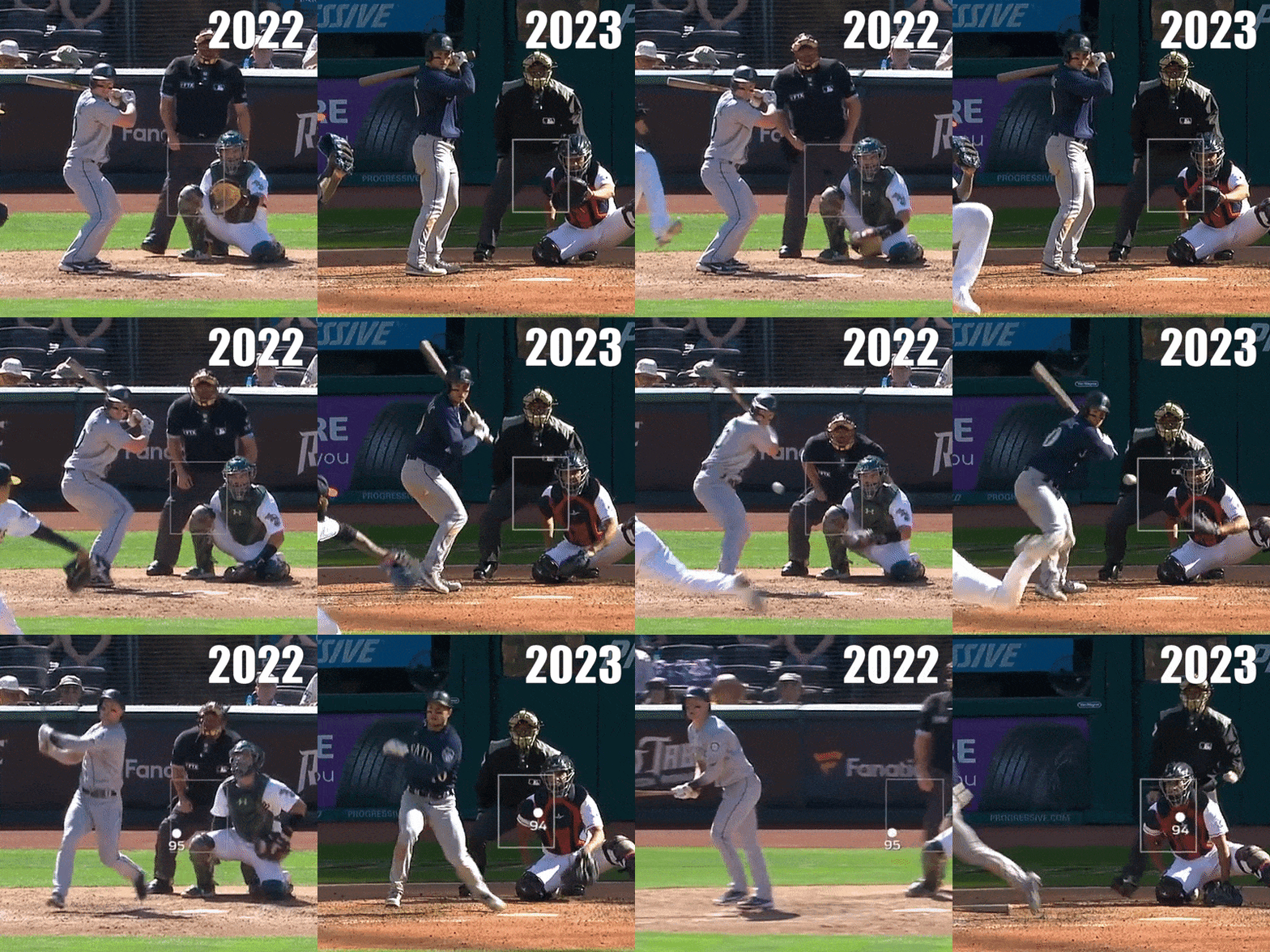
Of course, the season is still too young to know with the utmost certainty that Kelenic's improved performance is genuine. Sometimes, what looks like a breakout will prove to be little more than a hot start. Still, we wanted to highlight three statistics that explain why Kelenic has performed so well, and that provide some hope that his apparent gains may prove to be sustainable. (Do note that the numbers used in this piece come from TruMedia.)
1. Quality of contact
The best things a hitter can do are impact the ball hard and spray it at a good angle. To paint broadly for a sentence: the former depends on a hitter's bat speed and strength; the latter is more dependent on swing plane and barrel awareness. The best hitters tend to have those attributes and more.
Kelenic has thus far shown improvements in terms of how hard he's striking the ball, and where he's hitting it. Coming into Thursday, he had an average exit velocity of 92.2 mph -- nearly 3 mph better than last season, and almost 5 mph better than his 2021 average. More than 54% of his batted balls have had an exit velocity of 95 mph or harder. For the sake of comparison, the league-average mark this season is around 40%.
.@jarredkelenic off the scoreboard! #SeaUsRise pic.twitter.com/a5LJy4kgn5
— Seattle Mariners (@Mariners) April 11, 2023
As for Kelenic's spray, his average launch angle is just under 7 degrees. In previous seasons, he was closer to 14 degrees. In layman's terms, that means he's hitting the ball on the ground more frequently. Overall, 33% of his batted balls have been launched between 10 and 30 degrees -- often described as the "sweet spot" for hitters. That's superior to his previous high mark of 29.9%, and it's even a little above the league-average mark of 31.1%.
If you're looking for comparables, Kelenic is one of 10 players in the top 50 of average exit velocity with a single-digit launch angle. The others are: Randy Arozarena, Ronald Acuña Jr., Christian Yelich, Bo Bichette, Bryan De La Cruz, Shohei Ohtani, J.D. Davis, Julio Rodríguez, and Corbin Carroll. Overall, that's a good group of names to be associated with as a hitter.
2. Improved approach
One of those hitting traits we omitted in the section above is plate discipline. Again, in general, the ideal approach is swinging at strikes -- particularly those located around a hitter's nitro zone -- and laying off balls. The exact calculus varies by hitter and that makes it tough to analyze from afar, but Kelenic's statistical profile suggests he may have improved in this respect.
What we know for sure is that Kelenic is doing a better job of maintaining the strike zone. He's chased after just 22% of the pitches he's seen this season, several percentage points better than the 29% and 28% rates of his past. Whereas some hitters can "fake" improved strike-zone command by swinging less overall, Kelenic has remained aggressive within the zone. His zone swing rate, 65.9%, is slightly higher than it was last season (65.6%).
.@jarredkelenic is LOCKED IN 🔒 pic.twitter.com/nfToMJ1LQi
— Seattle Mariners (@Mariners) April 15, 2023
3. Performance versus pitch types
To take it a step further, we'll note that one of the main knocks against Kelenic has been his pitch recognition, or the ability to discern pitch types. That made him easier for pitchers to exploit, since they could get him out with breaking balls. In an extremely small sample (fewer than 70 total), he's swinging and chasing at them less, and making contact with them more frequently than in the past. If those gains hold, that would be a significant point in his favor.
Additionally, it's commonly accepted knowledge that you have to be able to hit the heater if you're going to make it in the majors. Kelenic is doing just that so far this year. Coming into Thursday, he had a 95.9 mph average exit velocity on fastballs, ranking him 21st in the majors in that category, just behind Wander Franco.
We'll see what the rest of the season holds for Kelenic. There are enough encouraging signs here, however, to think that he may be onto something -- even if he doesn't finish the season ranked as one of the 10 best hitters in the game.