MLB hot stove free agency season finally heats up with a trio of bullpen moves
The A's added Yusmeiro Petit, the Diamondbacks grabbed Brad Boxberger, and the Angels lassoed Jim Johnson to get things going

•
4 min read
Though it may seem absurd, given December is a day away, baseball's hot stove is warming up.
Need evidence? Consider that the bullpen market has seen action in each of the past two days. On Wednesday night, the Oakland Athletics signed swingman Yusmeiro Petit to a two-year deal worth $10 million. Then, on Thursday afternoon, the Arizona Diamondbacks acquired Brad Boxberger from the Tampa Bay Rays in exchange for prospect Curtis Taylor, while the Los Angeles Angels added Jim Johnson from the Atlanta Braves for Justin Kelly.
That Petit is one of the first free agents off the board (and on a multi-year deal) is a remarkable turnaround from last winter, when he didn't find a home until February with the A's division rivals, the Los Angeles Angels.
The A's (and everyone else) saw plenty of Petit, who threw 91 innings while recording a 2.76 ERA and 5.61 strikeout-to-walk ratio. The most impressive aspect of his season was that he ate so many innings while making just a single start. If pitchers like Petit are afforded trademarks, then his has become his rubber arm: he's averaged 76 innings and one start over the last three years. It makes sense that Petit would become more appreciated (and better compensated) in a league that seems content to lean more and more on the bullpen for innings consumption.
Oakland is a comfy fit for other reasons, too -- reasons that go beyond how Petit's extreme flyball tendencies fit well in the A's cavernous ballpark. Their rotation is young and largely unproven -- in the conventional, performance-related sense, as well as the durability sense. Last season, Sean Manaea was far and away the A's leader in innings, and he finished an out shy of 159 innings. Jharel Cotton and Kendall Graveman also topped 100 frames, giving the A's three pitchers in total to break triple-digits -- an amount tied for the lowest in the American League. Petit's ability to soak up those excess innings should come in handy. Who knows, he might even get a look-see in the rotation should the A's deem it necessary.
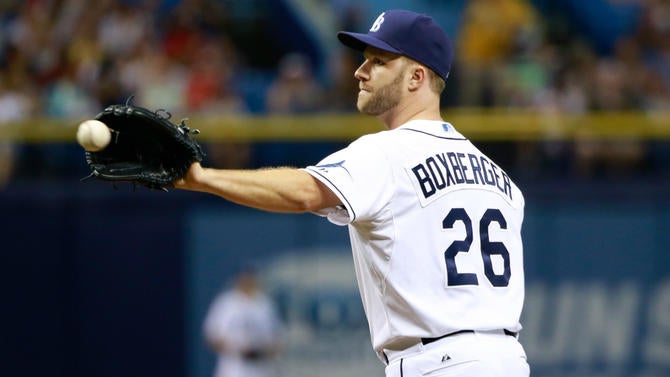
The Diamondbacks' decision to trade for Boxberger is just as sensible. Arizona needed the bullpen help -- what, with Fernando Rodney, Jorge De La Rosa, and David Hernandez all fleeing to free agency -- and by trading for Boxberger they avoid the competition that likely would have arose if he had been non-tendered. The cost, Taylor, is himself likely a future reliever.
In Boxberger, the Diamondbacks receive a former all-star closer. He hasn't flown close to his breakout 2014, when he managed a 2.37 ERA and struck out more than 14 batters per nine. In fact, his past few years have been a battleground on that his command and body have fought for the sake of deciding his most problematic attribute. Boxberger has thrown just 53 ⅔ innings over the last two years. He's done that while yielding five walks and 1.2 homers per nine -- an unsettling combination for any manager asking him to work in a late-and-close situation.
Still, there's reason to like this move. Boxberger has historically had reverse splits due to his top secondary offering being a high-grade changeup. In recent times, however, he's developed more confidence in his slider in an attempt to immobilize right-handed bats. He continued to allow too much hard contact to righties (hence the .753 OPS against them), but it's worth noting his 3.29 strikeout-to-walk ratio against them was the highest its been since 2014 -- to the extent that it was nearly higher than the sum of his previous two years' strikeout-to-walk ratios, at 3.36.
If Boxberger is hearty and hale -- and hey, who knows if he'll be either -- he should slot in to a high-leverage role, perhaps even succeeding Rodney as closer.
Boxberger wasn't the only former all-star closer on the move, as Johnson (or, more precisely, his $4.5 million salary) was shipped to the Angels by new Braves general manager Alex Anthopoulos.
Whereas Johnson used to be old reliable, throwing strikes and coercing groundballs, he's done less of both in recent years. Last season marked the first time in his career he'd permitted more airballs than groundballs. Perhaps predictably, Johnson's increased flyball tendencies led to a career-worst home-run rate. He finished with a career-high strikeout rate to balance things out a bit, but walks and homers are no way to go about life for a high-leverage reliever.
Typically, such shifts are accompanied by an alteration in pitch usage. Not here. Johnson used his sinker and curveball more in 2017 than 2016. The difference doesn't seem rooted in location, either. Rather, the key seem to be that Johnson's sinker lacked the downward movement typically associated with the pitch. Is that a better or worse sign? Depends on your point of view.
The Angels, for their part, appear optimistic they can get a better performance out of Johnson. He could fill a late-inning role, or he could be a middle reliever with a famous name. It all depends on how right Billy Eppler is in his evaluation.