MLB trends: Vlad Guerrero Jr.'s trouble at home, Jose Abreu's fight with Father Time, Ryan Noda's lucky chance
With less than a month until the All-Star Game, several first baseman are at a turning point

By
Mike Axisa
•
10 min read
The 2023 MLB season is nearly three months complete and the All-Star Game at Seattle's T-Mobile Park is right around the corner. Before you know it, we'll be at the trade deadline, then we'll into the postseason races in August and September. The baseball season seems to move a little faster with each passing year, doesn't it?
Our bi-weekly series breaking down various trends across the league continues Wednesday with a look at three first baseman: one with an unusual home/road split, one showing signs of life with the bat, and one breaking out as a rookie. Two weeks ago we broke down Shohei Ohtani's control issues, the Rangers' offense, and the Twins' struggles with the bases loaded.
Guerrero's home power outage


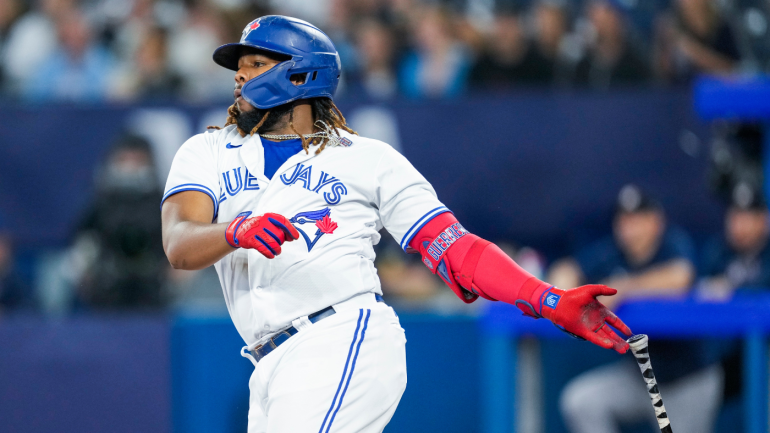
I'm going to show you a home run. It is a notable home run even though it is not unlike dozens of other home runs you've seen. It was a two-run homer in the third inning of what became a 9-0 win. It wasn't on a pitch comically out of the strike zone nor was it a towering home run that traveled 475 feet or something like that. It's notable, but you've seen homers like this before:
Why is that home run notable? Because it's the last homer Vladimir Guerrero Jr. hit in the Rogers Centre. And, as the old outfield walls tell you, it happened last season. Sept. 30 to be precise, in the Blue Jays' third-to-last home game of the regular season. Including the postseason, it has been 36 games and 152 plate appearances since Vlad Jr. last went deep in front of the home fans.
"You chalk it up to kind of a really small sample size," Blue Jays manager John Schneider recently told TSN about Guerrero's home power outage. "I'm sure he wants to hit a home run here and I'm sure the fans want him to hit a home run here and those are going to come. And when they come, they're probably going to come in bunches when they do."
Vlad Jr. has been much more productive away from home in general this season. He's missing batting average in addition to homers at home: .239/.311/.299 at Rogers Centre this year and .308/.380/.522 on the road going into Tuesday night's game in Miami. For whatever reason, Guerrero has been excellent on the road and almost a replacement level hitter on the road.
The underlying data tells us Guerrero is more or less the same hitter at home as on the road. His strikeout (18.2%) and walk (10.2%) rates at home are higher than they are on the road (14.0% and 7.8%, respectively), though it's not like Guerrero is striking out excessively or not walking enough. Those plate discipline numbers are more than fine. Here's the contact quality:
| Ground ball % | Pull % | Average exit velocity | Hard-hit % | Barrel % | |
|---|---|---|---|---|---|
Vlad Jr. at home | 42.1% | 36.8% | 94.7 mph | 54.7% | 12.6% |
Vlad Jr. on road | 51.9% | 43.7% | 94.3 mph | 58.5% | 14.1% |
MLB average for RHB | 42.7% | 40.8% | 89.1 mph | 40.7% | 8.5% |
Guerrero is annihilating the ball wherever he plays. His ground ball rate is higher than you'd like on the road, though the sample is small enough that it could be down around 40% after another 2-3 games. Point is, there is not some massive difference in the way Vlad Jr. is hitting the ball at home and on the road. He's crushing the ball and getting wildly different results.
Perhaps the Rogers Centre itself is to blame? The ballpark received a facelift this season that raised the walls and brought them in at some spots. The expectation was there would be not uptick in home runs because the higher walls compensate for the shorter distances, though that hasn't really played out. Here are Statcast's home run park factors for Rogers Centre:
| All HR | RHB HR | LHB HR | |
|---|---|---|---|
2022 | 117 | 128 | 88 |
2023 | 91 | 92 | 90 |
There have only been 32 games played in Rogers Centre this season, though in those 32 games it has suppressed home runs to 91% of the league average. Last year it was 117% of the league average, and right-handed hitters have felt the squeeze more than lefties. Vlad Jr. is, of course, a righty hitter. The small sample numbers suggest the stadium's new dimensions have hurt Guerrero.
That all said, Vlad Jr. has not exactly been peppering the wall with doubles or even the warning track with fly outs at home. He's hit three balls at Rogers Centre this year that Statcast says would have been a home run in at least one other ballpark. That's it. Three. Here they are:
Guerrero has been mired in a slump in all ballparks the last few weeks and he took a good but not truly great .279/.350/.428 line into Tuesday night's game. Something's off at the plate for the 2021 AL MVP runner-up and it is showing up disproportionately at home. This is a "Guerrero is slumping, period" problem, not a "Guerrero forgot how to hit in Rogers Centre" problem.
"I'm very aware (I haven't hit a home run at home this year), but it's not like I'm not trying to do great things here at home," Guerrero told TSN. "Every day I come here and work very hard trying to get things right, but that's part of it, and I know eventually I'm going to start hitting some homers here."
Worrisome signs for Abreu


When the defending World Series champion Astros replaced Yuli Gurriel with José Abreu over the winter, it looked like a significant upgrade. Gurriel was a good player for a long time with Houston, but, at age 38, he hit a weak .242/.288/.360 in 2022. There weren't many roster spots the Astros could meaningfully upgrade over the winter, though first base was one of them.
Abreu, who turned 36 in January, carried age-related risk himself, though he authored a .304/.378/.446 batting line with the White Sox last season. His contact and plate discipline numbers were strong and so was his contact quality. Abreu hammered pitches in the zone and didn't expand often. He's been a really good hitter for a really long time and looked like an improvement over Gurriel.
Alas and alack, Father Time is undefeated, and he'll often sneak up on even the most productive players. Abreu did not hit a home run until his 52nd game this season and, to his credit, he had fun with it when he did finally go deep:
"I think when I stepped on first base, that was when I noticed that the ball wasn't in play anymore. I think that's when I flipped the switch," Abreu told MLB.com after the game. "... The guys have always supported me since the first minute I got here. They supported my ups and downs. They've been working, trying to get me to be my best self. I'm very grateful for that."
Abreu had a six-game hot streak earlier this month, going 11 for 27 (.407) with three home runs from June 8-14, but he took a 2 for 19 (.105) slump and a .224/.279/.309 season batting line into Tuesday night's game. He has been one of the least productive first baseman in baseball and there are troubling signs aplenty. Abreu's chase rate spiked over the 28.5% MLB average in the middle of last season and it has remained elevated:
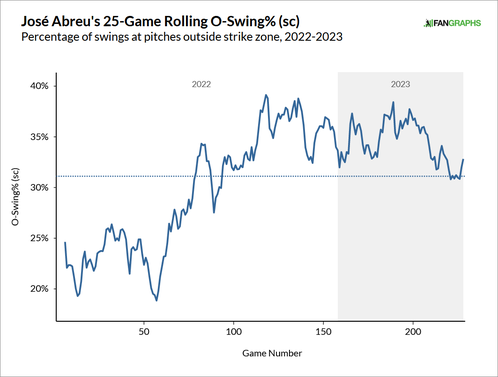
Abreu's average exit velocity has dipped from a robust 92.2 mph last year to an average-ish 88.7 mph this year. His barrel rate, the rate at which he hits balls with the combination of exit velocity and launch angle most conducive to extra-base damage, has slipped from a strong 9.5% last year to a below-average 5.4% this year. Abreu's simply not hitting the ball like he did a year ago.
Historically, two telltale signs of a slowing bat are a) more chases out of the zone and more strikeouts (Abreu's strikeout rate has jumped from 16.2% last year to 23.9% this year), and b) more ground balls. Those suggest the hitter is cheating and starting his bat earlier. Now that we can measure things like exit velocity, we can add reduced contact quality to the list as well. When a hitter on the wrong side of 35 shows some or all of those traits, it usually means trouble.
Abreu's ground ball rate is actually lower than last year (47.9% to 45.6%), though his chases and strikeouts are up, and he's not hitting the ball as authoritatively as in the past. Those are worrisome signs for a 36-year-old in the first year of a three-year, $58.5 million contract. That isn't to say Abreu can't make an adjustment (or a few) and find a way to be a productive hitter, just that there are several indications he is no longer the hitter he was even last season.
"Sometimes our fans really want to see him hit the home runs and do the things we are used to seeing out of José Abreu, but I think it's just a matter of time," Astros bench coach Joe Espada told the Houston Chronicle last month. "This guy has been a really good hitter for a long time, and I think it's a matter of days or weeks when we're going to see José just get hot and carry our ballclub for a while."
A bright spot for the A's


Recent seven-game winning streak aside, the Athletics have had a terrible season that is bordering on historically terrible, and it's all by design, right? The roster was intentionally stripped down and owner John Fisher and team president Dave Kaval cried poor until a city gave them a bag of money for a new stadium. Las Vegas took the bait, so in a few years they'll be a VegA's.
Owners and front offices tank. Players do not. A's players are playing for their jobs, careers, and livelihoods, and if you're a young player or fringe big leaguer looking for an opportunity, Oakland is a great place to go. Brent Rooker is a perfect example. The 28-year-old bounced from the Twins to the Padres to the Royals via minor trades and waiver claims before finding landing with the A's this season. He's been a lineup mainstay all year and could very well represent the team at next month's All-Star Game.
Another player benefitting from the A's tear-it-all down roster building approach: Ryan Noda. The rookie first baseman was selected from the Dodgers in the Rule 5 Draft this past December (Los Angeles acquired him from the Blue Jays in the Ross Stripling trade a few years ago) and, after beginning the season as a part-time player, Noda hit his way into the everyday lineup and replaced Jesús Aguilar at first base. Aguilar was released earlier this month, further cementing Noda as the starting first baseman.
The 27-year-old Noda slugging 29 home runs in Double-A in 2021 and 20 home runs in Triple-A in 2022 while also posting big walk totals and on-base percentages. In that respect, he's a cliche "Moneyball" player. With the A's this season, Noda took .245/.397/.422 line with seven home runs and a league-leading 48 walks into Tuesday's game. Among 157 qualified hitters Noda ranks:
- 8th with a .397 OBP (2nd in the AL)
- 2nd with an 18.7% walk rate (behind only Juan Soto)
- 19th with a 138 OPS+ (just ahead of José Ramírez)
- 26th with a 13.3% barrel rate (tied with Rafael Devers)
- 14th with a 19.7% chase rate (tied with Alex Bregman)
Noda does strike out a good deal -- his 33.1% strikeout rate is fourth highest among those 157 qualified hitters -- but he's shown excellent plate discipline and he hits the ball quite hard when he does make contact. Is he a star-caliber hitter? Nah, I don't think so. Is he a good hitter and an MLB regular? It sure looks like it. Getting on base and socking dingers will never go out of style.
Back in 2014, the Athletics struck Rule 5 Draft gold with Mark Canha, who is the best position player to come out of the Rule 5 Draft since Josh Hamilton in 2006. Canha developed into a reliably above-average big leaguer with the A's before departing as a free agent two years ago. Noda strikes out more but has a similar plate discipline-driven skill set as Canha. For a bad Oakland team, Noda's rookie success is a nice bright spot. They just might have found themselves a young first baseman for the long haul.
"It's tough when you're a Rule 5 kid to feel comfortable," A's manager Mark Kotsay told MLB.com about Noda recently. "Being in the big leagues for the first time and knowing a team took a chance on you creates expectation. For how he's handled that and now to see the confidence, it's a good sign."