Three MLB players making strong spring impressions, including Yankees lefty trying to make big-league return
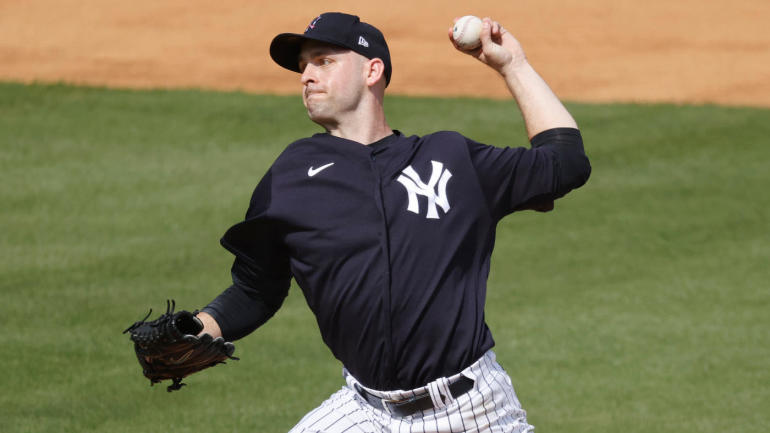
Lucas Luetge hasn't pitched in the majors since 2015, but he could crack the Yankees bullpen

By
Mike Axisa
•
8 min read
Spring training is full of lies. It's the worst time of year to evaluate players and the statistics are close to meaningless because the quality of competition varies so much, plus you never really know who is working on what. I'll never forget Andy Pettitte saying he was working on his changeup after getting blasted one spring game, going back and watching the video, and yep, almost all changeups.
At the same time, jobs are on the line in spring training. Teams will hold spring competitions to decide their final Opening Day roster spots and it's up to the player to perform. A good spring may not be enough to win you a job. A bad spring will almost certainly take you out of the running though. Here are three players putting themselves on the map and in position to hold important roles come the start of the regular season in three weeks.
1. DH Ty France, Mariners


Acquired from the Padres in the Austin Nola trade, France looked like a potential Quad-A player at this time last year. He obliterated the Triple-A level in 2019 (.399/.477/.770 in 76 games) but was so-so at best with San Diego (.234/.294/.402 in 69 games). As a 25-year-old with no real defensive home, France was at risk of getting left behind on a deep Padres roster.
The expanded 28-man roster gave France another opportunity last year and he made the most of it, going 17 for 55 (.309) with two home runs with the Padres before the trade. With the Mariners, France went 26 for 86 (.302) with two homers. All told, he authored a .305/.368/.468 batting line in 155 plate appearances and was a 1.0-WAR player in 2020.
The Mariners had a quiet offseason on the position player side and France reported to spring training with a leg up on the starting DH job. He's done nothing to lose it so far. He is 8 for 13 (.615) with three homers and zero strikeouts in the early going.
"He has a good swing. What he does with his swing, to keep the barrel of the bat on plane for an extended period of time allows him to hit so many different pitches and so many different velocities, he's able to drive balls out. He stays through it," manager Scott Servais recently told reporters, including 710 AM's Shannon Drayer. " ... He's got what he needs to be successful in this league."
France admitted he got caught up trying to elevate the ball after 2019, and he's since gone back to the swing he used earlier in his career. "Guys were just beating me at the top of the zone with fastballs. I went back to being myself. It's just a thought process. I know if I'm thinking, swing down, it'll flatten my barrel out through the zone for as long as possible," he told Ryan Divish of the Seattle Times.
The underlying numbers are underwhelming -- France ranked near the bottom of the league in average exit velocity and hard-hit rate last season -- though exit velocity and hard-hit rates aren't everything. France excels at lining the ball over infielders and in front of outfielders, and for extra base hits down the line and into the gaps. He'll hit for more power that way than he will muscling up and trying to hit homers.
Truth be told, the DH job was likely always going to France after what he did last year. His primary competition for that job is Jose Marmolejos, who had a .261 on-base percentage as 27-year-old rookie last year. France did enough to get the job last year and what he's done early this spring put him in position to get a much longer look in 2021. The Mariners will give him plenty of time to show this is the real him.
"It'll depend on what we need as a ballclub and Ty understands," Servais told Divish about France's role. "Anytime you can do that much damage at the plate and have that good of an idea of the strike zone and you just continue to get better, that's a really, really valuable offensive player. We're going to need it."
2. LHP Lucas Luetge, Yankees


It has been five years since Luetge, 34 later this month, last pitched in the big leagues. He threw 40 2/3 innings with the Mariners as a Rule 5 Draft pick in 2012, worked as an up and down depth arm from 2013-15, and has spent the last five years in the minors. Luetge had Tommy John surgery in June 2017 and spent last season at the alternate site with the Athletics.
The Yankees gave Luetge a minor-league contract over the winter and he's been spectacular early in camp: 11 batters faced, eight strikeouts, and 17 misses on 26 swings, which is incredible any time of year. In his most recent outing, Luetge struck out Didi Gregorius, Bryce Harper, and Andrew McCutchen in order.
"I knew we were excited to sign him. He's absolutely jumped out at us going back to even the first bullpens," manager Aaron Boone recently told reporters, including SI.com's Max Goodman. "It's a really good breaking ball, it's a swing-and-miss breaking ball. He's got all the spin numbers that take you back a little bit. Even though he's not overpowering with the fastball, the fastball really plays as well."
Luetge pitches at three speeds: 90 mph fastball, mid-80s slider, and mid-70s curveball. When he was last in the big leagues in 2015, his spin rates were mediocre if not straight up bad. Luetge improved them while in the minors the last few years -- those spin rate are what attracted the Yankees to him -- and he now boasts comfortably above-average spin on all three pitches.
| 2021 spin rate | 2015 spin rate | MLB average spin rate | |
|---|---|---|---|
Fastball | 2,770 rpm | 2,578 rpm | 2,306 rpm |
Curveball | 2,866 rpm | 2,329 rpm | 2,532 rpm |
Slider | 2,801 rpm | 1,975 rpm | 2,441 rpm |
The Yankees recently lost setup man Zack Britton to elbow surgery and will elevate Justin Wilson in the pecking order. That creates an opening for a middle innings lefty, a job Luetge could potentially fill. If nothing else, he's put himself on the radar with his prolific strikeout and spin rates this spring. He was going to have to wow to get serious Opening Day roster consideration. Being merely good was not going to be enough, and Luetge has wowed thus far.
"Every free agent minor leaguer's plan is to start off hot," Luetge told the New York Post's Joel Sherman. "They tell us the first little bit does not matter, but first impressions do matter."
3. UTIL Josh Rojas, Diamondbacks


Every team wants their own Ben Zobrist, that super utility guy who can play anywhere and put up really good offensive numbers as well. It's not an easy job -- Zobrist himself was primarily a second baseman the last few years of his career -- but if you find a guy who can do it, like Enrique Hernandez or Marwin Gonzalez the last few years, it's a major boost to the roster.
The D-Backs acquired Rojas in the Zack Greinke trade in hopes he would become their super utility guy. He played every position other than pitcher, catcher, and center field in the minors, and Arizona has used him at second, short, left, and right in his limited big-league action. Here's where Rojas has played this spring:
- Second base: 2 games and 11 innings
- Shortstop: 7 games and 34 innings
- Left field: 1 game and 5 innings
Nick Ahmed has been limited by a knee injury this spring, opening up playing time at short. As important as the positions on the field are the spots in the lineup. Rojas has started eight games this spring, including five at leadoff, all within his last six starts. The D-Backs had a revolving door at leadoff last year (three players had at least 13 starts at leadoff) so the job is there for the taking.
"There's a ton of bat speed, there is great barrel awareness. The barrel is finding the baseball," manager Torey Lovullo recently told reporters, including 98.7 FM's Kevin Zimmerman. "… What his best position? His actions for me are that of a middle infielder. Where that takes us, I don't know. I don't know exactly at this point."
Of course, Rojas has to hit to make the team, nevermind take over as the full-time leadoff hitter. He is a .206/.295/.271 hitter in 227 career plate appearances with the D-Backs. So far this spring the 26-year-old is 9 for 25 (.360) with three home runs, and he attributes his early success to a new offseason program.
"I changed a lot of things," Rojas told MLB.com's Steve Gilbert. "I changed my diet. I changed my sleep habits. I changed how hard I was lifting. I also started swinging a lot earlier. I started working with (our hitting coaches) probably at the beginning of January. A little bit in December but really picked it up in January. So instead of coming in for Spring Training like (it) used to happen, making those adjustments while playing games, now I can actually work on at-bats and fine-tune those things instead of making big tweaks while playing other competition."
The D-Backs lost Kole Calhoun to knee surgery recently and he will be out a while, opening an outfield spot. Arizona could plug Rojas in the outfield, or they could put Rojas at second and move Ketel Marte back to the outfield. Point is, a full-time lineup spot just opened, and Rojas is early in the process of playing his way into a prominent role. His bat could win him a job in spring training and his versatility could keep him on the roster permanently.
"I think that it's my job to compete and do the best I can," Rojas told Gilbert. "Obviously there's openings on the field, depending on where Ketel has to go and anything like that. So it's my job to show that I can play and crack the lineup. It basically falls on my shoulders to show that I can compete against anybody we face."