Yankees vs. Red Sox in MLB playoffs: A tale of three lefties that could quickly swing the ALDS
Lefties Chris Sale, David Price and J.A. Happ could be the key to this series

By
Jonah Keri
•
6 min read
In this, the five trillionth series pitting the New York Yankees and the Boston Red Sox, a passel of different factors could decide the outcome.
For Boston, you've got the Killer B's, the homegrown core of the roster that's led by likely MVP Mookie Betts. J.D. Martinez and Craig Kimbrel are super-elite talents in the middle of the lineup and back of the bullpen.
Meanwhile New York's got the Baby Bombers, the group of young sluggers led by Aaron Judge and Giancarlo Stanton that got even better when the Yankees heisted out-of-nowhere star Luke Voit from St. Louis. Combine an offense that produced more home runs than any other in baseball history with the best bullpen in the league and you've got a fearsome October matchup.
But here's the thing: The American League Division Series might very well get decided by midnight tomorrow night. And with big question marks surrounding Boston's top two starters, it's the underdog Yankees who could jump out to an early lead.
Here are the three lefties who could swing this series in the next two nights.
How effective, and durable, will Chris Sale be?
The answer to this question, at least before we watch Sale pitch in Game 1 of the ALDS on Friday night, comes down to your general level of optimism.
If you're a glass-half full Red Sox fan, you appreciate management's plan to ramp Sale's workload back up gradually in September, following a shoulder injury that knocked him out for three weeks. After going one, three, 3 1/3, and 4 2/3 innings in his final four outings of the regular season, then getting eight days rest to recover further, the hope is that Sale will be at or close to full strength against the Yankees, enabling him to pitch well and pitch deeper into the game.
Color me skeptical. First, if Sale pitches five innings or fewer then gets pulled in a close game, the Yankees' dominant bullpen gets the edge over Boston's merely very good relief corps. More importantly, the odds skew heavily against Sale looking his best, given recent trends. In his final August start before his disabled-list stint, the lanky lefty's fastball clocked in at 98 mph. It trended down from there, going from 96 to 94 to 93 and then to an alarming 90 in those four post-DL appearances. Sale is no one-trick pony, dominating hitters with his slider and changeup as well as his fastball when he's in a groove. But if his heater isn't heating up, he'll lose ticks on his other pitches too, which also making hitters better able to adjust to slower stuff, knowing they don't have to gear up for high-90s cheese.
The Red Sox obviously believe this won't be a major problem, since they've marked Sale down for Game 1 duty. But as we'll see, that might be partly due to the fact that expected results in this series for Boston's Game 1 and Game 2 starters might not be as rosy as their broader track records might lead you to believe.
The Price might be wrong for Boston
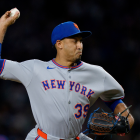
While he wasn't quite back to his vintage age self this year, David Price did toss 30 starts, posting a 3.58 ERA and striking out a batter an inning while pitching as a lefty in front of the Green Monster. Many observers remain concerned about his numbers against the Yankees, though.
To wit: For his career, Price owns an ugly 4.90 ERA against New York, allowing a disturbing 270 hits in 250 innings. He's been the man on the mound for numerous Bronx Bomber highlights too.
I'd argue that Price's results against Derek Jeter, and other players who long ago stopped wearing pinstripes, isn't all that relevant for this year's ALDS. But Price doubled down by being absolutely horrendous against the Yanks this season. In four appearances, he posted a putrid 10.34 ERA against them, allowing 21 hits, nine walks, and an incomprehensible nine home runs over 15 2/3 innings.
And while I often believe that players' postseason reputations get built on misleading small sample sizes and often reverse themselves over time (ask this guy, or this guy), Price's lousy performances in October start to reveal a pattern. We're now at 73 1/3 innings of playoff pitching with a 5.03 ERA, with 16 home runs allowed doing much of the damage. More than that, Price has fared better as a reliever than as a starter in the playoffs, holding opponents scoreless in six of his eight postseason playoff appearances, including 6 2/3 shutout innings in two long-relief against the Astros in last year's ALDS.
Now as ever, it's much harder to dominate over six, seven, or eight innings in a game than it is for one or two. The challenge becomes even greater for starters in the postseason, given that they might be throwing innings number 228, 229, and 230 for the year, and might be running out of gas. Whether it's his predictable repertoire of almost all fastballs, fatigue at the end of long seasons, or something else, it's fair to wonder if Price might not be cut out to be a top-flight starting pitcher in October ... especially against the Yankees.
J.A. Happ is just what the Yankees needed
Flash back to the start of this season, and you'd have a hard time convincing people that J.A. Happ would look better than the former Cy Young winner Price and the five-time Cy Young top-five guy Sale. But that's exactly where we are, on the eve of this matchup.
Happ's career renaissance dates back to 2015, when the Pirates nabbed him in a deadline deal, then coaxed terrific numbers out of him for the rest of that season. Pittsburgh's pitcher whisperer Ray Searage convinced Happ to throw more high fastballs, advice you didn't usually hear issued to 30-something lefties with so-so velocity. But Happ followed that advice, and flourished.
Now just two weeks away from his 37th birthday, Happ has continued to thrive. And while his fastball-heavy repertoire looks a lot like Price's, the difference is that Happ has mastered the ability to throw heat up in the zone and get outs that way, whereas Price has struggled at times with his more corner-to-corner approach -- despite throwing harder than Happ does. Opponents hit just .203 against Happ's fastball this year, and just .160 against his slider.
The final step was getting Happ out of going-nowhere Toronto and sending him to the one team that could use him most. Staff ace Luis Severino struggled mightily for much of the second half, Sonny Gray never made good on his potential after being acquired from Oakland, and young lefty Jordan Montgomery had season-ending surgery. The loss of Montgomery in particular left the Yankees short on left-handed arms. With a comically short porch in right field that could entice any left-handed hitter who played a year of Little League to swing for the moon, finding a quality lefty to slot into the rotation alongside righties Severino and Masahiro Tanaka became a top priority. Happ has come through in spades, flashing a 2.69 ERA, punching out a batter an inning, and (if you're into this kind of thing) posting a flawless 7-0 record as a Yankee.
You could nitpick and point to the four runs Happ allowed in his final regular-season start at Fenway Park, and note that he might be a better fit pitching in the Bronx than he is in Boston. But he's also quickly emerged as the Yankees' most consistent pitcher, and far less of a question mark than Chris Sale still trying to bounce back from a shoulder injury. New York could easily steal Game 1 tonight thanks to both the starting pitching matchup and the Yankees' killer bullpen, giving them a big edge in the best-of-five series.