Exploring Utah Jazz's decision not to retain Enes Kanter
If Enes Kanter is a max player, why did Utah -- with cap space and a desperate need for talent -- not want to keep him? And what does its decision say about OKC's max contract for him?

By
Matt Moore
•
7 min read

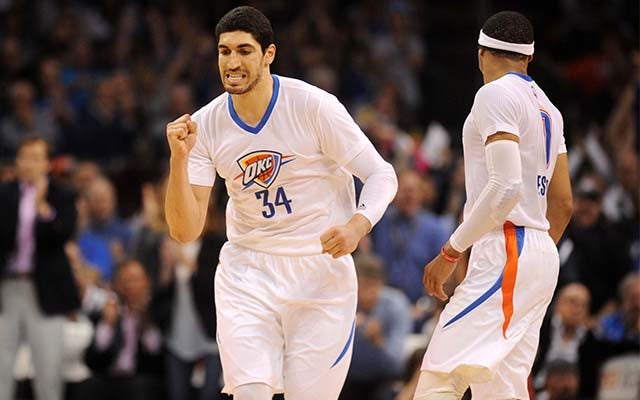
The Enes Kanter era in Utah ended poorly. Kanter was drafted third by the Jazz in 2011, and Utah envisioned him as a key part of their future. Instead, his progression stagnated repeatedly; it was always a one-step-forward, two-steps-back situation. Talks with Kanter on an extension broke off last fall and the situation deteriorated from there, with Kanter effectively demanding a trade.
After the trade to Oklahoma City, Kanter said he just didn't see himself as a fit in Utah. Most of that, however, was the emergence of Rudy Gobert. Kanter lost significant minutes along to Gobert. Instead of embracing that challenge, Kanter pouted, and the week of the trade he admitted that he didn't always play hard there -- a pretty damning admission. He also trashed his former team's organization in a big way.
The mounting frustration weighed him down. On Saturday, he admitted, "I didn't bring it every night.
"I think the difference is probably I like playing basketball there," Kanter said. "That's the most important thing. Never liked playing basketball before in my NBA career. That's my first time I start like playing basketball there, for my team, for the fans, for my teammates, for coaches, everybody. That's the first time."
Kanter said upon arriving in Oklahoma City that he experienced a higher level of professionalism, though he declined to discuss specifics about his issues with the Jazz.
"I don't want to make no comments on them," he said. "But right after I went to OKC, I was like, 'Oh man, this is how an NBA team is.' "
Source: Enes Kanter rips Jazz organization after shootaround (with video) | The Salt Lake Tribune.
Openly flame-broiling your former team doesn't look good, no matter what the situation was. (For what it's worth, other Jazz players took a lot of exception to his comments.)
Here's what's interesting, though. Kanter received a max extension from the Oklahoma City Thunder this summer. The prevailing logic around that move was that with OKC cap-strapped, and if they wanted to keep Kanter, they had to pay him big money (matching the Blazers' max offer for him). Regardless of his overall value, Kanter was worth that money to them. Here's a different perspective on it, however.
The Jazz are still rebuilding. They made strides last year, and some believe they can challenge for a playoff spot this summer. But they have oodles of cap space with such a young roster and every reason to stockpile young talent, especially talent they've spent a top-three pick on. Kanter was making the situation uncomfortable, but they still could have retained him and forced the situation. To do so, the Jazz would've had to spend big money on him -- money they had to spend -- and they were in just such a position to spend it on Kanter. After all, they need "elite offensive talent" as Kanter is so often described.
Jonathan Tjarks over RealGM made a good point that's worth considering:
The only things (the Jazz) need on the market are finding veterans who can fit into small roles and complement what they already have. Soon enough, they are going to have to pay all of these guys and that’s what you really want to spend your money on. They knew Kanter was probably not going to be worth the contract his statistics warranted because they had seen him up close and personal over the last three years. That’s what’s so often forgotten in free agency - a lot of times you end up paying for guys other teams don’t really want, which is why they were on the market in the first place.
Source: Utah's Internal Improvement - RealGM Analysis.
To reinforce Tjarks' point, Kanter sat on the restricted free-agent market for most of the heavy free agency period without receiving an offer sheet, before the Blazers -- desperate and cap-free after four of their starters departed in free agency -- tossed a max at him. Teams expected the Thunder to match. But consider that Gordon Hayward got an early max offer from Charlotte a year ago, which Utah quickly matched. Instead, Kanter kind of sat there, because teams weren't chomping at the bit to challenge OKC's resolve in keeping him.
Utah had motive and opportunity to keep Kanter long-term. This becomes even more stark when you look at OKC's decision to make him one of its highest-paid players. The team that drafted him and with less offensive talent had every reason to retain him, but was fine with dealing him. Most of that is the emergence of Rudy Gobert, a far superior player, but it also speaks to Kanter's value.
Here's kind of how the logic and arguments break down about the Kanter situation. No one disagrees that Utah should have traded him, or that Rudy Gobert is a better player. (The defensive metrics for the Jazz after trading Kanter and committing full-time to Gobert were insane.) So it breaks down:
-
Utah was right not to pay Enes Kanter big money, despite having the money and reasons to do so.
-
Utah was right to trade Enes Kanter, and getting back essentially only a protected first-round 2017 pick.
Here's where the logic gets interesting, because Kanter's decision was pretty controversial (hence this post).
-
The Thunder, with way more offensive talent, way less cap space and as a more attractive free agency destination, needed to give Kanter a max contract.
That seems interesting, right?
The reason this isn't an open-and-shut failure by Oklahoma City is that it's entirely contextual, as we talked about before. For OKC, maxing Kanter makes sense. For Utah, it made no sense. But read back the end of what Tjarks wrote.
"A lot of times you end up paying for guys other teams don’t really want, which is why they were on the market in the first place."
Kanter was only available because the Jazz didn't want him. This wasn't a James Harden situation (not to invoke that hornets nest of a discussion) where Utah wanted to keep him, but couldn't afford it. It wasn't a Chris Paul situation where a top-end All-Star was coming to the end of his contract and wanted a bigger market. Kanter was expendable in Utah, and had to be retained at any price in Oklahoma City.
The point is to illustrate something about the NBA and player value that goes beyond Kanter specifically. How you evaluate a move like this largely comes down to whether you believe in subjective value, or objective value. In economic terms, that's investor value vs. market value. Kanter, objectively, was not worth a max contract based on his disastrous play on the defensive end, his attitude problems and what he brings to a team. He was subjectively worth that contract for the Thunder based on:
A. What they felt were their key needs (a post-scoring presence)
B. Based on their limited options this summer because of their cap situation (OKC would've had to let Kanter just walk and not be able to obtain a replacement)
C. Based on his long-term upside at age 23 vs. the expanding cap that will make his deal less restrictive in the future
If you buy into the idea that a guy is "worth what he's worth," then the Kanter contract was a disaster, and if you think it's entirely contextual to the team, you think it's a steal. There are shades of this (I personally think it's fine to overpay for key roleplayers if they fit an essential need and fit the culture of the team), but with a few weeks of perspective from the Kanter deal, that's what this comes down to. Objective value vs. subjective value.
That's the more interesting argument, rather than battling over whether the Kanter move was good or bad, because there's no real way to predict its future estimation at this point. There are compelling reasons to think Kanter's attitude and defensive limitations (I really can't stress how bad he was on that end) will make this a disaster. There are compelling reasons to think Kanter could be the player that pulls OKC over the hump, earning them its first franchise championship and helping the team retain Kevin Durant next summer. In that event, Kanter's value would be indescribable. There are also reasons to think Kanter wasn't worth the extension now, but could eventually develop into a franchise cornerstone.
The argument over subjective value vs. objective free agency value, however, is a fascinating one that says more about the person debating than it does about the source of the debate.