How will Carmelo Anthony fit with the Portland Trail Blazers? Examining his role on offense and defense
A desperate Blazers team made a desperate gamble that might help keep them afloat

By
Sam Quinn
•
8 min read
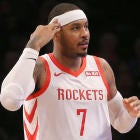
Carmelo Anthony is one of the most prolific scorers in the history of the NBA, but he hasn't played a game since November of 2018. That's about to change because the injury-riddled Portland Trail Blazers are reportedly expected to sign the 35-year-old veteran to a non-guaranteed deal.
In the broadest possible terms, Anthony is a perfect fit for the Blazers. Of the nine players who have spent at least 100 minutes on the floor for them this season, only three have played the majority of their careers at forward. Two of them, Mario Hezonja and Anthony Tolliver, are playing out minimum contracts. The third, Skal Labissierre, is in the final season of a rookie deal, and has only played center this season. Even if you generously classify Labissiere, Pau Gasol and Zach Collins as forwards rather than centers, Portland is paying less for all of their forwards combined this season than the New York Knicks are paying Julius Randle alone.
Portland has no shortage of guards or centers, but there is nary a playable forward to be found on this entire roster. So the Blazers have improvised. The 6-foot-4 Kent Bazemore is spending the majority of his minutes at small forward. Hezonja, once compared to J.R. Smith coming out of college, now plays the same position as Anthony Davis. This problem was apparent long before Collins was lost to injury. Portland planned to play this way. They've just failed at it. At 4-8 through 12 games, a return to the Western Conference finals would be nothing short of a miracle. And so, the Blazers are rolling the dice.
Enter Carmelo, the best forward remaining in a free-agent class that was unsurprisingly picked clean by mid-November. Portland exposed themselves to almost no risk here. The contract Anthony signed is non-guaranteed, and we are now only a month away from Dec. 15, when teams can trade summer free-agent signees. If this move doesn't work out, Portland will cut Anthony and move on to the trade market.
But given the relative lack of interest in a player of his stature, there is at least a shred of hope that this does work. Anthony will never be an All-Star again. But if he manages to play useful, team-first basketball, here is what it will look like:
Anthony on offense (with the starters)
Much has been made about the fabled "Olympic Melo" that has set numerous records for Team USA and whether or not that player would ever present himself in the NBA. The truth is that Anthony actually has largely adopted his Olympic playing style. During his lone-season with the Oklahoma City Thunder, 40.6 percent of the shots Anthony took were from behind the arc. That figure rose to 52.9 percent during his brief stint with the Houston Rockets, while his mid-range attempts fell significantly. Once Carmelo left the Knicks, he started taking the right shots.
Those shots just didn't go in. Anthony made 35.7 percent of his long-range attempts in Oklahoma City, but only 32.8 percent in Houston. The sample size is small with the Rockets and that Oklahoma City number is far closer to his career averages, but with more than a year off of NBA courts, Anthony's timing is going to be impacted. There is no telling how well he'll shoot as a Blazer.
Still, the fact that he is willing to shoot at all is meaningful. For years, Portland's offense has been plagued by plays like this.
The Blazers are among the league-leaders in pick-and-rolls almost every season, but too often defenses were free to leave their forwards open either to send an extra defender at Damian Lillard or C.J. McCollum in the paint or to facilitate a trap by rotating the corner shooter's man over to the now open big man. Players like Al-Farouq Aminu and Maurice Harkless were not only poor shooters, but hesitant ones. Teams could leave them in the corner knowing that they'd rarely shoot, and when they did, they'd likely miss.
Anthony has typically been afforded far more respect than that. Even without posting elite shooting percentages, defenses still assume that Anthony is a willing gunner. If nothing else, that could buy Lillard and McCollum a bit more room to operate in the pick-and-roll, and frankly, they were doing just fine in that area this season. Only the Boston Celtics and Dallas Mavericks have scored more points per possession on pick-and-rolls finished by the ball-handler this season. When Lillard and McCollum are in the game together, Portland is scoring 113.5 points per 100 possessions, per Cleaning the Glass. The Celtics lead the NBA as a whole with 113.8.
In that sense, Anthony's role should be fairly boring when he shares the floor with Lillard and McCollum. It's when they go to the bench that things get interesting.
Anthony on offense (with the bench)
The Blazers are dominant offensively when both Lillard and McCollum play. Remove one and they immediately become below-average. Take out both and Portland's offense craters to 87.4 points per 100 possessions. Those minutes are few and far between, though. In truth, Most of Anthony's minutes will likely come with one or the other on the floor.
And in those minutes, Anthony is probably going to need to be a bit more than Olympic Melo. Portland is already an isolation-heavy team. They rank only behind the Rockets in terms of isolation frequency, but only three players are using those possessions: Lillard, McCollum and Anfernee Simons. All three are guards, and that renders Portland's isolations somewhat redundant and hardly matchup proof.
The Blazers score quite well on those possessions, but Anthony serves as a sort of insurance against defenses overcommitting to stopping those players. He has spent the better part of two decades roasting true power forwards. Teams won't be able to go big against Portland with him on the floor if he still has anything left in the tank.
Terry Stotts will also no doubt experiment with ways of getting smaller defenders switched onto him in order to facilitate mismatched post-ups. Mike D'Antoni tried to create such situations in Houston last season with only limited success. Notably, when the Rockets used Anthony as a pick-and-roll screener, defenses tended to swarm Chris Paul and James Harden rather than give Anthony the switch out of a combination of fear toward the formers and antipathy toward the latter.
Defenses often treat Lillard and McCollum the same way, and it has been a problem for years. That problem is particularly pronounced this season with Hassan Whiteside at center. He is such a limited passer and scorer outside of the paint that teams face almost no consequences for double Lillard and McCollum off of the screen. Anthony is hardly Draymond Green, but he is at least comfortable enough with the ball in his hands in short-roll situations that Portland should experiment with him in that role.
The key, aside from actually making the shots that he takes, will be in striking the right balance. Anthony is a capable passer if not always a willing one. Portland's offense relies on a fair amount of motion and quick decisions. Neither have been his strong suits, and the Blazers will likely meet him halfway with a slightly ball-heavier role than he had with the Rockets. But he has to do his part as well, and if he doesn't his defense will likely be a big enough problem to sink this entire ship.
Anthony on defense
When we last saw Carmelo Anthony attempt to play defense on a big stage, he was getting utterly abused by Donovan Mitchell.
There was barely even the pretense of a play most of the time. Utah's offense in that series often boiled down to "figure out who Carmelo is defending, and having that person screen for Mitchell." This is one of the few areas in which Portland could meaningfully fall off defensively. They are holding opponents to 0.833 points per possessions on isolations so far, a number that would likely rise if they began hunting Anthony.
The rest of the Blazers' defense probably couldn't get much worse. They are currently ranked 19th on that end of the floor, but have steadily declined as the season has progressed. They are ranked 24th in November, which has largely coincided with Collins' absence. Anthony isn't going to help matters. His size will be welcomed, as teams have had some success posting up the guards Portland has had disguised as forwards this season, but with so many other ways to attack this roster, offenses will gladly eschew such opportunities.
But the notion that defenses will relentlessly attack him specifically is probably a bit far-fetched at the moment merely because those other holes exist. There's no need to hunt anyone specific as things stand right now. Whiteside continues to chase blocks as much as ever. Lillard and McCollum are too small and too offensively drained to contribute much on that end. Anthony helps the size problem on the wings, but he doesn't fix the structural problems inherent in this roster.
That, on the whole, is the likeliest outcome to this experiment. Anthony is better than he showed in Houston. He is worse than he was as a Knick. He immediately provides a few things that this team needs. He might yet provide a few more. His weaknesses are well-known at this point and will make things harder.
But ultimately, Portland's success or failure will not be determined by this move in itself. It will be determined by their offseason failure to find even a single defensive-minded wing and how able they are to rectify that before the deadline. Anthony is an ancillary piece. At best, he'll help a team that needs it. At worst, he'll hurt a team that wasn't one player away from being saved.