
In first chance to stick to Joel Embiid's minutes restriction, Sixers go for the win
After Brett Brown said his star would likely play somewhere in the teens, Embiid logged 26 minutes in the opener

By
Brad Botkin
•
4 min read
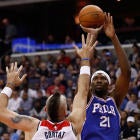
Two days after 76ers coach Brett Brown told the Philadelphia Inquirer that Joel Embiid's minutes, for at least the early part of the season, would likely be limited to "somewhere in the teens," the prized Philadelphia big man promptly logged almost 27 minutes in a 120-115 season-opening loss to the Wizards on Wednesday.
We probably shouldn't be surprised by Embiid's uptick in playing time. For starters, it's not like he played 35 minutes. The 27 minutes is barely over the 25-minute goal they set for Embiid during his 31-game stint last year. Besides that, Brown didn't sound all that committed to the minutes restriction in the first place -- perhaps especially after Embiid told reporters that the idea of his playing time being capped was "f------ bull----."
Brown, asked if Embiid’s minutes limit could increase quickly: ‘I think so, but you’re talking to a greedy coach.’ #Sixers
— Tom Moore (@TomMoorePhilly) October 18, 2017
Brown, understandably, is likely running thin on patience after enduring an unprecedented stretch of losing in an effort to put together the kind of team that can legitimately compete. Well, this team can compete. We saw that Wednesday night, when the Sixers gave a good Wizards team everything it could handle on the road.
Honestly, this would have been more of a story had Brown kept Embiid on the bench to finish the game. Had he done that, in a close game, it would've been a clear statement that the Sixers, for all the expectations people want to place on them this year, were still prioritizing patience and caution over results. Instead, Brown brought Embiid back for the final five minutes. He tried to win the game.
And it almost happened. On consecutive possessions down the stretch, Philly turned it over with a chance to tie or take the lead. On both occasions, they missed a wide-open potential scorer -- first Ben Simmons running free in the open floor, then Jerryd Bayless spotted up for a corner 3-ball. This is why Embiid, and all of Philly's young guys, need to experience these types of games and situations not from the bench, but from inside the heat of the moment. How else do you learn how to win?
After all, there's a difference between making plays and staying composed in the first three quarters, and doing it in crunch time. Overall, Embiid was predictably great in his first 22 minutes, but down the stretch neither he nor Simmons were able to provide the kind of consistent offense Philly needed as it tried to keep pace with what John Wall was doing for the Wizards -- which, pretty simply, was creating plays for himself and others every time down the court.
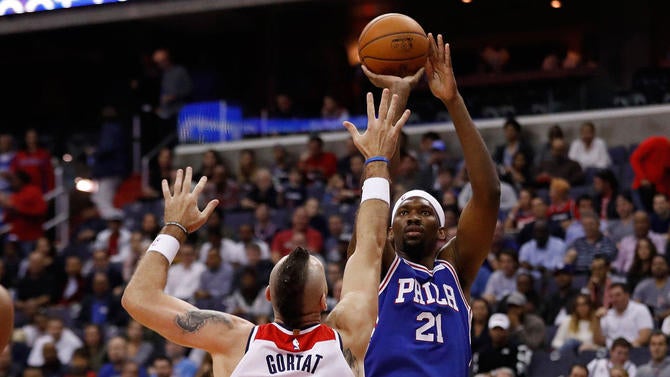
Wall did what great players do when the game was on the line, and Embiid clearly has a chance to be that kind of force. He posted 18 points and 13 boards in his 27 minutes Wednesday. But again, little things are the difference between posting good numbers and leasing your team to a tough win. And the only way you figure those little things out is by playing.
It's not to say this is an easy decision to just put Embiid out there and let the chips fall where they may. There is plenty of data to support the heightened likelihood of injury that comes with a heavier workload; this is true even for players who don't have Embiid's injury history. It's a very fine line. With young pitchers, baseball teams ask themselves this question all the time as it pertains to innings restrictions. Ask Washington Nationals fans about 2012, when the team shut down Stephen Strasburg for the entire postseason, prioritizing their young ace's health over winning. If there's anything more frustrating than losing, it's not trying to win -- something Sixers fans already know plenty about.
Keep in mind, the Sixers just gave Embiid a $148 million extension. You can understand not wanting to risk that kind of investment. It begs the question: If not now, when? At a certain point, you have to let a horse run. Embiid has sat out two full NBA seasons. He played just 31 games last year. The kid is finally healthy, and he wants to play.
Moreover, he needs to play. If Embiid, Simmons and Markelle Fultz are going to turn their great potential into actual winning production, they need as much time playing together as they can possibly get. They need to begin feeling where one another is on the court. They need to know where each other likes the ball, how to communicate on defense, when to prioritize their own playmaking and when to move the ball. Pretty simply, they're the future -- and for the Sixers, for the first time in a long time, the future feels like it has arrived.
Though it's only one game, Philly looked more than capable of playing with a Wizards team that projects as one of the better squads in the East. Keeping that game close didn't feel like a fluke. Simmons looked scary good running the point at damn near seven feet tall. He got to the rim. He pushed the pace. He found scorers. Fultz had a silky fade away late in the game and showed some explosion in going to the hole.
But this all centers on Embiid. He's the best player. If the Sixers have any chance of becoming the team we'd all like to think they can be, be it this year or down the road, Embiid has to be on the floor as much as possible. If Wednesday night was any indication, Brett Brown is going to employ his young star accordingly.