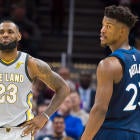
Jimmy Butler latest to shun LeBron James; so why don't NBA stars want to play with the King anymore?
Stars not wanting to team up with James is actually starting to become a thing

By
Brad Botkin
•
7 min read
On Wednesday, Jimmy Butler reportedly let it be known that he wants to be traded from the Minnesota Timberwolves. It's another tricky trade demand from an impending free agent in that nobody wants to give up much for a guy who can bolt next summer. So Butler reportedly listed three teams with which he would consider signing an extension: the Knicks, Nets and Clippers, with subsequent reports surfacing that Butler is most determined to find his way to the Clippers.
If you take Butler's request at face value, he is clearly looking for two things in his next destination: A major market, and a team with the cap space to add more star power to the roster -- which is why he reportedly is focused on joining the Clippers, who have room for two max players next summer, thanks in large part to the Pistons so kindly taking on Blake Griffin's outrageously bloated contract.
But anyway, in getting back to Butler and his preferred designation, there would appear to be at least one team, which also meets all of the above criteria, that is conspicuously missing from Butler's list: the Los Angeles Lakers. They're obviously in the same market as the Clippers and also have set themselves up to have enough cap space for another max free agent next summer. Oh, and they already have LeBron James.
That's where this gets interesting.
When it was reported by Jason Lloyd of The Athletic that Kyrie Irving, before he was traded to the Celtics last summer, had told Cavs owner Dan Gilbert that he "did not want to play another minute" with LeBron James, it could be dismissed as a one-off. Irving is, and always has been, an alpha-dog player. So he wanted his own team. No big deal.
But then this summer, Paul George re-signed with the Thunder. For the last year it had seemed like a virtual lock that George would end up with the Lakers. Before he left Indiana, he flat-out told the Pacers that's where he wanted to go. Then the Lakers got LeBron, which, one would think, would've further cemented George's desire to wear the purple and gold. Instead, he never even gave the Lakers a meeting.
Again, this could be dismissed. George said he had unfinished business in Oklahoma City, which had gone out on a limb to trade for him even knowing he could leave after one season. George appreciated that kind of commitment from an organization. He wanted to return the favor. It didn't help that the Lakers hadn't been willing to trade for George when they had the chance. George remembered that. It's reasonable to conclude his decision to stay in OKC had nothing to do with not wanting to join LeBron.
But then it happened again, this time with Kawhi Leonard -- who, just like George in Indiana, made it clear that he wasn't happy in San Antonio and eventually wanted to end up with the Lakers. Again, we all assumed this would happen one way or another. It just made too much sense. Leonard would give the Lakers two superstars with enough cap room to add a third. Leonard, like George, is from the Los Angeles area. Everything fit perfectly ... until multiple reporters began suggesting that Kawhi had, in fact, soured on the Lakers after LeBron had signed on. The following came from Shams Charania, then of Yahoo Sports and now of The Athletic, while appearing on The Herd with Colin Cowherd back in July:
... I don't think [Kawhi's] jumping for joy that LeBron James is in L.A. with the Lakers.
OK, so Kyrie doesn't want to play with LeBron, it's a one-off. George has such little interest in playing with LeBron that he doesn't even give the Lakers a meeting, it's circumstantial. But then Leonard comes along and hints that he also might not like the idea of playing with LeBron, and now we've got a pattern. Then, on Wednesday, after news broke that Butler had demanded his trade from Minnesota, it was reported that Butler didn't list the Lakers as one of his preferred destinations because, you guessed it, he doesn't like the idea of playing with LeBron. From ESPN's Adrian Wojnarowski:
Butler had once imagined playing for the Lakers, but LeBron James' arrival as the franchise's cornerstone made it less appealing for Butler in the prime of his career, league sources said.
What's that old saying about where there's smoke there's fire? Well, I think it's safe to say we have at least a little blaze burning here. Playing alongside LeBron doesn't appear to have quite the same appeal these days. It's important to point out that this is not, in any way, a suggestion that LeBron somehow isn't a good teammate. That likely has absolutely nothing to do with this.
But you can understand the shadow he casts. When a LeBron James team wins, he gets the credit. When a LeBron James team loses, you get the blame. That's just the way it works. Even if you were a star in your previous NBA existence, when you hook up with LeBron, you are an extra. Just ask Kevin Love. People talked about LeBron's Cleveland teammates last season like they'd been rounded up at an open tryout down at the YMCA.
A lot of people like to assume that the chance to win a title outweighs whatever challenges might come with playing alongside the best player in the world, but these are prideful men. LeBron might have started the super-team movement when he went to Miami back in 2010 to play with Dwyane Wade and Chris Bosh, and Kevin Durant might've doubled down on it when he joined forces with Stephen Curry and the Warriors, but that doesn't mean it's for everyone. In fact, it's starting to look like that trend might be turning back around. Guys appear to be getting back to the old-school way of wanting to earn their championship stripes on their own terms. If that is the case, good for them.
Because let's be honest about this: From a purely competitive standpoint, waiting to see where LeBron signs so you can then run along and join him, is weak. Super-teams, unless they're built largely organically, are weak. That's not just true in the NBA. That's true on every basketball court in the world. The best kids on the playground getting together to dominate the, shall we say, less athletically gifted kids, is weak. The best kids are supposed to want to play against each other. The saying, after all, isn't "to be the best, you have to join the best." The saying is: "To be the best, you have to beat the best." It's always been that way. And it always will be.
That's why you still hear Durant getting defensive about his decision to join the Warriors two years after the fact, because he knows from a competitive standpoint it was weak. Everyone knows it. Now, there are other reasons to change employers. Personal reasons. Business reasons.
Think back to when you were in your late 20s and imagine if you'd gotten a job offer from the best company in your industry, and the prospect of this big exciting change was suddenly a reality. Almost every single person reading this article, and certainly the guy writing it, would have put their two weeks notice in before the ink on the new offer dried. Everyone deserves the right to make the best decision for themselves and their families based on their own set of criteria. These guys are human beings. It's important to remember that. More than basketball goes into these decisions.
But again, we're just talking about competition here. All that other stuff is a different conversation. A very valid conversation, but a different one. Competitively speaking, joining LeBron is always going to have somewhat of a sellout stigma to it, same as joining the Warriors has for the last few years. It's an implicit admission that you didn't think you could beat them, so you joined them.
To be clear, after the Butler news broke I wrote a column that was basically a plea to the basketball gods to let Butler end up with a team where he could play with another star -- if not a few other stars -- in the interest of the competitive balance of the league. So it's not as if I'm knocking the accumulation of top-end talent in general. In today's NBA, you have to accumulate top-end talent. It's a prerequisite to even have a chance to win a title. But joining LeBron is different. That's not a knock on him. It's a testament to his greatness.
So, good for Butler, if this deduction is indeed accurate, if he really does want to go against the best and carve his own path. Good for Kyrie and Kawhi and Paul George. There is still pride in the pursuit. There is still hope for honest competition. These are some of the most talented people in the world, in any trade. These aren't the kind of people who join up with the King. These are the people that overthrow him, or at least die trying. Everyone roots for that guy for a reason. And these players, if not to appease the public then simply to satisfy their most primal competitive cravings, appear to be realizing that.