LaMarcus Aldridge is dominating, and the Thunder are just fine with that
Aldridge has been incredible through two games of the OKC series, but at what cost to the Spurs?

By
Matt Moore
•
8 min read

PLAYOFF SCHEDULE | EXPERT BRACKETS
OKLAHOMA CITY -- LaMarcus Aldridge was always a great player. He was good from the start in Portland, but constantly overlooked. First it was Brandon Roy, then Greg Oden, then Damian Lillard. He was an All-Star, but it was always hard to say he was an outright superstar. That LaMarcus Aldridge had phenomenal games against the Rockets in 2014, dominant games even. But you never expected him to take over a game at the highest level, with the biggest stakes, and completely own it. He was overlooked on his team, overlooked among power forwards, overlooked in this league.
No one is overlooking him now. That LaMarcus Aldridge ... is not this LaMarcus Aldridge.
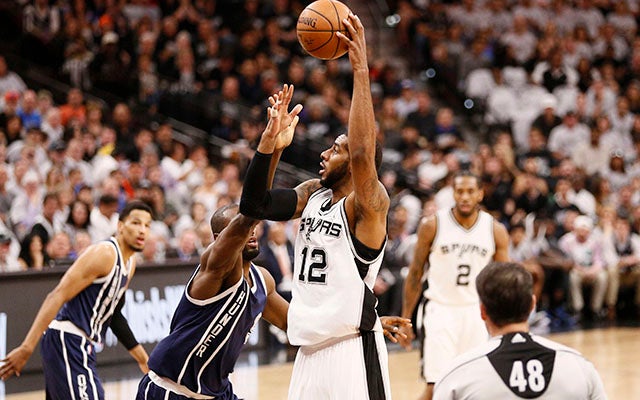
Through two games of Thunder-Spurs, Aldridge is shooting an incredible 75 percent from the field, 33 of 44, and has scored a cool 79 points in 74 minutes. Aldridge has been a human volcano and the normally movement-centric, selfless Spurs have turned to him to try and bludgeon the Thunder into submission. In Game 1 it was the pick-and-pop action that tore the Thunder defense in half, and when the Thunder prioritized taking that away in Game 2, the Spurs gave it to their big new star down low and let him cook in the post.
And man, did he burn the Thunder to ash -- all the more impressive for the fact that the Thunder did everything you would want to do defensively against a guy who has it going. They didn't get caught up in switches and end up with mismatches, and consistently had the right personnel guarding him. They made him work to get to his spot, got into him and took away his space, contested his shots. They did it all right, and it just flat out didn't matter.
"He's an All-Star player, man. He's one of the best players in the league," Kevin Durant said Thursday after practice before Friday's Game 3. "There are times when we could have stopped him from scoring, and there are times when you just have to pat him on the ass, and say 'Hey, that's a tough shot.'"
The Thunder mostly left Aldridge in single coverage, but sometimes even when they brought help, it was futile.
Aldridge has taken two different approaches to the two players he has been mostly matched up with in this series, Steven Adams and Serge Ibaka. Ibaka has great length and is a tremendous shot-blocker; he has given the Spurs fits throughout the years. However, he's just not strong enough to handle Aldridge, who is simply beating him to get to his spots close to the rim.
Ibaka is having to muscle Aldridge so much that he winds up getting caught in the air and Aldridge just has moves on top of moves with his footwork.
Adams is stronger and more physical, so Aldridge is getting the Big Kiwi moving so that he doesn't have to try and go through him.
Aldridge wants to go up and through Ibaka, he's going around and away from Adams:
I asked Popovich at practice if Aldridge has the freedom to decide how to attack the matchup, or if that approach is baked into the game plan. He answered! Kind of...
"LaMarcus has been around for a long time. I don't screw with him too much. It wouldn't be smart. He knows way better of what to do than I can tell him."
Basically, the Spurs are letting Aldridge do his thing.
Ironically, so are the Thunder.
***
Here are two stats for you. These are facts. They should not be interpreted in any way before we talk about them, but they're things you need to know before we continue.
1. In Game 2, LaMarcus Aldridge scored 41 points, leading all players, and put on an absolute clinic, as showcased above.
That said, in the 42 minutes and 51 seconds that Aldridge was on the floor, the Spurs were outscored by four points. They of course lost the game by one (on a very controversial play). You do the math.
Now, this stat in no way means Aldridge's dominance was deceiving, or that he was somehow the reason San Antonio lost, or that he did anything but play awesome. It simply says that despite his 41 points, the Spurs were outscored by four points when he was on the court.
2. Since 2009, when San Antonio started to transition their offensive approach, the Spurs have had only two 40-point-plus performances. Tony Parker scored 43 in a 2009 game against the Mavericks, and Aldridge in Game 2 vs. the Thunder.
The Spurs are 0-2 in those games.
Forget the fact that they lost both games, that can be quite messy. Lot of factors and such. Instead think about how few games they've had with a 40-point performance. That's a lot of points, to be sure. But that's seven seasons of playoff play, 92 games, and only twice did a player crack 40. The Spurs, as we all know, have built their system not around individual starpower, but around the collective greatness. LaMarcus getting 41 is outside who the Spurs are, or at least who they have been for so long, and the Thunder know that.
Like Dion Waiters said: "If they want to continue to get out of their offense and throw the ball down there to him, we're fine with that. We've just got to make adjustments. Serge and Steven gotta do what they do and make it tough for him. He's a great player in this league, an All-Star, he's playing tremendous right now, but as long as they're not running their offense and just dumping it down to him, we're fine with that.
"One man can't beat you."
Aldridge, obviously, is doing his level best to disprove this theory, and collectively, the Spurs are more accustomed to playing this way than they have been in year's past. They've adapted to their personnel to become more of a post-centric, grind-it-out offense. They operate more in the mid-range than they have been in recent years. However, they've still shared the ball this year. Aldridge led the Spurs in usage, but Kawhi Leonard was right there with him, and Tony Parker wasn't far behind.
The double-edged sword here is rather obvious. Aldridge gets his, but the flow of the offense bogs down as a consequence, especially when he gets hot and rightfully demands the ball possession after possession. In Game 2, the Thunder left Aldridge in one-on-one coverage until the very end. Then, when they brought the double, it worked out, perhaps because none of the other players were in a rhythm and thus weren't ready when their number was called.
"You always have that discussion (about doubling), because then the other guys are not in rhythm," Tony Parker said Wednesday in San Antonio. "But hey, LaMarcus has been playing unbelievable. If keeps playing like that, it’s our job even if we get three shots, four shots, we have to make them. That’s a tough life. For me, I’m used getting 15 or 20 shots so I got time to get a rhythm. When you get four shots, you have to make them. That’s my job now. That’s my life now. I have to make those shots. I know I’m going to get three or four and then I’m not going to see it again for 10 minutes. It’s like that. I’m just going to have to make them."
Like Parker said, this can be easier said than done.
Case and point:
This adjustment is a a perplexing one for the Spurs, sort of a damned-if-you-do-damned-if-you-don't type deal, and the Thunder are clearly more comfortable taking out the guessing game and making Aldridge beat them on his ownas opposed to dealing with a barrage of open 3-pointers.
Still, at some point you do have to bring the double, if only to change up looks, when a guy has it going like Aldridge has, and the Thunder have not been reckless in doing this. They've picked their spots. They're not going to help from the short corner. They're bringing weak-side defenders behind Aldridge's back.
He can find outlet passes out of that, but there are only so many angles you can create if you can't see the double coming, especially with communication likely impaired by a raucous OKC crowd in Games 3 and 4. Finding ways to punish the Thunder if they do double is important for the Spurs. But this is the beauty of this series: both these teams know who they are. Nobody is being fooled. The Spurs know what the Thunder are doing, and they, in turn, are fully prepared to keep doing what they're doing.
"We are still running our offense," Tim Duncan said. "Just when (Aldridge) starts rolling like that, we are going to give him the ball. And keep riding him. He’s done an unbelievable job scoring the ball. If that changes, or they start double-teaming him or he’s missing shots, he’s a willing passer and we are there to run the same offense that we ran the entire year. But as long as he’s scoring the way that he is, that’s our best option."
Ultimately, maybe the other Spurs just had a bad shooting game in Game 2.
"We all have to step up, it’s not one person," Danny Green said. "It’s a group. I expect Patty and Tony to shoot better. I expect Timmy to shoot better. I expect myself to shoot better. Kawhi is probably going to shoot better as well."
But if the Thunder stay home, it gets more difficult to create those open looks. The Spurs will undoubtedly try more off-ball movement behind screens to get looks, but the ball still has to move in order to capitalize. This series all of a sudden presents the Spurs with a good problem to have, but a problem nonetheless. What to do with a man who can't be stopped?
Even if Aldridge continues to roar, if OKC can continue to outpace him collectively, then the Spurs' collective flow will almost certainly suffer. And perhaps that's the edge that OKC needs to pull the upset. In Game 3 Friday, the upper-hand is at stake in what has quickly become a fascinating series. LaMarcus Aldridge is on fire. The Thunder might be more than willing let him keep cooking.