

Warriors' Steve Kerr smart not to stretch Stephen Curry's minutes, but he could distribute them differently
Curry plays fewer fourth-quarter minutes per game than any Warriors rotation player outside of Kevon Looney

By
Brad Botkin
•
6 min read
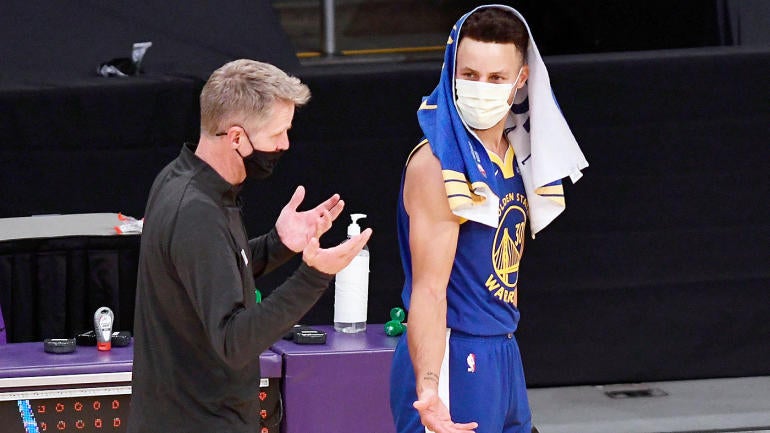
Steve Kerr says it all the time when the Golden State Warriors aren't lighting arenas on fire with the casual flick of Stephen Curry's wrist: "This is the real NBA." There's a lot of truth in that statement. New Golden State Warriors fans, and even original fans who've (perhaps selectively) forgotten where they came from, have no comprehension of struggle. They only know winning, and easy winning at that. But the NBA waters aren't supposed to be as smooth as the Warriors made them seem for half a decade.
Now that the Warriors are a positively average basketball team (12-12 after Monday night's loss in San Antonio), every loss, and to some degree every Kerr strategy, feels like a new test on the fan base's already thin patience.
First it was Kerr's insistence on using Curry more off ball than on, leading to significantly lesser creators controlling a startling amount of possessions as one of the greatest offensive players in history is reduced to a mobile bystander. Then they wanted Kerr to change the starting lineup, which he eventually did. Then they wanted Kelly Oubre Jr. completely off the court, but Kerr stuck with him (with a shift in his minutes distribution) and he's starting to come around.
The latest gripe is Curry's minutes. Specifically, why doesn't he play more? After the Spurs loss, Anthony Slater of The Athletic asked Kerr if there's a temptation to extend Curry's playing time in close games. Here was Kerr's response:
Asked Steve Kerr postgame about Steph Curry's minute totals. He remained firm that they'll hold him to 34, 35ish on a nightly basis and not chase wins. Here's the full quote. pic.twitter.com/jWHNvi26Z8
— Anthony Slater (@anthonyVslater) February 9, 2021
There's a very clear takeaway from this quote: The Warriors have no expectations of winning anything meaningful this season. They know they're an average team. But unlike most average teams, there's a reasonable expectation that the Warriors can be back in the mix for a title less than 12 months from now, when Klay Thompson returns, and they're going to do everything in their power to make sure Curry is running on a full tank when that time comes.
For what it's worth, I agree with this strategy. Pushing Curry from his current 33.8 minutes per game to, say, 37 or 38 minutes a night carries more risk than reward. Sure, the Warriors might win a few more games, but they're probably not getting out of the first round, at best, either way.
As an organization, Golden State guards against the cumulative effects of overuse as diligently as any team in the league. If Curry were to suffer a significant injury that could perhaps be traced back to redlining him for a few February victories nobody will ever remember, that would obviously be a disaster.
And this is to say nothing of the running clock on his meter. The Warriors want every second of Curry's remaining prime to tick down as slowly as possible. LeBron James has managed his regular-season workload for years, and he's still the best player in the world at 36 years old. Curry is 32. If they can squeeze four more years out of top-level Curry, they believe they can be in position to compete for at least one more championship before the sun goes down.
So, no, extending Curry's minutes is not the smart play right now.
What might be smart, however, is a redistribution of those minutes, subtracting a few earlier in the game so Curry can play more in the fourth quarter. At present, Curry plays the full first and third quarters, and Kerr reinserts him at the six-minute mark of the second and fourth quarters with almost military precision. Curry likes playing the full 12 minutes in two quarters to establish and maintain his rhythm, but we also know that Curry is dying to get back on the floor a bit earlier in the fourth quarter of close games.
"Of course I want to play [more]," Curry said of his fourth-quarter minutes, via Wes Goldberg of the Mercury News, who added that Curry has had conversations with the coaching staff about this and those conversations will likely continue.
There's an argument that all points count the same, whether they're in the first or fourth quarter, but in close games, common sense tells you it's better to have your best player on the floor for as much of the fourth as possible. On Monday, Golden State was winning by two points when Curry sat at the end of the third quarter. When he returned at the 5:33 mark of the fourth, they were down seven.
That's not the reason the Warriors lost to the Spurs. They committed 20 turnovers, resulting in 17 San Antonio points. Still, Golden State is not good enough to be digging late holes as Curry rests. By and large, the Warriors have managed to stay afloat with Curry on the bench so far -- plus-1.5 when he plays; minus-1.4 when he doesn't. But keep in mind, the Warriors have scored 2,734 points this season, and they have given up 2,732. Do the math, and that's just a two-point difference over 1,152 total minutes in 24 games.
When you take into account that razor-thin margin, with games literally swinging on a bucket or two, a turnover or two, or certainly a Curry minute or two, the fact that the Warriors are losing their non-Curry fourth-quarter minutes by 6.1 points per 100 possessions becomes an issue worth examining. And again, we're not talking about just a few minutes. Curry sits more in the fourth quarter than he plays. In fact, his 5.4 fourth-quarter minutes per game are the lowest of any rotation player on the team besides Kevon Looney.
Keep in mind, Curry has sat six entire fourth quarters this season because of blowouts one way or the other, which obviously impacts his MPG on paper, both for the fourth quarter and overall. He's also played three minutes or fewer in three more fourth quarters because of blowouts. Kerr has played him an extra minute or two in select situations, and even in Monday's loss to the Spurs you could see Curry going to the scorer's table around the seven-minute mark, but play went on for another minute before he could check in.
That context notwithstanding, if Curry is willing to not play the full first or third quarter, perhaps he can be on the court for more of the high-leverage fourth-quarter minutes. NBA players are creatures of routine, but maybe Curry is willing to go with the flow from game to game. If the Warriors build a big first-quarter lead, maybe he doesn't play all 12 minutes. If the game is tight in the third quarter and you can tell it's going to be close all the way, maybe he comes out a little earlier to end the third to get back sooner in the fourth. Maybe he and Kerr just decide to consistently shift the minutes distribution.
But one way or another, Curry is going to have to sacrifice somewhere if he wants more late playing time, because Kerr isn't going to just pile extra work on his plate to squeeze out a few more wins in a relatively lost season. And that's the right move. Even though it goes without saying that Curry isn't getting any younger, which naturally raises fans' urgency on the here and now, there is still a big picture in mind.