

Agent's Take: Will Zach Ertz reset the market? His case for a big payday, how Travis Kelce factors in and more
Find out everything you need to know about whether Ertz will be the next tight end to cash in with an extension
By
Joel Corry
•
6 min read
A long overdue reset of a stagnant tight end market took place last week with a highly-anticipated deal between George Kittle and the 49ers. Kittle received a five-year, $75 million contract extension averaging $15 million per year. His $40 million in overall guarantees and $30 million fully guaranteed at signing are both the most ever in an NFL contract for a tight end. Within a few hours of Kittle's deal being announced, Chiefs tight end Travis Kelce signed a four-year, $57.25 million extension averaging $14,312,500 per year. Kelce's deal has $23 million in guarantees where $21 million was fully guaranteed at signing.
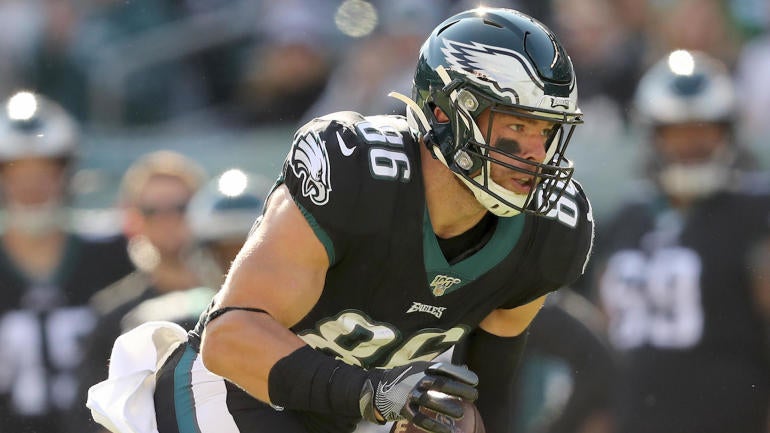
The Kelce and Kittle deals have prompted speculation about whether Zach Ertz will be the next tight end to get a big payday. Ertz has two years remaining on the five-year, $42.5 million extension he signed with the Eagles in 2016 worth a maximum of $45.8 million through incentives and salary escalators. He is scheduled to make $8 million this year and $8.25 million in 2021.
The Ertz argument: Delivering top-of-market value
The Eagles attempted to extend Ertz's contract last season around the same time Philadelphia signed Pro Bowl guard Brandon Brooks and Pro Bowl right tackle Lane Johnson to new deals in November. One of the sticking points with Ertz was a contract structure deemed too team-friendly for his liking. The expectation is the Eagles will make another attempt at extending Ertz's contract before the end of the season.
Ertz, who set the NFL single-season reception record for a tight end in 2018 with 116 catches, can make a case that he should be the NFL's highest-paid tight end because of his importance to Philadelphia's offense. I would imagine it has been brought to Ertz's attention that the Eagles made Brooks and Johnson the league's highest-paid player at their respective positions.
Ertz has been Philadelphia's primary weapon in the passing game since signing his extension in 2016. He has led the Eagles in receptions, receiving yards and touchdown catches in each of the last four seasons, with the exception of tying for second in touchdown catches during the 2017 season. Ertz is one of three tight ends in last 30 years to lead his team in receptions for four straight years; the other two are Antonio Gates (2004-07) and Greg Olsen (2013-16) with the Chargers and Panthers, respectively. Additionally, he is the only one to rank in the top five in receptions, receiving yards and touchdown catches among tight ends in each of the last three seasons.
Ertz's 525 catches are the most for a tight end over the first seven seasons of an NFL career. Jason Witten (523) and Travis Kelce (507) are second and third.
Ertz is also one of six players who have at least 200 receptions and at least 2,000 receiving yards over the last two regular seasons. The others in this highly exclusive group are wide receivers Keenan Allen (Chargers), DeAndre Hopkins (Texans), Julio Jones (Falcons) and Michael Thomas (Saints) as well as Kelce.
The Eagles argument: Diving into Kelce's extension
The Eagles will likely feel the Kelce deal is a more appropriate data point than Kittle's contract for a variety of reasons. Ertz and Kelce are both members of the 2013 draft class who are pretty close in age; Kelce turns 31 in October, while Ertz will be 30 in November. The two players signed new deals days apart in January 2016, with Ertz getting his extension first. Kelce's contract was expiring after the 2021 season, just like Ertz's will, while Kittle was in a contract year.
More importantly for the Eagles, Kelce's contract has an extremely team-friendly structure. Kelce isn't getting a raise this year, which is unusual for a deal of this magnitude, but instead is making the same $9.25 million in 2020 that he was in his previous contract.
The Chiefs used a "pay as you go" contract structure with Kelce where a player's cash and salary cap numbers are the same in each contract year because there isn't a signing bonus that would be prorated over the life of the contract (for a maximum of five years). Surprisingly, Kelce has minimal guaranteed money after 2021. Only $2 million of his $6.5 million 2022 base salary, which was guaranteed for injury upon signing, becomes fully guaranteed that March on the third day of the league year. This $2 million really should become fully guaranteed next March on the third day of the 2021 league year.
The Chiefs have maximum salary cap flexibility because of how Kelce's contract is structured. Should Kelce's skills rapidly start to diminish, Kansas City can exit the deal as early as 2022 without any salary cap consequences.
Kelce is only receiving $4.25 million more over his remaining two years than if he played out the 2016 extension. He has $11.75 million of new money through his first new contract year of 2022.
It would have cost $11.65 million for Kansas City to designate Kelce as a franchise player in 2022 if he played out his contract, which would have been 120 percent of his 2021 salary cap number. This assumes Kelce would have earned a $750,000 escalation of his 2021 base salary because of 2020 performance, just like he did for 2019 and this year. Kelce has $25 million in new money over the first two new contract years (through 2023), which is $630,000 less than Kelce would have made playing under two straight franchise tags in 2022 and 2023.
Kelce didn't get enough money in his existing contract years or security to give up four years. The Chiefs essentially have four team options with Kelce starting in 2022, his first new contract year.
Kelce's contract is backloaded, meaning there is more new money in the latter part of deal than in the early years. The chart below illustrates this point by comparing the percentage of new money Kelce earns after each contract year to the four-year, $60.4 million extension interior defensive lineman Jurrell Casey signed with the Titans in 2017. Casey is one of the rare veteran player four-year extensions signed with two years remaining on a contract.
| Player | Existing Y1 | Existing Y2 | New Y1 | New Y2 | New Y3 | New Y4 |
|---|---|---|---|---|---|---|
Jurrell Casey | 12.42% | 18.66% | 37.12% | 56.74% | 77.07% | 100% |
Travis Kelce | 0% | 7.42% | 20.52% | 43.67% | 69.87% | 100% |
Neutral | 6.25% | 12.5% | 25% | 50% | 75% | 100% |
Kelce's actual new money after each of the first three new contract years is $11.75 million, $25 million and $40 million. At worst, Kelce's new money percentages should have matched the numbers for a neutral deal, which is one that is neither frontloaded or backloaded. Under a neutral deal, Kelce's new money after these junctures should have been $14,312,500, $28.625 million and $42,937,500. In actuality, the percentages should be in the same ballpark as Casey's. Kelce would have been at $21.25 million, $32.5 million and $44.125 million after each of the first three new contract years.
Why Ertz's future is uncertain
It's hard to envision a scenario where Ertz would take a contract structure like Kelce's. Ertz's franchise number in 2022, a 20 percent raise over his $12,471,500 2021 salary cap number, will be $14,965,800. Franchising Ertz again in 2023 with another 20 percent raise would be $17,958,960. Ertz's camp will likely take the franchise tag dynamic into consideration during any renewed contract talks.
If an agreement is unable to be reached with Ertz for a second straight year, it wouldn't be too surprising for the Eagles to consider trading the three-time Pro Bowler next offseason either voluntarily or because he would want a change of scenery. The Eagles have another tight end, Dallas Goedert, who is very good in his own right.
Goedert and Ertz's contracts will both expire after the 2021 season. As a 2018 second-round pick, Goedert isn't eligible to sign an extension until the 2020 regular season ends on January 3, 2021. Goedert may not want to stick around long term in Philadelphia if Ertz gets a second veteran contract before the upcoming season ends.