Here's the Jets surprisingly logical reason for not calling Giants about No. 2 draft pick
The New York teams didn't trade in the draft because the Jets wanted to keep their intentions quiet

By
Will Brinson
•
3 min read
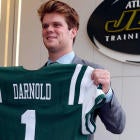
The New York Jets could not have imagined in their wildest dreams a situation unfolding where Sam Darnold fell to them at No. 3. The NFL is often weirder than reality and it unfolded as such, with the Browns taking Baker Mayfield, the Giants taking Saquon Barkley and the Jets finding themselves stunned that their top choice was there at No. 3.
It only happened through a bold, but expensive, trade up from No. 6 to No. 3. And even after making that move, the Jets received plenty of criticism for not trying to get to No. 2 -- the Jets were willing to settle at No. 3, understanding they could, at worst, get their third choice of quarterback there if the Browns (definitely drafting one) and Giants (definitely should have drafted one) both went in that direction.
According to a lengthy -- and excellent -- look at the Jets' pursuit of Darnold from TheMMQB.com's Albert Breer, the Jets actually chose not to talk with the Giants out of concern it could cost them a shot at No. 3 overall. Essentially it came down to relationships, with the Jets and Colts being closely tied front offices and the Bills and Giants being closely tied.
The Jets don't call the Giants. Why? The belief is because the two teams are in the same market, the Jets would have to pay a tax for the second pick. Also, keeping their trade pursuit quiet is paramount, to keep others from springing into action and setting off a bidding war. Tipping the Giants off, particularly with their connections to the quarterback-hungry Bills' front office, would have been risky.
Breer writes the Jets were "willing to pay a little over the point value to get the third pick, in exchange for Indy keeping the talks confidential."
Indy, of course, was willing to take the haul it got from New York -- multiple second-round picks -- knowing it would cause a shift in the economics of the draft that would allow them to still net a blue-chip player at No. 6. Multiple quarterbacks would go early and one of Bradley Chubb, Barkley and Quenton Nelson (the player Indy preferred all along) would be available to them.
The Bills were the big losers in this situation, because it basically boxed them out of an opportunity to move into the top three for a quarterback. Two signal callers were going before they would have the opportunity to make a pick, unless Dave Gettleman was willing to move out of No. 2. Ultimately he wasn't willing to move, or Buffalo GM Brandon Beane wasn't willing to pay the price to get him off his spot. Buffalo would still land Josh Allen, who might very well be great. But the Jets won this game of chess against the Bills, certainly.
Sometimes the process and results converge nicely at the end of an event. For the Jets, that certainly became the case, doubly so when we realize that we might not have been completely aware of their process. Not calling the Giants seemed utterly foolish, but if the Jets were indeed comfortable with Mayfield, Darnold or Josh Rosen, which is the case according to Breer, then ultimately their move was the right one.
It looked expensive to give up all those picks for a shot at their third option and it looked foolish not to call the Giants and try to guarantee themselves one of the top two picks. But they did some nice due diligence, guaranteed they could get one of the quarterbacks they believed was a franchise signal caller with their pick and didn't sacrifice a future first-round pick to do it.
The biggest bonus you'll see if you read Breer's full piece (and you should!) is that Darnold was the guy they fell in love with, and they never thought they'd get a chance at him until they were actually on the clock.