These 10 players got off to a fast start and have sent their NBA Draft stock soaring
Oklahoma's Trae Young leads the list of prospects who have helped themselves so far this season

•
8 min read

The seven months between the beginning of this college basketball season and the June draft will not be like the 2015-16 season, when players like Marquese Chriss and Buddy Hield rocketed up draft boards, from afterthoughts at the beginning of the season to mid-lottery picks by June. And I don't expect us to have situations like those of Skal Labissiere, Diamond Stone or Cheick Diallo, who went from top-10 recruits and likely lottery picks to late-first rounders (in Labissiere's case) or out of the first round altogether (like Stone and Diallo).
The top tier of this draft felt set coming into the season, and it feels like it won't change between now and June. Just like recruiting rankings told us coming into the college season, the top six in this draft ought to be, in some order, Marvin Bagley III, Michael Porter, Jr., Mo Bamba, DeAndre Ayton, Collin Sexton, and then the Slovenian wunderkind who is playing professionally in Spain, Luka Doncic.
But that's not to say we haven't had surprises pop up during the first six weeks of the college basketball season. Some of these may sneak into the lottery – especially our No. 1 surprise choice for a college player who has improved his draft stock. A lot of these players are upperclassmen who learned their biggest deficiencies and worked on them in the offseason. We may have a future star or two in this group, we may have a few solid NBA contributors, we may have a few role players. But there's no doubt that each of these players has used the non-conference portion of their season to open up the eyes of NBA scouts.
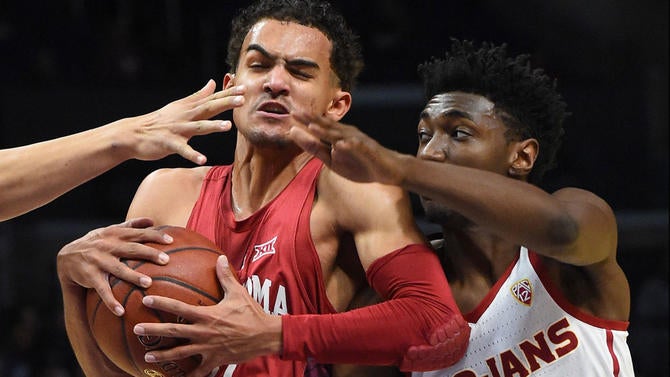
1. Trae Young, PG/SG, Oklahoma: Duh. Young has been, quite simply, the best player in college basketball, and has vaulted himself into the first-round conversation despite size limitations (6-2, 180) that had some doubting his NBA potential as a score-first guard. He leads college basketball in scoring (28.8 points per game) and is third in assists (8.9 per game). Right now he'd be the unanimous national player of the year, and he's shooting up draft boards. Remember that undersized guard at Davidson who in his junior season averaged almost the exact same points per game that Young is averaging now for Oklahoma? Oh yeah: Steph Curry. No college player will become Steph. It's an unfair and silly comparison. But with his range, his scoring creativity and his ability to be nearly as good of a passer as a scorer, Young is the closest we've seen since the man himself.
2. Mikal Bridges, SF, Villanova: The potential was always there with Bridges. The jump we expected to see from his redshirt freshman year (when Bridges was a reserve on a Villanova team that won the national title) didn't quite materialize last season, when Bridges took a secondary role to Josh Hart. Needless to say, it's all materialized this season, as Bridges looks like the rare fourth-year college student (when you include that redshirt season) who is going to be a lottery pick. He's all over the court, an absolute hawk on defense who does it all on offense as well, making a bunch of 3-pointers (47 percent so far) and being the unquestioned alpha dog for No. 1-ranked Villanova. He's a two-way physical marvel, the closest thing this draft has to a Paul George. He's made a bigger jump in production this season than any upperclassmen in college hoops.
3. Bruno Fernando, PF/C, Maryland: The Angolan big man has flashed onto the scene in a big way this year at Maryland. The freshman has shown big-time potential as a shot-blocking, rebounding big man, averaging more than two blocks and nearly six rebounds per game in limited minutes (19.2 minutes per game). Yes, he's a bit of a project. He's still learning how to defend without fouling. His offensive game is a work in progress. But he's shown great energy, strength and athleticism – and those are the attributes that give Fernando a high ceiling.
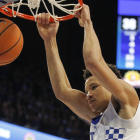
4. Kevin Knox, SF/PF, Kentucky: The question leading into the season was who would be the go-to guy on Kentucky's roster. To those who knew Knox's versatile if not flashy game, he was always the answer. His two-way ability and versatility mean Knox can give value to a team even in games where he's not dominating the box score. Knox has the size (his father played briefly in the NFL) to bang with NBA big men, though his height (6-9) is perhaps a big shy of ideal for an NBA power forward. But he's so young – he turned 18 after enrolling at Kentucky this summer – that his body will only fill out as he grows older. He has the feel of a low-risk mid-to-late lottery pick who could turn into something special.
5. Keita Bates-Diop, SF, Ohio State: A stress fracture in his leg ended his junior season with leg surgery last year, and Bates-Diop was awarded a medical redshirt, so he'll still be eligible next season for Ohio State. But Bates-Diop might not need that extra season. He's been electric under new head coach Chris Holtmann, the key piece in a surprising Ohio State team. Bates-Diop is averaging 18.3 points and 9.3 rebounds per game, shooting 42 percent from 3-point range and contributing solid defense. Bates-Diop has ideal size for an NBA wing, and above-average athleticism. Consistency from 3-point rangeis the top concern, especially with his unique shooting form. His sophomore year and junior year, he shot 32 percent and 20 percent from 3-point range respectively. Keep up this consistent shooting and Bates-Diop will hear his name called by Adam Silver in June.
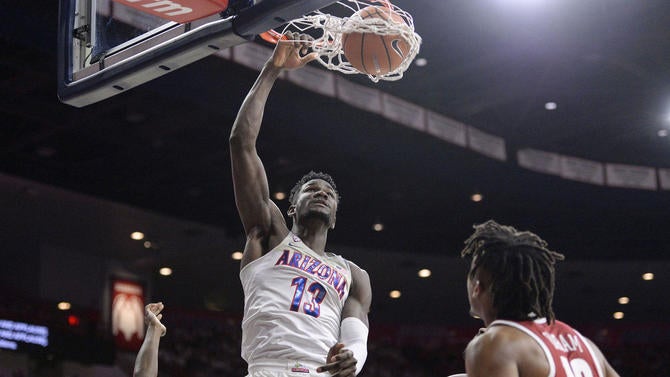
6. DeAndre Ayton, C, Arizona: How can a player who was considered a consensus top-five pick heading into the season improve his stock that much? Ayton is not a hands-down No. 1 overall pick, like Ben Simmons was a couple years ago. That's because the top of this draft is so special, and guys like Luka Doncic, Marvin Bagley III and Michael Porter Jr. will challenge Ayton for that spot all the way up to draft night in June. But what Ayton's done over the first six weeks of the season has been remarkable. First, and most importantly, he's answered questions about what some thought was a questionable motor – questions that came from Ayton stepping off the gas pedal his senior year of high school after several years as the obvious No. 1 recruit in his class. Second, even as Arizona has gone through some growing pains – namely, a three-game losing streak that knocked the Wildcats from No. 2 in the nation to outside the top 25 in one week – Ayton has continually been dominant. He's averaging 20 points and 12 rebounds and has notched double-doubles in all but two games. The 3-point shooting sits at 29 percent – not awful for a 7-footer, if less than ideal. Most impressive is how when Ayton walks into a gym, he's clearly the one unicorn in there. Listen to what another physically dominant big man, Shaquille O'Neal, told me without hesitation: "First pick in the draft."
7. Daniel Gafford, C, Arkansas: The Razorbacks had some nice wins in non-conference play, beating Oklahoma and Minnesota, and Gafford has been a big reason for the success of a team that ought to be flirting with the top 25 for much of the season. The big, long freshman has been doing the types of things a traditional big man is supposed to do. He's finishing near the rim at an efficient rate, and he's both rebounding and blocking shots; Gafford 2-point percentage, his block percentage and his defensive rebound percentage all rank in the top 100 in the nation. His jumper is, at this point, a weakness, but Gafford's athleticism means a large amount of NBA potential.
8. Khyri Thomas, PG/SG, Creighton: Thomas is shooting 43 percent from 3-point range and averaging 15.7 points per game, and he has an argument that he's the best perimeter defender in all of college basketball. Thomas does a little bit of everything for Creighton, and he projects as the type of NBA role player who can come off the bench, make a few 3-pointers and play intense, lockdown defense. Don't focus on his height (only 6-3) but instead his massive wingspan (6-10). Thomas is no lottery pick, but spending a second-round pick on such a complete player would be wise for a winning team looking to round out its roster.
9. Jalen Brunson, PG, Villanova: Yes, Brunson is six-two and 190 pounds, and some would wonder how that portends to his status as an NBA prospect. But he more than makes up for any physical limitations with the best brain in college basketball. The son of former NBA player and current Minnesota Timberwolves assistant coach Rick Brunson, Brunson has been raised to know the finer points of basketball. He's among the nation's most efficient offensive players, and he's among the nation's top long-distance shooters, hitting 3-pointers at a 54 percent clip. He's also upped his perimeter defense this year, and rarely turns the ball over. Remember when Fred VanVleet went undrafted out of Wichita State a couple years ago and now is playing 17 minutes a game as the Toronto Raptors' backup point guard? Think of Brunson as a better version of VanVleet.
10. Jo Lual-Acuil, C, Baylor: Is there a school in the nation that's better at developing big men over time than Baylor? Listen to the upperclassman bigs Scott Drew has had over the years: Jonathan Motley was one of the most impactful players in college basketball as a junior last season and is now on a two-way contract with the Dallas Mavericks. Taurean Prince played four years at Baylor and is now one of the few bright spots on the Atlanta Hawks. Cory Jefferson played four years, was taken in the second round and now plays overseas. Rico Gathers played four college seasons and now plays professionally – for the Dallas Cowboys. And Lual-Acuil has developed from a junior college transfer three years ago into a surprisingly versatile seven-footer as a senior today. He's averaging a double-double – 15.5 points and 10.2 rebounds – and has added an occasional 3-pointer to his arsenal. He's also one of the better shot-blockers in college hoops.
Honorable mention: Udoka Azubuike, C, Kansas; Nick Ward, PF, Michigan State; Jevon Carter, PG, West Virginia; Jalen Hudson, SG/SF, Florida