College teams becoming copycats as gap betweens haves, have-nots widens
In the era of the College Football Playoff, the widening gap between Power Five schools and the rest of the country continues to widen. And everyone is trying to do things the same way.

By
Dennis Dodd
•
12 min read

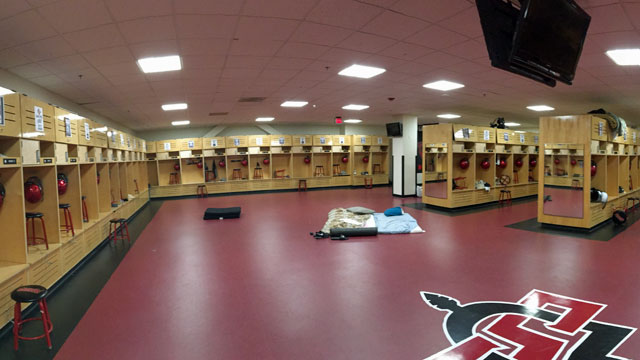
SAN DIEGO -- Rocky Long was showing his San Diego State locker room to a visitor recently. In a college football world where facility swag is everything, one part of the scene immediately stood out.
“I wonder who’s been sleeping in here?” the Aztecs’ coach asked out loud.
In the middle of the locker room, a pair of mattresses, pillows and blankets were strategically placed on the floor within view of a flat-screen television. Someone had indeed spent the night.
“We got a couple of GAs [graduate assistants] that sleep here,” Long said. “They sleep here at night because they don’t think they can afford apartments. They turn the TV on.
“They really don’t have any money either. This isn’t anything you’ve seen right?”
Well, no. That doesn’t mean it doesn’t happen. There are stories all over the game of coaches and staff sleeping over the facility during game-week prep. For underpaid grad assistants, that isn’t necessarily surprising.
You just wouldn’t expect to see it at a place like Texas or Ohio State or USC where the facilities swag is better, bigger. Here in San Diego, below college football’s Mendoza Line, the gap between the haves and have nots has never been wider.
That line is defined in gentlemanly terms these days as the difference between the “high-resource” Power Five conferences -- ACC, Big Ten, Big 12, Pac-12, SEC -- and everyone else.
San Diego State is part of "everyone else." The Aztecs play in a so-called Group of Five conference (Mountain West) that fits alongside the MAC, Conference USA, Sun Belt and American Athletic.
“I think it’s making it much more difficult for us to compete,” said the crusty 66-year-old Long, who is entering his 17th year as a head coach. “I don’t think our fan bases realize the enormous difference between what they have as resources and what we have as resources.
“It’s always been there, but in the past, you actually had a fighting chance. Now I can’t even come close.”
This from the coach of the school that produced Pro Football Hall of Famer Marshall Faulk. Long’s team plays in an NFL stadium and just won 11 games on its way to a conference title. Long's program resides in a modern 130,000 square-foot facility. SDSU is the home of the third-largest athletic budget ($19 million) in the 12-team MWC.
Long’s program has been whispered already as a contender for a New Year’s Six bowl in 2016.
Who wouldn’t want to play here in “America’s Finest City?”
It's just, in the College Football Playoff era, that aforementioned widening gap is further reflected, if not accepted.
Texas has a larger athletic budget -- No. 1 nationally at $179 million -- than the entire Mountain West combined. Nick Saban makes more per year than the lower-resource Mid-America Conference gets in network media rights. Two of the MAC’s head coaches have left their jobs in the last two years to become coordinators at major-conference schools.
Since 2009, 42 stadiums that house FBS teams have been built or significantly renovated. That’s approximately one-third of the Football Bowl Subdivision.
Twenty-five of those are Power Five facilities -- almost 39 percent of the 65 schools in the Big Ten, Pac-12, Big 12, ACC and SEC. That doesn’t count broad build-outs being planned at Syracuse, Oklahoma and Notre Dame.
“Buildings,” this Notre Dame video contends, “lay a foundation for achievement … to awaken a sleeping giant. To maximize its potential beyond six Saturdays a year.”
Wow. Is the school adding onto its stadium or building the Kennedy Space Center?
“We simply refuse to dream small,” said Notre Dame president Fr. John Jenkins.
That declaration might as well be used to describe the arms race that drives all 128 FBS schools. To stay relevant, they’re chasing a standard that is ill-defined. One man’s Notre Dame Taj Mahal is another man’s pay bump for grad assistants.
On their way to brick and mortar glory, the schools have become copycats. Everyone has to have an indoor practice facility. Everyone has to have a faux waterfall in the football building. (Don’t laugh, it’s trendy.) Everyone needs an architect on speed dial. Everyone wants to be the Oregon, which has more uniform combinations than scholarships.
Meanwhile, Long says he lost a recruit to Utah State because the school paid $150 more a month in cost of attendance. He doesn’t take recruits to the gameday locker room cross-town at Qualcomm Stadium because it is so sub-par.
“It’s terrible. The stadium is terrible,” Long said bitterly.
And yet, San Diego State is in the same NCAA division as Alabama. Last year, the Aztecs made $850,000 in TV revenue, Long said. As an SEC member, Saban’s program hauled in almost $33 million.
The Mountain West isn’t even close to being at the bottom among the 10 FBS conferences. In fact, it is expected to compete with the AAC for the automatic CFP berth in most years.
It’s just that the SEC and Big Ten are miles ahead of everyone else in revenue. Big Ten commissioner Jim Delany rather crassly defined the gap speaking to then-WAC commissioner Karl Benson a few years ago.
“The problem is your [teams playing on the] big stage takes away opportunities for my teams, to play on the stage they created in 1902.”
What has emerged since then is a smaller super-class of programs within that Power Five.
Since 2000, only 15 schools have played for a national championship. That is out of 36 available slots in the BCS and CFP. Fourteen of those 36 slots have been filled by three teams -- Oklahoma, Alabama and Ohio State.
“One has to wonder what’s the world going to look like 10 years from now?” said one Power Five athletic director who did not want to be identified. “That’s a fascinating conversation. If we don’t care [about the smaller schools], we might be needing to prepare to play each other.”
Most experts agree at the moment a separation of the haves and have-nots -- on the field -- is not likely to happen. Those 65 Power Five schools need the Group of Five to fill out their schedules, if nothing else.
“We make nice fodder,” said Bowden who has spent most of his career at the top of the food chain. His dad is Bobby Bowden. Terry coached Auburn to an undefeated season in 1993.
At age 59, he has reinvigorated a program that is coming off its first-ever bowl win.
“In the Group of Five our goals are win your conference and go to a nice bowl,” Bowden added. “What else is there? Anything else is usually just talk.”
And everyone seems to be OK with the current set up.
In the last round of conference realignment, your spot relative to that Mendoza Line was basically decided by a TV consultant. Your worth was evaluated by projected ratings points.
TCU (Mountain West to Big 12) and Utah (Mountain West to Pac-12) got lifelines that redefined their athletic existence, while the likes of Cincinnati (which seven years ago played in the Sugar Bowl) were left behind. The Bearcats weren’t perceived as a power-conference school.
“You’ve basically been grandfathered. You stand where you sit,” former Big Eight commissioner Chuck Neinas said. “That’s why Iowa State is in it and Cincinnati is not.”
Athlete welfare has replaced competitive equity as the guiding principle in NCAA governance. All those hydrotherapy pools and nutritionists mixing up personalized post-workout smoothies? All good for the athlete, all intertwined in the building boom.
The unstated goal hasn’t changed: Mine is bigger than yours.

Behold, then, a collective groupthink as to how to go about all athletic success. Behold the copycats …
The new/renovated stadium is at the top of the list. Texas A&M is one of those 42 schools to go all in since 2009. The school currently leads that category with a $500 million renovation of Kyle Field. “Our goal,” said Sam Torn, a former chairman of the 12th Man Foundation, “is when an opposing team walks out on that field, it’s going to be so wild and so intense, literally somehow is going to wet their pants.”
Maybe that explains why coach Kevin Sumlin may be on the hot seat after winning “only” eight games in back-to-back seasons. Kyle Field -- the fifth-largest venue in the Western Hemisphere -- must stay full.
Salaries. They’ve gone up 500 percent since 1985, according to economist Roger Noll. Five college football coaches make at least the NFL average -- $4.5 million. You’re nothing if you’re not perceived to pay big time.
The highest-paid Group of Five coach is Houston’s Tom Herman, now making $3 million per year. Each of the 30 coaches above him who earn more is from a Power Five league. When asked how often he has to explain to parents the assumption he will leave one day soon leave for a higher-paying, Power Five job, Herman says, “Each day.”
The gold standard includes that indoor facility, preferably with a standard 100-yard field. Teams have to be able to practice unaffected by wind, rain and cold. (Never mind actual games are played in those conditions).
There is to be no scrimping on the weight room, either. Might as well start with Alabama’s 17,000-square foot facility as the exemplar.
Perhaps the first, best impression made on recruits is the locker room. Consider engraving each player’s name at each cubicle. It suggests class, permanence. Each one of the lockers in Kansas State’s new facility is angled toward the center of the room -- better to take in the wisdom of legendary coach Bill Snyder. Players head to the field through a tunnel illuminated with what can only be described as disco lights.
A network not only brings in extra revenue, it pimps out a conference’s riches. It’s like a new Porsche. For the rich, you simply have to have one. Once again, the SEC and Big Ten are at the top of that list. The Pac-12’s version has been largely a failure but that hasn’t stopped the Big 12 from thinking seriously about a network.
In that space, the Big 12 is trying to imitate … itself. The conference is considering expansion (back to 12 teams) as well as a conference championship game. For the first 15 years of its existence, the Big 12 had both -- subsequently playing in five BCS title games and winning two.
Sports architects. They have become a cottage industry. Any AD worth his salary has a short list of who to turn to when upgrading the physical plant. If you don’t think facilities matter in recruiting, Populous -- a worldwide architecture firm -- lays it out here.
The NCAA can’t do a thing about the business model of an athletic department. It doesn’t oversee coaching salaries. In that sense, over-the-top spending is more important than paying players under the table.
While those lower-resource schools get approximately 15 percent of the $7.2 billion from the College Football Playoff contract, they are content -- if not rich. The Power Five commissioners have vetted the deal against anti-trust concerns. If the Group of Five don’t like it, well, there really is no alternative. Playing NCAA football in its highest division is enough to brand an entire university.
It impacts branding, fundraising, attendance, sometimes state appropriations. Ask the likes of Georgia Southern and Appalachian State. They gave up on-field success in the Football Championship Subdivision in recent years to chase low-level bowls in the Sun Belt.
It’s not outrageous to suggest some of those schools are playing football just to earn enough to … play football.
“Most of us deep down just want to have an existence,” Bowden said.
Theoretically, those Group of Five schools have a chance at the playoff. In reality, it’s virtually impossible. The highest-ranked team amongst the Group of Five is guaranteed a New Year’s Six Bowl (see: Houston beating Florida State in the Peach Bowl).
But after that, the reality is simple. The closest a Group of Five school has come to playing for a championship in the BCS era is TCU (then of the MWC) which finished third in the 2010 BCS.
Oregon remains the envy of modern college athletics -- a top program surrounded by top-notch facilities. It’s hard to believe the Ducks used to be one of those outsiders, once speculated to drop out of the old Pac-10. Now, its Hatfield-Dowlin athletic complex is considered an industry standard with custom weight-room wood that neither burns nor floats. A 40-yard, laser-equipped track is one of the few of its kind in the world.
“We have relied heavily on innovation and culture,” Oregon AD Rob Mullens said.

The school’s vision is also an answer to an unscientific equation: All those whistles and bells equal luring the best players.
“You know what makes football better? Better players,” Long said. “If the facilities attract better players, it makes the football better.”
And yet Mullens’ department isn’t in the top 20 nationally where it sometimes counts most for those in his position -- budget. The schools with the nation’s top 20 budgets have an average stadium size of 85,000. Autzen Stadium seats 54,000.
Despite that limitation, Oregon has become a national program having been to four BCS bowls and a playoff since 2009. Marcus Mariota put a bow on it winning the 2014 Heisman.
Mullens has been able to hold the line the last three years on ticket increases. But for how long?
“We’re the equivalent of a small-market professional franchise,” Mullens said.
No one is shedding tears for Oregon, but all that Nike money goes only so far. Phil Knight donated the land for Hatfield-Dowlin. There still has to be a way to pay for the lights to remain on.
“You still can’t buy a championship,” former San Diego State AD Rick Bay said. “You can spend a lot of money. You can only hope you can get a return on your investment.”
On the surface, Rocky Long has nothing to be ashamed of. He’d like a practice field he doesn’t have to share with the lacrosse team. He’d like a football-only weight room. He’d like a shot at the CFP.
He’d accept a modest budget bump so his GAs can get a proper night’s sleep.