Dabo's lost years: How Clemson's Swinney got back into coaching
Dabo Swinney has brought Clemson back from college football's purgatory. And to think, he came excruciatingly close at one point to never coaching again.

By
Jon Solomon
•
13 min read

CLEMSON, South Carolina -- Fifteen years ago, Dabo Swinney stood at a professional crossroads. He was a 31-year-old father of two. All he knew was football, first as a walk-on Alabama wide receiver and then as a promising young Crimson Tide assistant coach.
But in 2000, football had been taken away. Mike DuBose was forced to resign as Alabama’s coach. Within nine months, Swinney went from turning down another coaching job because Alabama provided a raise and promised him future play-calling duties to the entire staff getting fired.
“How did I get here?” Swinney recalled thinking. “I told my wife -- and this is how naive I was at the time -- 'Everybody’s gonna want to hire me. I’ve coached eight years at Alabama. I’ve won a national championship. I’ve won an SEC Championship. I’ve recruited all these guys.'”
No major college wanted him. Instead, Swinney worked two years as a shopping center leasing agent for a company in Birmingham, Alabama, under his former Crimson Tide strength and conditioning coach, Rich Wingo.
Those two missing years often go unmentioned when retelling Swinney’s remarkable rise as a coach. Before he became the energetic head coach who led Clemson to an undefeated season and the No. 1 seed in the College Football Playoff, he was out of the profession and wondering if he would ever coach again.
Instead of recruiting players those two years, Swinney sold tenants on moving into new shopping centers. Instead of coaching receivers, he bought people’s land and handled city council zoning.
“A lot of coaches have never done anything else,” Swinney said. “I had an MBA. I had a business degree. But all I had done was coached. It gave me this confidence I can be successful doing something else. It gave me a whole different peace about coaching. So all of a sudden when I came to Clemson, I had more appreciation, a different perspective of the little things, like your relationship with players.”
At the time Swinney was fired, Alabama coaches became nearly untouchable for other jobs. The NCAA was investigating major violations involving players getting paid, a case that in 2002 resulted in a two-year bowl ban for Alabama, which nearly received the death penalty. Swinney wasn’t tied to the violations, but that didn’t matter when looking for jobs.
Swinney attended the American Football Coaches Association convention to search for jobs. He was often told he wasn’t the “right fit,” which he took to sometimes mean he was not a minority. Swinney aggressively pursued the wide receivers coach job that opened at Notre Dame when Urban Meyer was named Bowling Green's head coach. Former Alabama coach Gene Stallings (Swinney’s mentor) and then-Crimson Tide athletic director Mal Moore made calls to Notre Dame coach Bob Davie recommending Swinney.
“I’m like, ‘Man, that’s the job for me,’” Swinney said. “Just couldn’t get it. I never talked to Bob Davie.”
Swinney was prepared to sit out the 2001 season if the right job didn’t surface. He had some financial comfort since he was owed $80,000 by Alabama. When Wingo called in February 2001 with an offer to for Swinney to work in real estate development at AIG Baker, Swinney had no interest.
“I really just went to meet him so he wouldn’t make me do updowns or something,” Swinney said. “I was scared to death of him. I just thought he was in construction. I didn’t know anything about shopping centers.”
Wingo told Swinney he wanted the coach for his energy and would teach him the rest. He offered Swinney a salary of $80,000 -- the same amount Alabama owed him for his salary -- plus potential bonuses.
“Now I’ve got a problem,” Swinney recalled thinking. “I had never really made any money. I had student debt. I had family things. I was like, ‘Holy cow, are you kidding me?’ I said I’ll do it. In my mind, I’m thinking, ‘I’ll go do the best I can and figure this thing out.’”
Swinney learns commercial development
There are countless reasons a person succeeds or fails in commercial development. A leaser faces constant questions. What is the demographic that you’re selling? What’s the disposable income like? What’s the demographic and educational level of the community? How many people travel up and down the nearby interstate?
Wingo loved Swinney’s work ethic from their time together on the football field. But in reality, Wingo admits all these years later, he hired Swinney largely because of his religious faith.
“One of the main reasons I hired Dabo was not because he had his MBA, not because I coached him and he had a strong mind and was a tough kid, but I try to surround myself around people that are good or better than myself,” said Wingo, who is now a member of the Alabama state legislature. “Dabo’s strong faith in Jesus Christ is probably the most important reason I hired him. I know it’s not politically correct to say, but it’s the truth and we need to be bold about it. If he didn’t have that strong faith, I wouldn’t have hired him.”
Wingo discovered that commercial real estate seemed to attract athletes. Just like in sports, real estate is very competitive. It’s about outworking, out-hustling, out-thinking and out-preparing the next guy.
When Swinney came to AIG, ex-athletes represented about two-thirds of the leasing staff, according to Wingo. Former Alabama football players Kevin Turner (prior to being diagnosed with Lou Gehrig’s disease), Craig Sanderson, Jeff Rouzie and Mike White have worked for AIG.
“The atmosphere where we worked was a great atmosphere,” Wingo said. “We had a gym. We had an outdoor basketball court. It wasn’t your normal workplace. We did everything together.”
Swinney knew from football how to compete. He needed to learn to develop business plans in his new world. He adapted on the fly and was quickly working on major deals. He handled projects in Kansas, Las Vegas, Colorado and Alabama.
Swinney’s final project was a $100 million deal to lease a prominent new shopping center in a Birmingham suburb. Firebirds, Panera Bread, Zoe’s Kitchen and Sumo Japanese Steakhouse were some of the restaurants he negotiated with for space.
“It’s similar to football recruiting,” Wingo said. “You have to know where you have a lead and if this person can or cannot fill that need. We don’t need just a defensive tackle. We need a defensive tackle that can contribute. Then you’ve got to sell your school. Dabo got that. He did a good job, he really did. He could have made a profession out of this.”
Two years at AIG could have turned into a career. Swinney didn’t know if he would ever coach again. He knew there was a void that his passion in life -- football -- was gone. He only attended one college game during his two years out, a Georgia-Tennessee game because he had friends on those staffs, including Woody McCorvey.
Swinney said he was offered a job in January 2003 to coach Alabama’s tight ends, but then-Crimson Tide coach Mike Price withdrew the offer three weeks later. Alabama fired Price for his off-field behavior before he ever coached a game.
At one point, Swinney passed on a chance to be a head coach at a Football Championship Subdivision school. “If you take that job, you’ll be lost,” Stallings recalled telling Swinney. “It’s going to be tough for you to come back. You need to bide your time and a good job will come around.”
McCorvey, who was Swinney’s position coach for his final three years as an Alabama wide receiver, worried that Swinney would never be able to get into coaching again.
“Sometimes when things like (Alabama’s NCAA violations) go on and they don’t know who it was in the program, who they gonna put the finger on, a lot of coaches get a little leery unless they really know you,” said McCorvey, who now works for Swinney as a Clemson football administrator. “He hadn’t been in coaching that long, plus Coach Stallings and Bill Curry were about the only head coaches he had been around. I made several calls. Nothing was said to me, but you got the feeling they were wondering, ‘What happened (at Alabama)?’”
In February 2002, Swinney made a trip to Anderson, South Carolina, to assist on a shopping center project. Swinney called then-Clemson coach Tommy Bowden to try to meet, but Bowden was out of town on a Nike trip. Swinney had never been to Clemson so he decided to make the 18-mile drive to check out the campus himself.
“I’ll never forget it. I remember standing right over here and seeing that orange paw on the stadium,” Swinney said, pointing out his office window. “I rode around and took a picture of the rock. I called my wife and said, ‘Man, I’m in Clemson. This is a cool place. I’m in Death Valley.’”
Even if he didn’t realize it at the time, the seeds had been planted for Swinney’s return to coaching. One year later, after Swinney’s second season out of football, one connection finally stuck: Bowden, the man who was Swinney’s first wide receivers coach at Alabama.
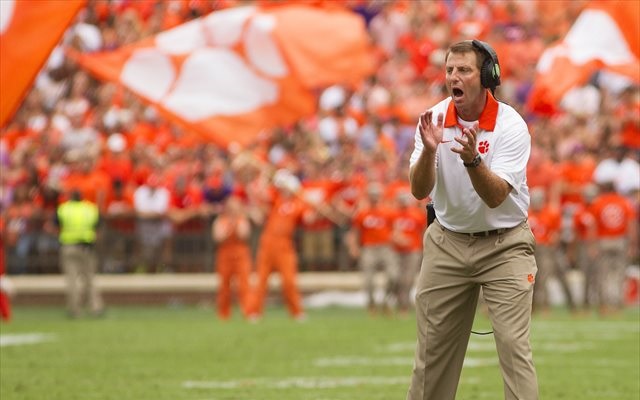
Bowden and Swinney take a chance on each other
In hindsight, Bowden’s decision to hire Swinney as his wide receivers coach was a perfect match. But at the time, there were significant risks for both men.
Bowden was facing a make-or-break fifth season at Clemson entering the 2003 season. Swinney’s wife was pregnant with their third child. The family was weeks away from moving into a new house they built in a Birmingham suburb and he was making good and dependable income with AIG Baker.
“There were a lot of reasons not to take the job,” Swinney said. “Some people told me, 'You’ll be fired in six months.' I had people tell me to rent in Clemson. We built a home.”
Bowden needed to replace Rick Stockstill, Clemson’s popular longtime recruiting coordinator and wide receivers coach. Stockstill had developed deep relationships with Clemson players and was popular with the fans. Bowden got heavily criticized for hiring Swinney given that he had been out of coaching for two years.
“I didn’t really ask him why he was out so long,” Bowden said. “That came up in conversation with the simple fact that, like Coach Stallings told him, he would only come back for a job he’s comfortable with.” Bowden paused and laughed, “But they all say that if they want a job.”
Before speaking with Swinney, Bowden called Wingo. They had coached together at Alabama.
“He asked me, 'How much Dabo is making?'” Wingo recalled, laughing. “He was trying to check me out and make sure it was worth his while (to pursue Swinney). I told him, ‘Forget it. I’m not telling you a thing.’”
Bowden interviewed two people for the vacant job: Swinney and T.J. Weist, another ex-Alabama wide receiver who played for Bowden. At the time, Weist was Western Kentucky’s offensive coordinator. He later coached at Cincinnati and Connecticut and now is a senior offensive analyst at Michigan, where he once coached Desmond Howard in the 1990s.
“Dabo had two strikes against him,” Bowden said. “Not only was he out of coaching, but he had never been a coordinator.”
Swinney’s recruiting skills at Alabama appealed to Bowden. During his interview at Clemson, Swinney met with the other assistant coaches “and they thought Dabo had a little more personality,” Bowden said. “I knew he had to get along with them.”
A past meeting between the two stuck with Bowden. When Bowden coached at Tulane in the late 1990s, he spoke at a Tuscaloosa church. Swinney attended and stuck around afterward to speak with his old position coach.
“From a Christian perspective, I believe more in divine intervention than chance and coincidence,” Bowden said. “If he doesn’t come to that church with his wife, I might not hire him. I’m not saying I would, I’m not saying I wouldn’t. All of a sudden he stays around after church and I talked to him. That stood out so that was a piece of the puzzle.”
The rest is history. Swinney became a valuable assistant and recruiter for Bowden, who almost got fired in Swinney’s first season at Clemson. When Bowden was forced out during the 2008 season, he recommended Swinney as Clemson’s interim head coach even though he had no experience as a play caller.
Swinney’s two years out of coaching seem like a lifetime ago now. In some respects, his struggles to get back into the profession remain very vivid to him.
“One of the most disappointing things in that whole experience is there were a lot of people that I wrote that I never heard from -- prominent people,” Swinney said. “I had a pretty strong resume. I had a really, really strong background and incredible references, and that has always stuck with me. To this day, I get resumes all the time. Even if it’s just, ‘Hey, I don’t have a spot right now, good luck to ya,’ I always give them something.”
Experiences shape people. Swinney acknowledged that his two years out of coaching influenced his decision to hire Jeff Scott and Tony Elliott as Clemson’s co-offensive coordinators last winter when offensive guru Chad Morris became SMU’s head coach.
Even Bowden wasn’t sure about Swinney promoting two assistants in their 30s with no coordinating experience -- and Bowden had coached Scott and Elliott when they played at Clemson.
“I knew them as players and quality people, but I was never around them,” Bowden said. “I thought it was a reach, but no one knew them better than Dabo.”
Swinney remembered the lessons from getting hired at AIG Baker with no experience in commercial development.
“You hire good people,” he said. “You’ve got to have the skill set. You’ve got to have the aptitude. I want the right people -- the right people who believe in who you are and what you do. That’s the secret sauce.”
Follow and read more from Jon Solomon on Facebook and Twitter.