
In the shadow of our opioid crisis, a college football player finds a family and a future
Thomas Lopez celebrated Mother's Day with his mom for the first time in 2017

By
Dennis Dodd
•
12 min read
MIDDLETOWN, N.J. -- There is absolutely no reason Thomas Lopez should be telling anyone his life story.
First of all, it's none your business. Would you want people knowing your mother was a heroin addict who overdosed in front of you -- twice?
Who would admit to an alienation so deep that his first Mother's Day with the woman who brought him into the world came eight months ago.
For that matter, why should anyone care about a 6-foot-5, 310-pound offensive tackle buried inside a storefront junior college in downtown Brooklyn, New York?
You don't know Thomas Lopez, but his story is America's in 2018. It is flawed and horrible and inspirational and poignant. It shines a light on the human condition, the nation's opioid epidemic, football culture and the common decency instilled in all of us.
But why is Thomas Lopez -- who inked with Ball State during the Early Signing Period -- telling anyone any of this? It turns out we need to know.
Addicts hide in plain sight. Fractured families limp by every day.
The best underdog stories aren't limited to slickly-produced weepers on ESPN's "College GameDay."
"I think it's finally time for me to explain everything," Lopez said, "show people everything."

Blink and you will miss ASA College. The junior college at 81 Willoughby Street in downtown Brooklyn could pass for an office building, a temp agency or a government outpost.
The weight room is three blocks away in a dorm basement. Players bus 40 minutes to practices at a local high school. The Avengers bussed 35 hours to play junior college power Trinity Valley in Texas. The Brooklyn "campus" houses the only junior college football program in New York City. Glamour is not the top selling point.
"I was born in Brooklyn, but I was like, 'Oh my God. This is not like the colleges I know,'" said Lopez' maternal grandmother Linda Heintz, who helped raise him. "He would come home sometimes and say, 'I can't take it anymore.'"
There are five for-profit ASA campuses scattered through the New York City area and in South Florida. Football was added to the ASA system only nine years ago.
Lopez was drawn to ASA from nearby Middletown, New Jersey. It was close (46 miles), and it was a cheap with an athletic scholarship.
"Just the fact I haven't paid a single penny for college is pretty amazing," Lopez said.
Not that he had much of a choice. His mother, Tracy, was in and out of his life with a drug problem. His parents divorced soon after he was born.
Out of Middletown South High School, Lopez was pursued by Rutgers as a walk-on candidate. FAU may or may not have been interested, but Lopez was so uninformed about what it took academically to play college football that he didn't know until weeks before enrollment that he was a non-qualifier. There was no way he could get a scholarship.
Someone had to explain the concept to him.
"If it wasn't for me waking up and having my back against the wall, this all wouldn't come to fruition at all," Lopez said this summer going into his second ASA season.
In the middle of a dreary cinderblock dorm room in the summer of 2016, a line was drawn. Football was a means to end.
Lopez wants to be an accountant, attend a noted business school. He's smart enough and big enough, just tremendously disadvantaged -- backed into society's corner. That's mostly what JUCO football is: a last resort. The players share a common bond. As football prospects, they're almost all deficient either physically, academically or legally. Sometimes all three.
It's a culture so amazingly desperate Netflix created the hit reality documentary "Last Chance U." ASA's program was a finalist to be featured for the 2017 season.
"There was really no structure in this program," said Avengers coach Joe Osovet, who took over in 2016. "The prisoners ran the asylum. Being in a JUCO, these kids need structure. They want structure. A lot of them have never had structure in their life. That's why they're here."
That's certainly why Thomas Lopez was here. At ASA, he put on 40 pounds and found a purpose.
"He has everything you want in an offensive lineman," Rizzo said. "He's a tough, nasty kid. He's a prick. He reminds me of myself when I played. I'd just bury guys."
Once committed to Scott Frost and UCF, Lopez was disappointed to find another vagary of junior college: timing. The second semester started at UCF on Jan. 8. Lopez won't get his associates degree from ASA until late January.
Akron coach Terry Bowden turned up the recruiting heat. As part of the recruiting process, Lopez's step grandmother was allowed to call Bobby Bowden, Terry's hall-of-fame dad.
"I just talked to a living legend," said Julie Chidichimo, a Florida State alum.
If it takes a village, then this village was blessed with the gene that makes humans dive into flood waters to rescue drowning victims. Coaches, family, friends, a girlfriend, they all got Thomas Lopez to this moment.
But mostly it was Thomas getting Thomas to this moment. A three-star JUCO recruit who played for a state champion at Middletown South found his next football home.
Soon after, he found a life balance.
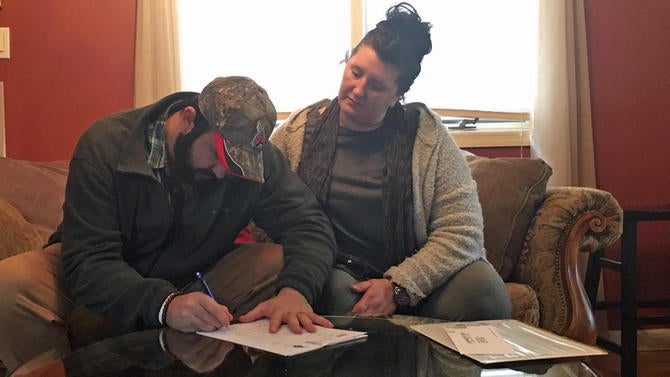
"I was lucky enough to be born," Thomas Lopez said. "My mom was doing [heroin] before [my birth]."
While there was no center to his day-to-day existence, his mother, Tracy, was certainly the daily center of his issues.
"She's always had mental issues since she was a little child," Heintz said. "They told me a long time ago if she didn't [abuse drugs] that she would have probably killed herself."
Tracy Lopez, 38, reluctantly agreed to an interview with CBS Sports. She emerged from a back room at Heintz's home earlier this season while still in treatment for her addiction.
"I'm a nervous wreck. I've been freaking out all week," she said.
She then went into detail about that first Mother's Day with her only child, now 20. It came in May. Tracy was well enough to attend a family get together.
The son and mother exchanged cards.
"Mine was simple: Happy Mother's Day," Thomas said.
"It was a big deal for me because this is my first year," Tracy said, "… because I usually do take a setback."
Mother and son have reconciled. The thing is, though, a motherless Mother's Day is more than once a year. It's kindergarten, bake sales, Cub Scouts, Halloween, Christmas -- all of it sometimes without a mom.
"When you're little, you're kind of confused," Lopez said. "You're numb to it all. It hits you in middle school and high school. You start experiencing things. I feel like I matured a lot faster than other people. I had to protect myself."
Lopez basically grew up without his birth mother and father but with a family. One that collectively hugged him in its arms, not wanting him to slip away.
"He was really a feral child," said Peter Kafaf, a personal coach who worked developing Lopez's football skills. "He had people who loved him, but Thomas' character came from Thomas.
"You have no support at home. You get no guidance. You try to keep your mother from dying because she's overdosing. You come home to find her on the floor and foam spewing out of her mouth."
The addicted among us can sometimes function at a high level. But the addicted can also drag down an entire family.
They don't teach you anywhere how to dig down to the last penny of your $600-a-month child support payment to treat your mom's habit. Lopez did that on at least one occasion.
"I haven't eaten in two days," Lopez once told Kafaf. "I had to use my food money to buy my mother methadone."
There is no primer to rebound from hopelessness.
"I was pissed off at everything," Lopez said. "I was pissed off I didn't have the same home life. Where my grandmother lives is a really nice area. Mine was a really good school. All the kids have really nice lives, and I was like, 'Why do I not have this?'"
"I really didn't care in high school," Lopez added. "It really hit me when I came here, when I realized I don't want to become what my parents were."
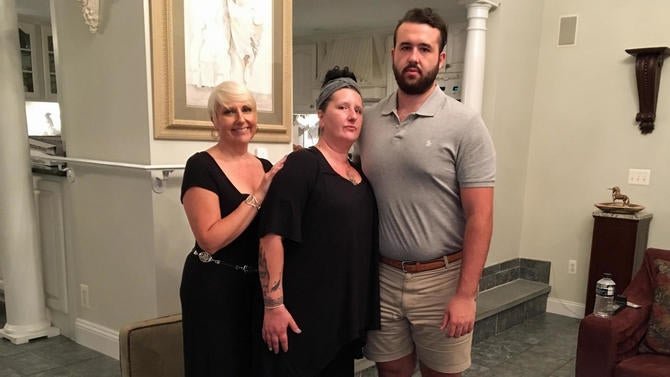
This American family drama was played out in the relative opulence of the New Jersey suburbs. Middletown is an upscale community within driving distance of New York. Heintz's home should be in the National Register of Historic Places.
It was built in 1720. A movie was filmed there. In that pastoral setting, Heintz recalls the dialogue with her two other children sitting on the steps of the front porch deciding who wanted to go inside to tend to Tracy after another bender.
You go in.
No, you go in.
Is she still breathing?
Can you see her chest move?
"We've been through a lot in this house," Heintz said.
Her husband once ran a psychiatric hospital. A simple Achilles surgery turned into tragedy. Complications caused a lack of oxygen during the procedure that led to brain damage.
"Thomas used to say, 'This daddy's broken. We need a new one,'" Heintz recalled.
Thomas Heintz -- actually Thomas' grandfather -- was in a coma for a month. He lasted seven more years. Thomas was named after him.
"I was then taking care of someone who had a brain injury. You just do it," Linda Heintz said. "That's when Tracy had her problems."
The opioid problem in the U.S. is real. The class of potentially addictive painkillers is being prescribed at record rates even though the amount of pain reported by Americans hasn't increased, according to the Centers for Disease Control and Prevention.
Abuse of heroin, oxycodone and the like cuts across all classes, all incomes. In October, President Donald Trump declared an opioid epidemic a national health emergency.
On average, 91 Americans die each day due to an opioid overdose. Lopez says his best friend got hooked on heroin in eighth grade.
"Drugs are a huge problem in my area of New Jersey," Lopez said. "I never want to go through any of that again. I saw things I can't really take back. It's still there in the back of my mind."
It is at this point a promising young adult with his whole life ahead has to consider what will always be a part of him.
"I saw everything," Lopez said. "I saw my mother overdose twice. The day after my junior prom, I saw her on the floor. I came over, hungover. I saw her on the floor. She was not responding. I was trying everything to wake her up. I called the police. They ended up bringing her back. The second time, police had to do an internal investigation. She didn't get arrested. She had some on her."
Somehow, Tracy is still around and able to recall -- in vivid detail -- her son's youth. Too big for Pop Warner football, Thomas gravitated to other sports. He loved baseball, once scooping up a handful of infield dirt at Yankee Stadium, pocketing it for a souvenir. A Chicago Bears' fan, Lopez once wrote Brian Urlacher submitting a list of players that would help the Bears win the Super Bowl.
"I really feel like Thomas found father figures through sports, through the years, all these men," Tracy said. "I knew he had to get his aggression out somewhere."
Uncle Mark in Staten Island never missed Thomas' high school games. His step grandfather turned him on to the Bears.
"A lot of times, I feel like I was here but I wasn't present," Tracy said. "Somehow, through it all, he found some great parenting and sports. I believe it saved him."
Kafaf came into Lopez's life by chance. The executive vice president of the swimwear division of Nautica works with local New Jersey players pro bono on their technique. Despite a powerful job, a 1 ½-hour commute into the city and a family of his own in Fair Haven, Kafaf helps out of the goodness of his heart.
He tutored five-star stud Rashan Gary at Paramus (N.J.) Catholic; Gary is now at Michigan. Offensive lineman Will Fries was one of 17 freshman to play at Penn State this season. St. Louis Rams linebacker Garrett Sickels is from nearby Red Bank.
Kafaf contends Penn State coach James Franklin would hire him right now if there was an opening. But this a vocation that has lasted nine years. All Kafaf charges is a hat from the college his pupils choose.
"If you're committed, I'll work with you," Kafaf told Lopez. "But here's the knock on you: I hear you're weak. I hear you're soft. I hear you don't want it. I hear you don't have heart. If that's what you want, go play the flute."
Indeed, Lopez injured his shoulder early on. What Kafaf says was Crohn's Disease caused Lopez to lose weight.
When the child support ran out that month, Lopez finally broke down and told Kafaf his situation. The pair quickly got in the car and went to the local supermarket.
"Buy whatever you want," Kafaf told him. "If that ever happens to you again, you call me. Don't go hungry."
Heintz remembers being taken aback by the grocery delivery. "Thomas comes in with all these packages -- groceries, steak, food. I said, 'What are you telling this man that he brought you all this food?' I was mortified."
Thomas' stomach was satisfied, for the moment. Those motherless Mother's Days never seem to end. Kafaf recalled one of Lopez's own high school teammates teasing about his mother being an addict.
"I pulled the kid aside," Kafaf said. "'I don't know who you think you are. In my eyes, you're a piece of shit. I don't ever want to hear it again.'"
Kafaf isn't particularly spiritual. But like everyone around Lopez, he does seem to have that gene regarding drowning victims.
"I make good coin at my job," he said. "Let's say I start charging these kids $150 an hour for a session. So now I get some rich kid with some rich parents who are nutty …
"Then I don't get a Thomas Lopez. I don't get, on my last dying day, closing my eyes saying I made a difference in the world."
That's why Thomas Lopez's story is everyone's business. We need to know one of the basics of common human decency.
"He loves his mother dearly," Kafaf said.