Miami's missed dynasty: The controversial 2003 Fiesta Bowl vs. Ohio State that altered each program's history
Ohio State and Miami meet in college football's postseason for the first time since the 2003 BCS National Championship

•
6 min read
When No. 10 Miami and No. 2 Ohio State meet on New Year's Eve in the Cotton Bowl, it will be a postseason rematch more than two decades in the making.
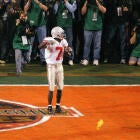
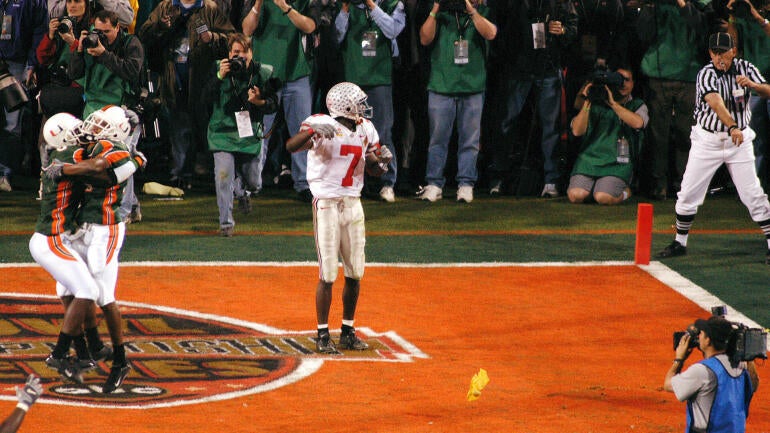
The last time the Buckeyes and Hurricanes met in college football's postseason it was for the national championship in the 2003 Fiesta Bowl, ending in such a controversial Ohio State win that the ref who made the fateful pass interference call is still a household name in some circles (Terry Porter, as Miami fans will tell you). Looking for a second consecutive championship and armed with a preposterously talented roster, Miami was 11.5-point favorites against the Buckeyes in Tempe. Ohio State won 31-24 in double overtime.
On the final day of this year, Miami and Ohio State meet in the College Football Playoff quarterfinals, and while the stakes aren't quite as high with the winner needing two more wins to capture another national title, both programs have plenty on the line.
It's somewhat poetic that the roles are reversed from the 2003 Fiesta Bowl. This year, the Buckeyes come into the Cotton Bowl as the heavy favorites and defending national champions, looking to win back-to-back titles for the first time in school history. Miami, meanwhile, is a team trying to rekindle the glory of the past and return to the top of the sport for the first time in more than two decades.
Back in 2003, the Hurricanes were the favorites as the defending national champs with a stacked roster featuring loads of NFL talent.
Miami's 2002 Starting Lineup
Bolded text indicates future Round 1 NFL pick, italics denote All-America pick from that season.
| Position | Player |
|---|---|
| QB | Ken Dorsey |
| FB | Kyle Cobia |
| RB | Willis McGahee* |
| WR | Andre Johnson |
| WR | Kevin Beard |
| TE | Kellen Winslow II |
| LT | Carlos Joseph |
| LG | Sherko Haji-Rasouli |
| C | Brett Romberg* |
| RG | Ed Wilkins |
| RT | Vernon Carey |
| DE | Andrew Williams |
| DT | Matt Walters |
| DT | William Joseph |
| DE | Jerome McDougle |
| WLB | D.J. Williams |
| MLB | Jonathan Vilma |
| SLB | Howard Clark |
| CB | Antrel Rolle |
| CB | Kelly Jennings |
| SS | Maurice Sikes |
| FS | Sean Taylor |
| K | Todd Sievers |
| P | Freddie Capshaw |
| KR | Roscoe Parrish |
*Consensus All-America
In the way of the Miami juggernaut was Ohio State, the once-storied program that had struggled to get all the way back to the mountaintop -- entering that game on a national title drought of over 30 years.
Ohio State's 31-24 win launched Buckeyes back to the top of the sport, and for the past 23 years they have maintained their place among college football's elite. The Buckeyes rarely slipped from the top 25 after their last AP national title in 1968, but could never quite get back to championship form. That changed with their dramatic Fiesta Bowl victory in 2003, and they've played in five national championship games since then, winning two.
For Miami, that game was the last time they played for a national title and the Hurricanes rather quickly fell out of the national conversation, spending the past 20 years struggling to break through on the national landscape. To put it in elementary terms, the median and mode of Miami's by-season win totals since 2003 is seven -- and the mean (average wins per season) is 7.68.
Mario Cristobal has steadily changed the baseline for success in Coral Gables, though, with a 10-3 mark in 2024 and a glittery 11-2 record this season. Championship relevancy that for so long has been out of reach is quite quickly upon Miami's doorstep.
A stunning upset of the Buckeyes on New Year's Eve would be a full-circle moment for Miami. While no one on this current Hurricanes squad remembers that 2003 Fiesta Bowl -- Carson Beck was born two months earlier, Malachi Toney four-and-a-half-years later -- the shadows of that night have haunted the program for decades.
Mere mention of that game will draw a deep sigh and a lengthy rant about what could have been for the Canes (Willis McGahee's gruesome knee injury) and how it was stolen from them (a pass interference call gave Ohio State a second chance in overtime).
In July of 2003, Dennis Dodd wrote up a piece for CBS Sports vindicating referee Porter's decision to throw a flag. In the eyes of the head officiating bosses, where Porter mostly erred was in his delayed timing.
Earlier this year Big 12 commissioner Kevin Weiberg said game films had been reviewed and that, in fact, Porter had made the right call. The Big Ten supervisor of officials, who is used by the NCAA to assign officials for bowl games, concurred this week.
The problem is, few people saw the actual infraction. All the replays focused on Miami defensive back Glenn Sharpe jumping for a ball in the end zone intended for Ohio State receiver Chris Gamble.
The penalty occurred on fourth-and-3 from the Miami 5 in the first overtime of Ohio State's 31-24 victory. At the line of scrimmage, Sharpe tried to "jam" Gamble and impeded his progress. When the official who apparently had the call in the end zone didn't make one, Porter came rushing from the back of the end zone to throw the flag four or five seconds after the play had ended.
"The timing of the flag might have looked not good," said Dave Parry, the Big Ten supervisor of officials, who works with the NCAA. "Terry was probably trying to be very thorough. He signaled a push for a defensive pass interference, then a signal for holding. There is a time lapse there. When the camera showed it they didn't see the line of scrimmage. They saw the downfield play about 7 or 8 yards."
Porter has been the subject of Miami fans' message board rants for months since the call. Miami's stance seems to be that while the call might have been right, it was inexcusable that Porter waited those pregnant seconds before throwing the flag after running from the back of the end zone.
"I replayed it in my mind," Porter said after the game. "I wanted to make double-sure that it was the right call."
Without saying it was the case, Parry said this week there could have been a "small, small little downgrade" in Porter's evaluation for shoddy mechanics in waiting so long to make the call.
It's not just the way that game ended that still burns Miami fans, but the fact that it was the last time they were ever on that stage. A win would have changed so much. The 2001 Miami team that won the title has an argument as the greatest college team ever assembled. The 2002 team wasn't far off and had they repeated with a win over the Buckeyes, perhaps the Hurricanes would've cemented themselves as the dominant force in the world of college football. Instead, and quite quickly, USC one season later began the decade's most dynastic run.
Miami fans have watched as the Buckeyes and others jumped over them after that Fiesta Bowl to become the nation's dominant programs and can't help but wonder what could've been if that flag hadn't been thrown. Would the last 20 years still have played out the same way? Or would back-to-back national titles have changed their fortunes and given them a stronger foothold at the top of the sport?
Miami has not finished a season in the top 10 of the AP poll since. That will almost change this year after a first round CFP victory over Texas A&M, but the Hurricanes believe they should be a national title threat, not just a top 10 finisher.
That's what Cristobal was brought in to do, and Wednesday night will be his first real chance to prove Miami is back at that level.
The old adage of "to be the best, you have to beat the best" will be firmly in play on Wednesday night in Dallas. Almost 23 years to the day since Ohio State did exactly that to claim the national title over a dominant Miami team, the Hurricanes will attempt to exact some revenge over the Buckeyes.