
'It's like euphoria': How Texas Tech All-American LB Jacob Rodriguez mastered the art of the punch-out fumble
The heart and soul of the Red Raiders' stifling defense is an expert in forcing turnovers

By
Chris Hummer
•
5 min read
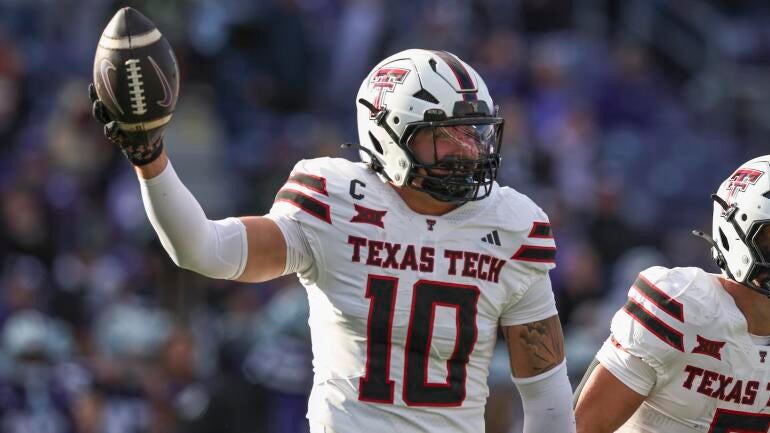
In the seconds after the attempted punch out of the football, Texas Tech All-American linebacker Jacob Rodriguez will occasionally have a concerning thought: "I think I broke my hand."
Sometimes he missed and hit a face mask or shoulder pad.
Sometimes he connected with the ball, but it didn't move. His wrist though …
Sometimes he can't tell exactly what's wrong because his hand is too busy pulsating with pain.
It's happened at least five times this season. It's also led to an FBS-high seven forced fumbles. So, you can bet Rodriguez will keep swinging.
"That's just the risk and reward," Rodriguez told CBS Sports. "I'd much rather go punch as hard as I can and miss than punch soft and not get the ball out. It's all about managing that risk."
In that way Rodriguez is a perfect embodiment of what Texas Tech coach Joey McGuire labels as a "take three" defense. The No. 4 Red Raiders, who face No. 5 Oregon in Thursday's College Football Playoff quarterfinal at the Orange Bowl, want to create three takeaways every single week. They've largely succeeded, leading the FBS with 31 forced turnovers through 13 games. Rodriguez has accounted for 11 of them on his own -- more than 22 FBS teams have for the entire year.
Four interceptions. Seven forced fumbles, many of which have come via punch out.
"I've never been around a guy who has that instinct, that ability, that knack for doing it," Texas Tech defensive coordinator Shiel Wood said.
Pretty high compliment for a player who's only played defense since 2022.
Rodriguez is a quarterback by trade. That's what he went to Virginia out of high school to do as a borderline four-star prospect in the 2021 class. It wasn't until he walked on at Texas Tech following his freshman season that defense became part of his reality.
The punch out took a season or two to become part of Rodriguez's repertoire. It's something that popped on film as Rodriguez watched the great llinebackers and how they created game-changing plays. Linebackers are already trained to rip at the ball as the second player in on a tackle. Rodriguez wanted to do more.
"I kind of thought, 'Why not?'" Rodriguez said. "Why wait to be the second guy in when you can do it all in one?"
Texas Tech’s Jacob Rodriguez is the best peanut puncher in the country … just constantly forcing fumbles. Playing his way into All-American honors this season pic.twitter.com/y8a2cpjYz4
— Bobby Football (@Rob__Paul) November 1, 2025
There probably isn't a better example of Rodriguez's ability to both finish a tackle and punch at the same time than a fumble he forced this season against Kansas State's All-Big 12 tight end Garrett Oakley.
Rodriguez squared up to make the tackle, before planting with his right foot and swinging at the ball. He connected and it went flying. Rodriguez didn't see it. He was too busy bringing Oakley to the ground in one motion, wrapping up with the same arm that punched the ball out.
When Rodriguez thinks about that play, which swung a 12-7 game early in the third quarter, he breaks it down in two areas:
- 1. Rodriguez likes punching with his dominant right hand. Same foot. Same shoulder. That's how you strike. It's where the power comes from.
- 2. You can't be afraid. Any hesitation will lead to a missed tackle. You've got to trust your teammates to clean up, and Rodriguez knows the 10 others on the field with him are doing their "dead-level best" to fly at the ball.
"That one came out pretty clean," Rodriguez said.
Punching out may seem like in-the-moment brute force, but it's as much science as it is instinct. Texas Tech spends a period each week practicing different forms of punch outs and strip sacks. There are weighted footballs mounted in Texas Tech's facility that defenders are supposed to strike when they walk by. You've got to hit them hard. As Rodriguez would tell you, punching a dense 10-pound football hurts if you don't hit it with enough force.
Even part of Texas Tech's offseason practice is built around the punch.
Every Saturday morning the Red Raiders participate in a "Fight Club," a boxing workout where some 40 players -- spread across two waves -- move through stations that train everything from footwork and hitting speed bags. The Red Raiders aren't trying to become boxers. It's just good cardio. But it's not lost on Rodriguez that those sessions have increased his hand/wrist strength and got his hands ready for contact.
There's also a situational awareness necessary to even try the punch.
Rodriguez is an All-American linebacker because of more than just his ability to force turnovers. He's the centerpiece of the nation's No. 1 rush defense. Texas Tech gets players to the ground over and over again.
When Rodriguez thinks about the punch, it only makes sense in certain situations. If it's third down, Rodriguez probably isn't trying to force a fumble. Why bother if they're just going to punt with a stop and an extra yard or two by the offense can extend a drive? First and second down it's far more likely he'll try. On the goal line? Rodriguez will punch every time. It's all he thinks about. It's the play that can change the game.
Punching is a risk-reward pursuit. Rodriguez is so good at it because he's done the calculations to mitigate that jeopardy.
"He plays with a ton of confidence because he puts in the work," Wood said.
Unreal desperation, Jacob Rodriguez delivered the best right hook in Texas Tech history to win this game pic.twitter.com/7GexYmhKgz
— Jackson (@JacksonBig12) October 6, 2024
Only five FBS players the last 20 years have forced more career fumbles than Rodriguez with 13 of those coming over the last three seasons. Not all of those have come via the punch, but it's become Rodriguez's signature much like it was for Charles "Peanut" Tillman on the Chicago Bears.
When thinking about the origin of his forced fumble technique, Rodriguez can't remember the exact moment he made it happen the first time. The feeling? That's a different story.
He compares it to baseball when you hit a ball square on the sweet spot of the bat, and it just flies effortlessly. It's the same for the punch. So many times, Rodriguez will swing at the ball and his hand stops. It hits the ball. It hits a shoulder pad.
Occasionally, he'll hit the ball just right and his hand will slide right through where the ball sat moments before.
"It's like euphoria," Rodriguez said. "It's such a cool feeling."
That's what Rodriguez chases every Saturday. The moment that happens more for him than any other player in college football in recent memory.
How could fear or pain outweigh that?