Another great Open Championship proves that this major tournament always delivers
The oldest major in golf is a paragon of consistency

By
Kyle Porter
•
6 min read
The Open Championship always delivers, doesn't it?
That's the question I was left pondering all weekend as Tiger Woods, Rory McIlroy, Jordan Spieth, Tommy Fleetwood, Tony Finau, Justin Rose and ultimately Francesco Molinari -- the most elite ball-strikers on the planet -- traded blow after blow on one of the great links courses we get to see every decade or so.
At the outset, this might seem like an overreaction to what we witnessed over the weekend. Perhaps I could write this column about any one of the four majors the day after it happened. And maybe I could, but it struck me this year that The Open provides the highest level of entertainment nearly every year and that it's a fun thought experiment to compare this event to the other three majors.
To me, the PGA Championship is not unique enough. It doesn't go to enough interesting courses. It is not set apart enough from, say, the Farmers Insurance Open or Wells Fargo Championship. The U.S. Open does go to interesting courses that demand a lot of your game, but its sideshow of course setups has turned into a game of, "Whom will they ruin and when will it happen?" rather than, "Will they get it right this time around?" They'll never get it right; it's just a matter of how wrong they'll get it.
Then there is the Masters. The Open and the Masters are pretty clearly the two best and most important events in professional golf, and they are fundamentally different in nearly every way. The Masters goes to the same course every year, prides itself on a limited field, and it would sooner sell McGriddles out of its clubhouse than allow the fescue we see at Open Champions to grow on its grounds.
Conversely, The Open, by definition, is open to anyone who might qualify, fills out its 156-player field with golfers who qualify at PGA Tour and European Tour events in the months leading up to the big one, and allows seemingly endless TV coverage. Both are great and unique for their own reasons. Here are five reasons The Open -- much like Augusta National -- delivers almost every year.
1. The greatest courses: Augusta is incredible. So are many of the courses the U.S. Open visits. Elite modern facsimiles of an amalgamation of links courses in some of the greatest theaters in all of golf. But they don't match -- they can't match -- the links land that marks Opens. Are Carnoustie, Muirfield, Troon and St. Andrews better golf course than Augusta National and Pebble Beach? I don't know, but I do know that they ask more and often better questions of their conquerors.
Think about all the different styles of golf we saw this week: fast and firm, soft and easy, windy, calm, every trajectory known to man. And in the end, a metronomic swing that couldn't stop hitting greens and couldn't stop making putts won the day. Isn't that all we want at these things anyway? The greatest golfers in the game needing to deliver answers under the most mentally and physically taxing circumstances possible. It gives some cachet to the term "Champion Golfer of the Year."
2. Course setups: My first three points are all related. I could not have been more impressed with the course setup at Carnoustie. Maybe it's because we were all coming off of whatever it was that we saw at Shinnecock Hills, but the R&A let the course be the course. They tucked pins when they needed to be tucked, rewarded elite shots that flirted with bunkers (or worse) and didn't try and create an artificially difficult track. It seemed so ... simple. This is not really something that separates The Open from the Masters -- Augusta does the same things -- but it stood out this week following June's U.S. Open. As an aside: Imagine being the USGA, watching that weekend at Carnoustie and thinking, "Nah, we're really nailing this."
Still amazing to me that the USGA has every option outside of cloud seeding at their disposal and still can’t get out of their own way, but Mother Nature turns an Open venue into a lunar colony and the R&A just installs a sign pointing to the first tee.
— Will Gray (@WillGrayGC) July 21, 2018
3. R&A might be great: Look, the R&A has had its issues (even recent ones), but they seem to do a great job of making the game be about the game. From their rebranding a few years back of this, their oldest tournament, to the TV coverage I mentioned above, to taking their governance role seriously, I've been impressed by their efforts in recent years to even-handedly balance a relationship with the best golfers in the world as well as those of us consuming their work. Again, some of this (maybe a lot of it) is perception. I don't read or hear everything. But if perception is reality for me -- somebody who lives and breathes this stuff on a daily basis -- imagine what it is for the majority of golf fans.
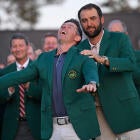
4. That trophy: It sounds trivial, but it's not. Is the Stanley Cup the Stanley Cup without an iconic bowl from which to consume alcohol? It might be 98 percent as good, but the margins are thin as it is when we're discussing differences between the two best tournaments in the world. The green jacket is great, and it's certainly unique, but Phil Mickelson isn't imbibing $40,000 bottles of wine out of the sleeve of one of those jackets (or who knows, maybe he does in private). I don't really think this tournament (or argument) needs a punctuation mark, but if it does, the Claret Jug -- a 150-year-old trophy that has seen pretty much every corner (and beverage) of the planet -- provides.
"I was like, man, this was my possession," 2017 winner Spieth said last week. "I took it to all the places that allowed me to get to where I am today. My family was able to take it around. Members of my team were able to take it. It's the coolest trophy that our sport has to offer. So having to return that was certainly difficult; [it] kind of hit me a little bit there on the tee box."
5. Last six years: Just as we must point to results when it comes to players, we ought to do so when it comes to events, too. There is a magic to the entire process that is impossible to put a finger on, but the proof is so often in the final round. Some of this is luck, but some of it is a combination of factors I noted above. I've been covering golf for the last six years for CBS Sports, and in that time, I've watched the following:
- 2013: The greatest round of Mickelson's life to beat Tiger Woods, Lee Westwood, Henrik Stenson, Adam Scott
- 2014: Rory McIlroy closing with two eagles in Round 3 and takes a victory lap over Rickie Fowler, Sergio Garcia
- 2015: Spieth's grand slam bid goes 216 holes but dies at the Old Course on the 72nd
- 2016: Stenson and Mickelson put on one of the great shows of all time
- 2017: Spieth plays one of the great five-hole stretches in golf history
- 2018: Francesco Molinari swipes the Jug from Tiger-Rory-Spieth on a bonkers Sunday
There was a 90-minute stretch in the final round of this Open when Tiger took the lead and then bequeathed it to McIlroy, Spieth and a host of others where I was just sitting at home with my hands in the air like the Elmo GIF.
— Kyle Porter (@KylePorterCBS) July 22, 2018
At this point, after six years of waking up at 3 a.m. (one of the best traditions of the season, by the way), I've begun to expect only the most outrageous situations at this event. I haven't been let down yet. The Open might not be the best major, but I think it has become my favorite. And as the USGA has learned in recent years, none of the rest of it really matters. Perception is reality.